March 19, 2026 | By Daniel Burrus
Leadership, Newsletter, Strategy, Technology, Transformation
Brain-computer interface technology has left the research lab. It’s attracting billions in private investment and entering enterprise strategy conversations at the highest levels.
For business leaders, the question isn’t whether brain-computer interface will touch your industry. It’s whether you’ll be ready when it does. Start building that framework now with strategic advisory support.

What Is a Brain-Computer Interface?
A brain-computer interface is a direct communication pathway between the brain and an external device. Sometimes called a brain machine interface, it reads electrical brain signals from neurons and translates them into commands a computer or prosthetic can execute. No voice. No keyboard. Just thought.
The technology has existed in experimental form since the 1970s. Recent advances in AI, miniaturized hardware, and neural signal processing systems have compressed the timeline dramatically. What once took decades in lab settings is now moving toward scalable commercial deployment.
How Brain-Computer Interface Technology Works
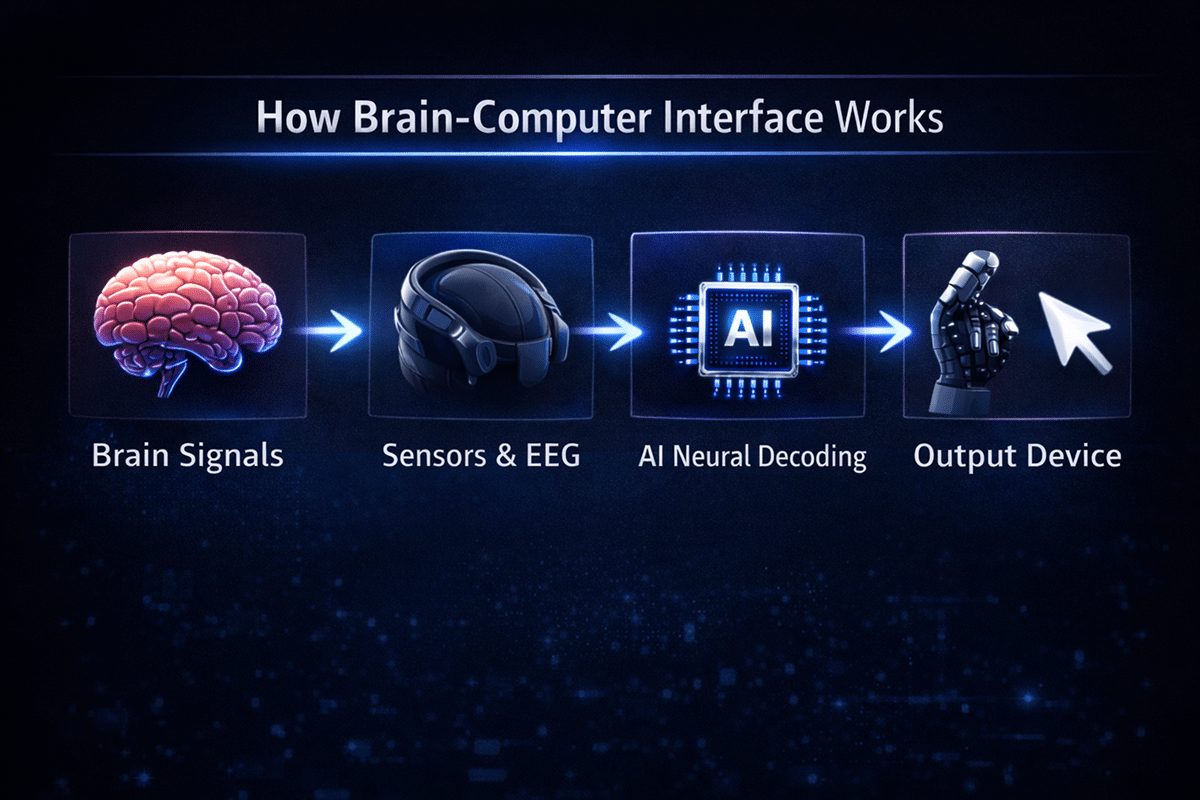
Every brain computer interface follows the same three-step process. Sensors detect neural signals from electrical activity in the brain. A neural signal processing system then decodes those signals and identifies intent. The system executes an output, such as moving a cursor or generating synthesized speech.
Neural signal decoding is what makes real-time accuracy possible. Raw brain signals are complex and noisy. Machine learning models trained on neural data are what separate a research prototype from a functional computer interface.

Invasive vs. Non-Invasive BCI
There are two primary categories of brain computer interface systems. Understanding the difference matters for assessing near-term relevance to your organization.
An invasive brain computer interface requires surgical implantation of electrodes directly into brain tissue. Invasive brain interface devices deliver higher signal resolution and are used in clinical settings for paralysis, ALS, and severe neurological conditions.
Non invasive BCI uses external EEG-based headsets to capture brain signals through the scalp. Signal fidelity is lower, but adoption barriers are far smaller. This is the category most relevant to near-term enterprise applications.
Brain-Computer Interface Applications Worth Watching
Medical and Rehabilitation
The most validated brain computer interface applications are in healthcare. Patients with spinal cord injuries, ALS, and locked-in syndrome are using BCI devices to communicate and control computers. Neuroprosthetic devices represent another active frontier, with motor cortex interfaces allowing paralyzed patients to control robotic limbs with documented clinical success.
Neural implants are progressing through formal trials with measurable outcomes. Leaders tracking the AI human augmentation trend will see BCI as a direct extension of that trajectory.
Workforce and Cognitive Performance
The enterprise angle on brain computer interface technology is still early but directionally clear. Non invasive BCI devices are being studied for focus monitoring, cognitive load assessment, and human-machine collaboration in high-stakes environments.
Defense and aerospace are already using brain computer interfaces to improve operator performance in complex control systems. Healthcare, manufacturing, and financial trading are tracking closely behind.

Companies Shaping the Brain-Computer Interface Landscape
Several organizations are defining the commercial terrain for brain computer interface technology right now. Neuralink completed its first human implant in early 2024. A paralyzed patient controlled a computer interface using thought alone.
Synchron’s Stentrode device threads neural implants through blood vessels, avoiding open-brain surgery entirely. Blackrock Neurotech holds one of the longest invasive brain interface track records in the field.
On the non-invasive side, Emotiv, Neurosity, and OpenBCI are building commercial-grade EEG platforms for enterprise productivity. These are the players worth monitoring now.
Why BCI Is a Hard Trend
The forces driving brain computer interface forward aren’t speculative. They’re built on convergences you can see and plan around. Exponential technologies like AI, advanced sensors, and miniaturized computing make BCI advancement inevitable, not optional.
Compute power is rising while hardware costs fall. Neural signal decoding improves with every AI training cycle. Aging populations are creating sustained demand for neuroprosthetic devices and neurological health solutions. Regulatory pathways are developing in parallel with the technology itself. These are directional certainties, not maybes.
The Strategic Opportunity for Enterprise Leaders
While reactive organizations wait for BCI to become mainstream, anticipatory leaders are building informed positions now. The competitive advantage isn’t in being first to deploy. It’s in understanding the brain computer interface landscape before deployment becomes urgent. That’s what technology foresight makes possible.
That means tracking investment flows across brain computer interface applications and identifying which verticals are moving fastest. It means assessing how neural implants and interface technology intersect with your workforce strategy and product roadmap. Leaders who engage before urgency strikes will always have more options than those who don’t.

Risks, Ethics, and the Regulatory Landscape
Brain computer interface technology introduces risk unlike other emerging technologies. Direct access to brain signals raises questions about consent, ownership, and security that existing frameworks weren’t built to answer.
The FDA governs BCI devices through its digital health framework, reflecting the high-risk nature of invasive brain computer interface systems. Leaders evaluating BCI-adjacent vendors or investments should treat regulatory trajectory as a material factor. Neural data is more intimate than biometric data. Who owns it and who can access it will define public trust for a generation.
The Future of Brain-Computer Interface Technology
The World Economic Forum has flagged neurotechnology as one of the defining categories of the next decade. Its neurotechnology governance report frames brain computer interface technology as a strategic priority, not a medical niche. Enterprise leaders are starting to engage accordingly.
Near-term development will center on non invasive BCI devices improving in accuracy and neural signal processing systems becoming more capable. Longer term, brain computer interface technology is likely to become an ambient layer in how humans interact with complex enterprise systems. The trajectory is visible. The only question is where your organization wants to be when it arrives.
What Business Leaders Should Do Now
Most organizations don’t need a BCI deployment strategy today. They do need an awareness strategy.
- Assign someone on your innovation team to track brain computer interface applications quarterly, covering clinical milestones, regulatory updates, and commercial launches.
- Identify which operational challenges in your industry could intersect with neural implants and brain machine interface technology over the next five to ten years.
- Monitor how healthcare, defense, and manufacturing deploy non invasive BCI and what workforce outcomes they report.
Anticipatory leaders don’t wait for disruption. They position before the wave.
The Bottom Line
Brain-computer interface is moving from clinical research into commercial reality faster than most organizations are tracking. The leaders who benefit most won’t necessarily be first movers. They’ll be the ones who built informed perspectives before the technology forced their hand.
If you want to understand how brain computer interface technology fits your long-term strategy, learn about Burrus and how he helps enterprise leaders anticipate what’s coming next.
Frequently Asked Questions
What is a brain-computer interface?
A brain-computer interface is a direct communication pathway between the brain and an external device. It reads brain signals and translates them into commands without voice or physical input.
How does a brain-computer interface work?
Sensors detect electrical activity in the brain, a neural signal processing system decodes intent, and the system executes an output. Neural signal decoding is what makes real-time accuracy possible.
What is the difference between invasive and non-invasive BCI?
An invasive brain computer interface requires surgical implantation into brain tissue for higher signal resolution. Non invasive BCI captures brain signals through external EEG headsets with no surgery required.
What are the main brain-computer interface applications in healthcare?
Brain computer interface applications include communication devices for ALS patients, neuroprosthetic devices for paralysis, and neural implants for motor rehabilitation, all progressing through formal clinical trials.
What companies are leading brain-computer interface development?
Neuralink, Synchron, and Blackrock Neurotech lead in invasive brain interface development. Emotiv, Neurosity, and OpenBCI lead on the non-invasive side.
What is Neuralink and what has it achieved?
Neuralink develops invasive brain computer interface systems. In early 2024, it completed its first human implant, enabling a paralyzed patient to control a computer interface using thought alone.
How is AI used in brain-computer interface technology?
AI powers the neural signal decoding layer that interprets brain signals in real time. Machine learning models are what make brain computer interface technology functional outside lab settings.
What are the ethical concerns around brain-computer interfaces?
Key concerns include neural data privacy, consent, and ownership of brain signals. Invasive brain computer interface systems raise additional questions about long-term safety and equitable access.
Who regulates brain-computer interface devices?
The FDA governs brain computer interface devices as high-risk medical devices requiring premarket approval. Leaders should treat the regulatory trajectory as a material factor in any BCI-related investment.
What is neural data privacy and why does it matter for enterprises?
Neural data privacy governs information captured directly from brain signals. It matters because frameworks for ownership and security of that data are still being established.
What is the future of brain-computer interface technology?
Near-term development will focus on non invasive BCI accuracy and more capable neural signal processing systems. Longer term, brain computer interface technology is expected to become an ambient layer in enterprise human-machine interaction.
How should business leaders think about BCI as a strategic opportunity?
Leaders don’t need a deployment strategy today but do need an awareness strategy. Tracking brain computer interface applications across healthcare, defense, and manufacturing will surface early signals relevant to your industry.