The Characteristics of a Vision Statement That Drive Organizational Clarity
Most organizations have a vision statement. Far fewer have one that actually works. The difference between a statement that guides strategy and one that collects dust comes down to a specific set of qualities that either exist in the writing or don’t.
Understanding the characteristics of a vision statement isn’t just an academic exercise. It’s a practical leadership skill that directly shapes how well your organization aligns, adapts, and moves forward.
The main characteristics of a vision statement include:
Future-oriented
Inspirational and motivating
Clear and concise
Ambitious but achievable
Aligned with core values
Focused on impact
Unique and distinctive
Long-term perspective
Easy to communicate
Strategic and directional
Futurist keynote speaker like Daniel Burrus has worked with Fortune 500 executives for decades, helping them build organizations that anticipate the future rather than react to it. A strong vision statement is one of the clearest signals of whether an organization is built to lead change or simply respond to it.
Looking to inspire bold, future-ready thinking at your next event? Hire futurist Daniel Burrus as your AI keynote speaker and spark real innovation.
Watch the reaction to Daniel Burrus’ Recent Keynote presentation.
Daniel Burrus has over three decades of being right about where things are going, which is evidenced by his long and diverse list of repeat clients. Daniel has worked with leaders from Fortune 500 companies, the Pentagon, and heads of State-delivering powerful insights and actionable strategies.
By applying Daniel Burrus’ principles to our business, in less than a year we have been able to double our revenues and increase the value of our company by a factor of four, and we feel the biggest impact is yet to come.
We are going through an incredible digital transformation right now, and in his keynote speech, Daniel touched on a large number of points that tied everything together with practical strategies that we can immediately take action on.He really energized our dealer network to embrace the transformation that we’re going through.I can’t recommend Daniel enough!
“Your keynote at our digital annual convention was perfect. The Hard Trend future facts you shared was exactly what our industry leaders needed.It gives them a critical view that provides confidence for decision making.”
Daniel Burrus did a truly outstanding job as the opening keynoter for our CIO 100 2017 Symposium conference. He impressed our audience of 350+ Chief Information Officers and senior IT executives with his innovative ideas, business acumen and – most importantly — his thorough understanding of the challenges they face as enterprise technology leaders.
“You covered all the key points we discussed and more in your digital keynote to our audience of executive customers, and you customized your examples for our industry in just the right way.”
“Daniel delivered a great keynote at our Annual Global User Conference; his presentation was nicely tuned to our audience and the examples he incorporated were all accessible and helpful. It’s not easy to find compelling speakers who appeal to a broad audience and also convey something practical, but Daniel sailed over this bar. I would enthusiastically recommend him to companies looking to inspire innovative thinking.”
A ‘must-hear’ presentation.
It came as no surprise that you were rated the top speaker in our audience evaluations. Your unique blend of wit and insight awakened all of us to the need to develop the knowledge network necessary to move to a 21st century mind set.
Daniel studied the details about our audience in advance and listened carefully to our objectives for his keynote speech. He seamlessly incorporated every key point we discussed. As a result, the audience hung on every word, relating directly with each insight and recommendation. It’s no wonder he received a standing ovation. People are still buzzing.
Daniel Burrus was the keynote speaker at the ITF STORE Capital 2018 conference, and he was amazing – thought provoking, interesting, relevant to the business leaders in the audience. He customized the program for the group, and he did his homework. Many of the attendees are continuing to talk about his presentation and content. He was terrific to have right before lunch to spark lots of good conversation. I would highly recommend Daniel to speak to any leadership group that is interested in being prepared for the future and learning ways to be more innovative in their business.
Your presentation and interactive discussion with the Agents Council for Technology was a transforming event for our group. You helped us look at trends in a much more methodical way that will enable us to rework our Vision of the Future document into a much more credible and living tool for our industry.You spent the time in advance to understand our issues and then applied them actively throughout your presentation.
This is the third time you’ve addressed this conference and each presentation has been better than the last… and I wouldn’t hesitate inviting you back to a future conference!
Our people, without exception, felt that your ideas were provocative, original, and timely. Your entertaining style captured the audience and compelled them to listen, think, and apply your thoughts to their own professional and personal lives.You truly made a memorable impression on the audience.
“Your comments and insight were perfect and led right into the topics we planned to present at our digital event. Survey responses were highly complementary after the event concluded. Many thanks for your time and talent.”
You were fabulous! You received rave reviews from our participants for the relevancy, insight and expertise of your presentation material and style.You are the only keynote speaker we have invited back numerous times. I am convinced the extraordinary success of your continued contribution is due in no small part to the enormous amount of time you put into each presentation by customizing it to fit the unique and challenging needs of our CMO audience each year.
I don’t know any other speaker that could present after Bill Gates and ‘wow’ an audience of CEOs like you did! You were the perfect choice.
Your thoughts on how to create an opportunity for change through a customer focus is the excellence our team is striving for. The framework you provided on innovation, creativity and customer value will be instituted as a management practiceto enable the technology infrastructure group to take Wells Fargo to the next stage.
We hired Daniel as the keynote speaker for both our Business Innovation Technology Summit as well as our annual company meeting. I was thoroughly impressed with not only his actual keynote speeches, but even more so with his preparation process beforehand. We had a great conversation via phone a couple weeks beforehand where I realized how much he genuinely cared about catering his speech specifically to our audience, as well as aligning it with the message we wanted to send as a company. He is engaging, incredibly well spoken, and great to work with.
“Daniel Burrus is a dynamic speaker and delivered a lot of “aha” moments with his insights. I appreciated the activity and takeaways that he left the audience with. Daniel also was very engaging before the meeting, asking our clients questions, taking notes, and genuinely interested in learning more about our clients’ business.”
“Daniel is a powerful business strategist bringing significant value to those he works with.”
Daniel Burrus delivered! Not only did he do the upfront homework and research, ensuring that he fully understood the SPECS audience, but he presented an excellent keynote address that hit all the points we discussed in advance. He was interesting, knowledgeable, and dynamic. Our audience is still raving about his performance — and I would hire him again in a heartbeat.
“Daniel Burrus was exceptional, and we are thankful for the opportunity to have him join our meeting. Thank you for everything you have done in making our Annual Partner Meeting a huge success.”
Daniel came highly recommended and delivered on his Keynote at the Global CISO Executive Summit. He made the keynote interactive and challenged participants to put their newly gained insights to work in an interactive session identifying trends that you can anticipate and prepare for through strategic planning.
“Daniel Burrus did an excellent job. The feedback was extremely positive and he made me look like a genius.”
“Your digital presentation to the hospital CEOs gave them a new anticipatory mindset to view the present and future. This was exactly what they needed to help them design transformational strategies going forward.”
“Daniel Burrus exceeded our expectations, it was simply out of this world!”
“The feedback from the attendees on Daniel Burrus has been excellent. The content was right on point and very eye opening for everyone.”
Our practitioners were invigorated by the presentation and they left the conference thinking differently about how to navigate the road ahead. Daniel Burrus was 100% on point aligning our message to our conference’s theme.
What Is a Vision Statement?
A vision statement describes where an organization is headed, not where it currently stands. It’s a declaration of long-term intent that gives everyone inside and outside the company a clear picture of the future you’re building toward.
A vision statement isn’t the same as a mission statement. Your mission explains what you do and why you do it today. Your vision defines what success looks like years from now.
Extraordinary leaders understand that expressing vision with clarity is one of the most important things they can do for the people they lead. Without it, strategy loses its anchor.
Why Vision Statements Matter in Strategic Planning
A well-constructed vision statement does more than inspire. It aligns teams, informs resource allocation, and gives decision-makers a consistent filter for evaluating priorities.
Research from Harvard Business Review consistently shows that organizations with clearly articulated long-term direction outperform those operating without one. The vision isn’t a soft element of strategy. It’s the foundation everything else is built on.
When leaders skip this step or treat it as a formality, they end up with teams pulling in different directions. A strong vision prevents that drift before it starts.
10 Key Characteristics of a Vision Statement
The characteristics of a vision statement separate statements that lead from statements that sit in annual reports. Here’s what the strongest ones have in common.
Future-Oriented
A vision statement describes a future state, not the present. It answers the question of where the organization is going, not what it’s doing right now. The further and more clearly it projects that future, the more useful it becomes as a planning tool.
Inspirational and Motivating
People need a reason to commit. An effective vision statement energizes employees and stakeholders by connecting daily work to something larger than the current quarter. If it doesn’t move people, it won’t move the organization.
Clear and Concise
Complexity kills clarity. The best vision statements are short, direct, and free of jargon. If someone can’t grasp it in one reading, it won’t stick, and a vision that doesn’t stick can’t guide behavior.
Ambitious but Achievable
Stretch is necessary. A vision statement should push the organization toward something that doesn’t yet exist. But it also needs to stay grounded in reality. Unrealistic aspirations breed cynicism, not commitment.
Aligned With Core Values
An effective vision statement reflects the culture and principles the organization actually operates by. When vision and values are misaligned, employees notice. That gap erodes trust and credibility faster than almost anything else.
Focused on Impact
The strongest vision statements go beyond internal goals. They describe a meaningful impact on customers, industries, or society. That broader purpose gives the statement staying power across leadership changes and market shifts.
Unique and Distinctive
A clear vision statement should reflect something specific about your organization. Generic language that could apply to any company in your industry signals a lack of strategic thinking. Specificity is what makes a vision memorable and defensible.
Long-Term Perspective
Vision statements operate on a 5 to 10 year horizon at minimum. Short-term goals belong in operating plans. A strategic vision statement keeps leadership focused on what they’re building over time, not just what they’re managing this year.
Easy to Communicate
If your leadership team can’t recite the vision without looking it up, it’s not working. An organizational vision needs to be simple enough to repeat in a hallway conversation and strong enough to hold up in a boardroom.
Strategic and Directional
A company vision statement isn’t decorative. It should actively inform business decisions. When new opportunities or challenges emerge, the vision gives leaders a framework for evaluating whether to pursue them or pass.
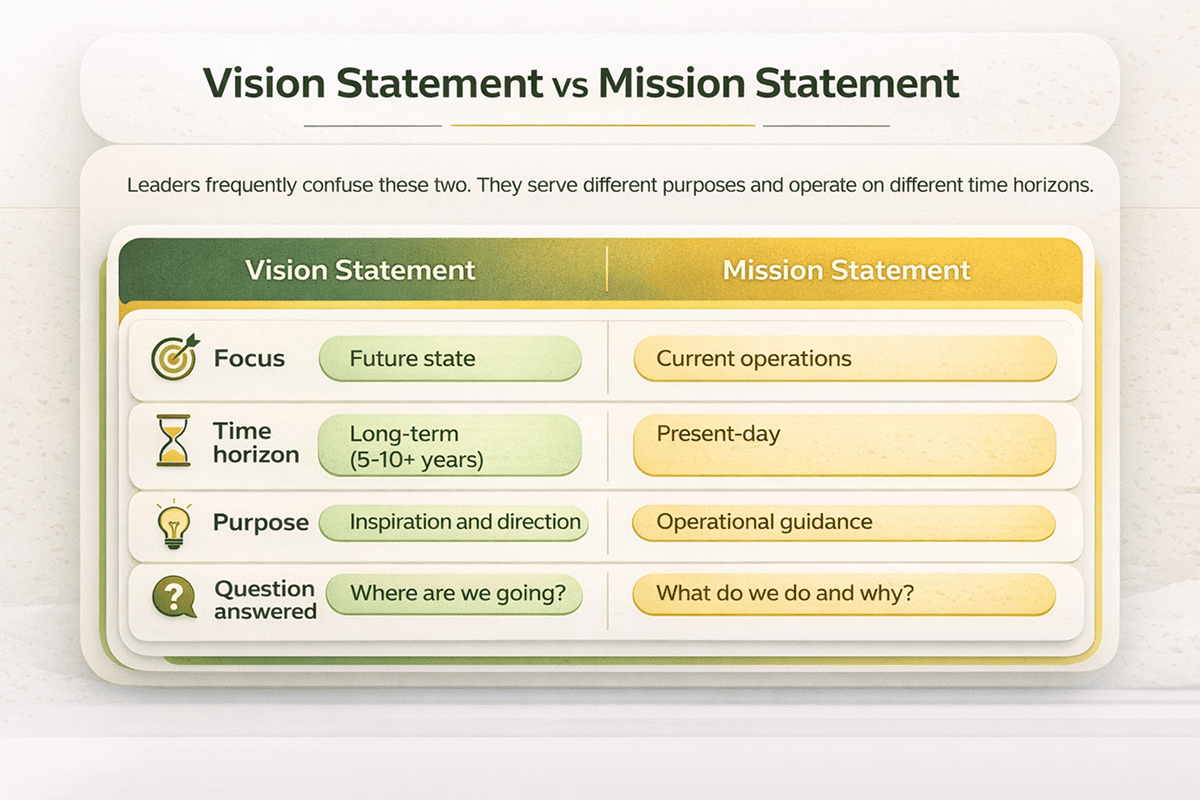
Leaders frequently confuse these two. They serve different purposes and operate on different time horizons.
Vision Statement
Mission Statement
Focus
Future state
Current operations
Time horizon
Long-term (5-10+ years)
Present-day
Purpose
Inspiration and direction
Operational guidance
Question answered
Where are we going?
What do we do and why?
MIT Sloan Management Review notes that organizations confusing vision with mission tend to underfund long-term strategy while overinvesting in short-term execution. Both matter, but they can’t substitute for each other.
Vision Statement Examples From Leading Companies
Seeing the characteristics of a vision statement in practice makes the concept concrete. Here’s how three well-known companies apply them.
Microsoft: “To empower every person and every organization on the planet to achieve more.” This vision statement is future-oriented, impact-focused, and broad enough to span decades without becoming outdated.
Tesla: “To accelerate the world’s transition to sustainable energy.” It’s ambitious, distinctive, and directional. Every product decision Tesla makes can be evaluated against this single sentence.
Amazon: “To be Earth’s most customer-centric company.” It’s clear, concise, and sets a standard that drives operational decisions at every level of the business.
Each of these reflects the core characteristics of a vision statement that actually functions as a strategic tool.
How to Write a Vision Statement
Writing an inspiring vision statement doesn’t require creativity alone. It requires a disciplined process.
Define your long-term goal. Where does the organization need to be in 10 years to be considered successful?
Identify your impact. Who benefits from what you do, and how does that change over time?
Align with core values. Make sure the language reflects how your organization actually operates, not just how it wants to be seen.
Keep the language simple. Avoid corporate jargon. Write it the way a leader would say it in a room.
Test clarity and inspiration. Share it with people at different levels of the organization. If they’re not energized by it, revise it.
Applying Hard Trend methodology to this process helps leaders ground their vision in future certainties rather than wishful thinking. That’s what turns an inspiring statement into a reliable strategic anchor.
Vision Statement Checklist
Before finalizing your company vision statement, run it through this checklist.
If the answer to any of these is no, the statement needs more work.
Common Mistakes to Avoid
Even experienced leaders make these errors when drafting a vision statement.
Being too vague. Statements like “to be the best” or “to lead the industry” say nothing specific. Vague future vision goals can’t guide real decisions.
Writing it too long. A vision statement is not a strategy document. If it takes more than two sentences to express, it needs editing.
Making it unrealistic. Aspirational is good. Disconnected from reality is not. A vision that nobody believes is possible won’t motivate anyone.
Confusing it with the mission. Vision describes the future. Mission describes the present. Blending them creates confusion at every level of the organization.
If your current vision statement has any of these problems, it’s worth revisiting it before your next strategic planning cycle. Working with a strategic advisor who specializes in future-focused planning can accelerate that process significantly.
Frequently Asked Questions
What are the characteristics of a vision statement?
The core characteristics of a vision statement include being future-oriented, inspirational, clear, ambitious, values-aligned, impactful, distinctive, long-term in perspective, easy to communicate, and strategically directional.
What makes a strong vision statement?
A strong vision statement combines clarity with ambition. It tells people exactly where the organization is headed while giving them a reason to commit to getting there.
How long should a vision statement be?
Most effective vision statements are one to two sentences. Brevity improves memorability and makes the statement easier to apply consistently across the organization.
What is the difference between mission and vision?
A mission statement describes what the organization does today and why. A vision statement describes where the organization is headed over the long term.
Can a vision statement change over time?
Yes. As markets shift and organizations evolve, vision statements should be revisited. The goal is to keep the vision relevant without changing it so frequently that it loses credibility.
What is an example of a good vision statement?
Microsoft’s vision, “to empower every person and every organization on the planet to achieve more,” is widely cited as a strong example. It’s clear, future-focused, and broad enough to guide decades of strategy.
Who should be involved in writing a vision statement?
Senior leadership should drive the process, but input from across the organization strengthens alignment. A vision built in isolation rarely earns the commitment needed to execute against it.
How often should a company revisit its vision statement?
Most organizations benefit from revisiting their vision every three to five years, or whenever a major strategic shift occurs. Regular review keeps it relevant without undermining its long-term nature.
What role does a vision statement play in strategic planning?
A vision statement sets the destination for all strategic planning. It provides the filter through which goals, investments, and priorities are evaluated across every planning cycle.
How does a vision statement support organizational culture?
A clear organizational vision reinforces culture by giving employees a shared direction. When people understand where the organization is headed, values-driven behavior becomes easier to sustain.
Book Daniel Burrus for Your Next Event
If you want to transform your team’s understanding of artificial intelligence and spark innovation across your organization, consider booking Daniel Burrus, a best selling author and artificial intelligence keynote speaker, for your next conference or corporate event.
Visit www.burrus.com to learn more or to request availability.
Because the future isn’t something you react to. It’s something you create—and the right keynote speaker can show you how. Booking an AI expert like Daniel Burrus can transform your team’s understanding of AI and its potential impact on your business strategy.