

March 09, 2026 | By Daniel Burrus
Leadership, Newsletter, Strategy, Technology, Transformation
Most enterprises are sitting on enormous reserves of institutional knowledge that are effectively invisible. Files buried in outdated repositories, expertise locked inside individual contributors, and processes that exist only because someone remembers how they’ve always been done.
The future of knowledge management isn’t about storing more of this. It’s about making it intelligent, connected, and available at the moment decisions get made.
That shift is already underway, and the gap between organizations treating KM as a support function and those treating it as a competitive asset is growing fast.
From Static Repositories to Intelligent Knowledge Ecosystems
Traditional KM was built around storage. Documents got filed, tagged manually, and retrieved through keyword search, if they were found at all. That model worked well enough when knowledge moved slowly, but it can’t keep pace with the speed at which organizations now need to act.
The emerging model is fundamentally different. AI-driven knowledge management doesn’t wait for someone to search. It surfaces relevant information contextually, inside the tools where work actually happens.
Knowledge ecosystems today connect structured data from CRM and ERP systems, unstructured documents, and the tacit knowledge that lives inside people and processes. When these layers work together, the organization stops losing what it knows every time someone leaves or a project closes.
This is the shift that separates reactive KM from anticipatory KM. While competitors are still managing documents, anticipatory organizations are managing intelligence.
7 Key Trends Shaping the Future of Knowledge Management
1. Generative AI and Automated Content Curation
Generative AI is eliminating the most labor-intensive parts of knowledge work. Auto-tagging, summarization, knowledge gap detection, and policy generation are moving from manual processes to automated ones.
The practical result is that organizations can maintain current, accurate knowledge bases without dedicating teams to constant upkeep. For a closer look at how this is reshaping enterprise operations, generative AI in enterprise strategy is already producing measurable results across industries.
2. Conversational and Contextual Knowledge Search
Keyword search is being replaced by something far more capable. Semantic search, retrieval-augmented generation (RAG), and enterprise AI search tools now allow employees to ask questions in plain language and receive synthesized answers rather than document lists.
AI copilots embedded inside existing workflows mean that knowledge retrieval no longer requires leaving the task at hand. The shift from search to answer engines is one of the most operationally significant changes in how enterprise knowledge gets used.
3. Proactive Knowledge Delivery
Future KM systems won’t wait to be asked. They’ll push relevant insights to the right person at the right moment, surface internal experts automatically, and suggest next steps based on what similar situations required in the past.
Integration with Slack, Microsoft Teams, CRM platforms, and project management tools makes this delivery seamless. Knowledge automation at this level is a Hard Trend, not speculation.
4. Predictive Knowledge Analytics
Organizations are beginning to use predictive analytics to manage knowledge as a strategic asset. That means forecasting skill gaps before they become operational problems, identifying knowledge decay in areas where expertise is aging out, and measuring the actual business impact of KM investments.
This brings the future of knowledge management into the same strategic conversation as workforce planning and financial forecasting.

5. Knowledge Governance and AI Ethics
As AI takes on a larger role in surfacing and generating knowledge, governance becomes a non-negotiable priority. Data privacy, compliance in GDPR-adjacent environments, hallucination risk, and bias mitigation all require deliberate architectural decisions.
According to MIT Sloan Management Review, organizations that build AI governance into their knowledge infrastructure early avoid the costly corrections that reactive organizations face later. Truth-layer validation isn’t optional anymore.
6. Connected Knowledge Ecosystems
Knowledge graphs are bridging the gap between structured databases, unstructured documents, and the tacit knowledge that lives inside people and processes. When these elements are connected, the organization gets a living map of what it knows, who knows it, and where it’s applied.
Digital transformation at the enterprise level depends on this kind of connected intelligence to function at scale. APQC research consistently shows that organizations with connected knowledge systems outperform those still relying on siloed repositories.
7. The Evolving Role of Knowledge Managers
The KM role is shifting from content librarian to AI governance strategist. Future knowledge managers will be data stewards who define how AI interacts with organizational knowledge, set governance standards, and ensure that knowledge ecosystems stay accurate and trustworthy.This is a meaningful upgrade in strategic influence, and it connects directly to how AI is reshaping workforce roles across every function. Organizations that invest in this transition early will have a structural advantage as AI becomes more deeply embedded in operations.
The Knowledge Management Maturity Model for 2026
Where does your organization sit today? This five-stage framework maps the progression from basic file storage to a fully autonomous knowledge ecosystem.
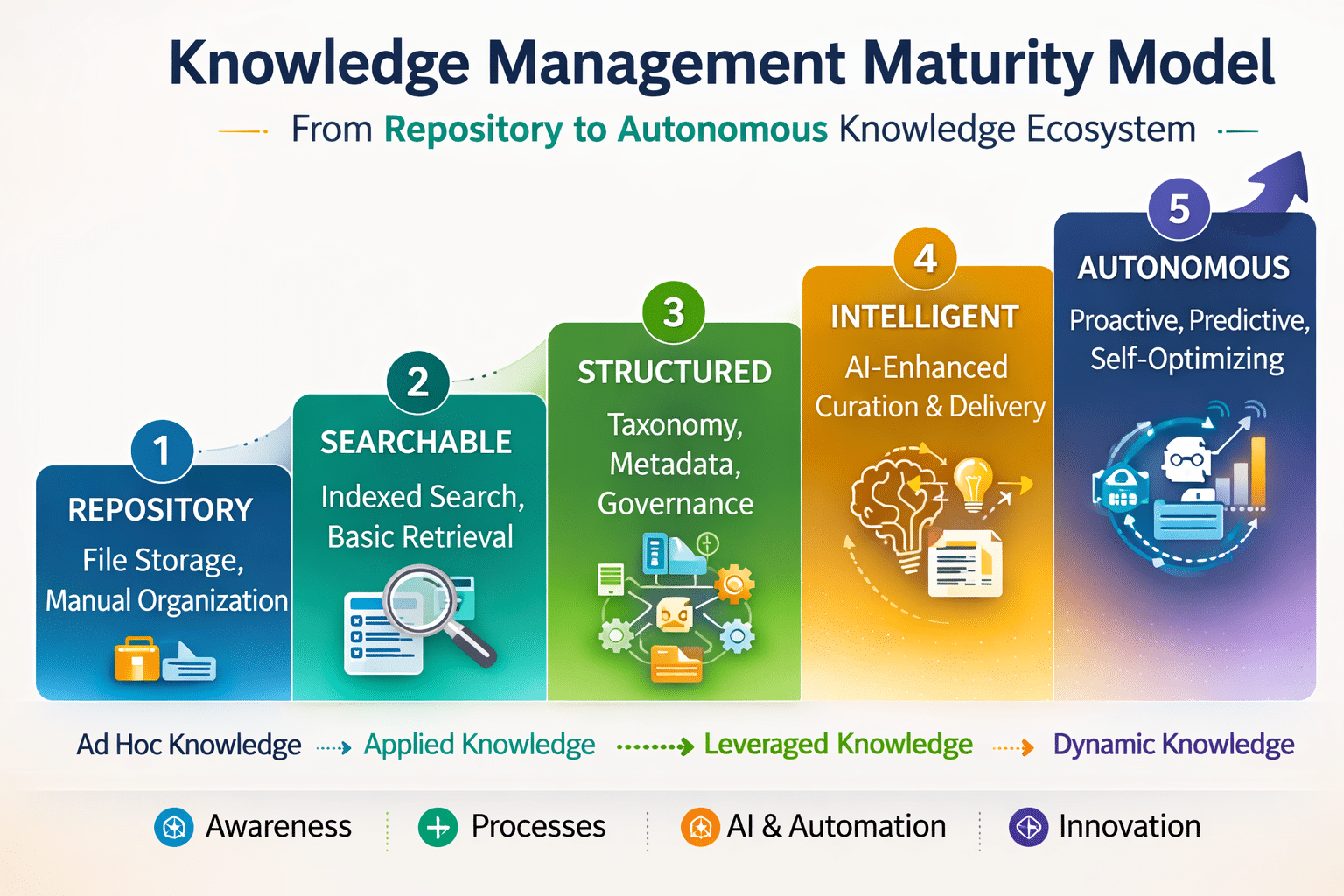
Most enterprise organizations today sit at Stage 2 or 3. The competitive pressure is building at Stage 4, and the organizations already piloting Stage 5 capabilities are setting the benchmark everyone else will chase.
Future KM Architecture Stack
The most capable knowledge systems in 2026 are built in layers. Understanding this architecture helps leaders make smarter investment decisions and avoid the tool fragmentation that plagues reactive KM programs.
- Data Layer – Documents, CRM records, ERP outputs, communication threads, and external feeds. This is the raw material the entire stack depends on.
- Knowledge Graph Layer – The connective tissue that maps relationships between information, people, and processes across the organization.
- AI Retrieval Layer – Semantic search and RAG capabilities that surface relevant knowledge in context, without requiring exact keyword matches.
- Generative Layer – The AI that synthesizes, summarizes, and produces new knowledge outputs from existing assets.
- Governance Layer – The controls that ensure accuracy, privacy compliance, and bias mitigation across all AI-generated outputs.
- User Experience Layer – The interfaces and integrations where knowledge reaches employees, including AI copilots, chat tools, and workflow embeds.
Organizations that build with this architecture in mind are building for organizational agility. Those that bolt AI onto legacy systems are building technical debt.
Challenges in the Future of Knowledge Management
The future of knowledge management isn’t without friction. A few challenges deserve direct attention.
- AI hallucinations and contextual accuracy remain genuine risks in any system where generative AI surfaces or creates knowledge. Governance architecture is the primary mitigation.
- Knowledge-sharing culture resistance is consistently underestimated. Technology solves the infrastructure problem, not the human one. Change management is required alongside any platform investment.
- Tool fragmentation is one of the most common KM failure modes. Organizations end up with multiple disconnected platforms that create more silos than they eliminate.
- Security vs. openness is a real tension, particularly in regulated industries. The more connected a knowledge ecosystem becomes, the more carefully access and permissions must be managed.
How Organizations Should Prepare for the Future of Knowledge Management

The organizations that will lead in AI-driven knowledge management aren’t waiting for the technology to mature. They’re building the foundation now.
- Audit your knowledge assets – Identify what exists, where it lives, and whether it’s current and trustworthy before layering AI on top of it.
- Invest in metadata strategy – Clean, consistent tagging is what makes AI retrieval accurate. Without it, AI tools amplify existing disorder rather than resolve it.
- Build a governance framework – Define who owns knowledge quality, how AI outputs get validated, and how compliance requirements get met at the system level.
- Train an AI-literate workforce – The bottleneck in most KM transformations isn’t technology. It’s people who don’t yet know how to work alongside AI effectively.
- Align KM with business KPIs – Knowledge management that can’t demonstrate impact on business outcomes won’t survive budget cycles. Build that measurement in from the start.
- Pilot AI copilots before full-scale deployment – Start in one workflow or department, measure the results, and expand from there.
Daniel Burrus has spent decades helping enterprise leaders build anticipatory strategies around exactly these kinds of technological inflection points.
Organizations that apply anticipatory thinking to their Knowledge Management investments now will be the ones defining the competitive standard in 2026 and beyond.If your organization is ready to move from reactive to anticipatory, strategic advisory services offer a structured path forward.
Frequently Asked Questions
What is the future of knowledge management?
The future of knowledge management is intelligent, proactive, and predictive. It’s about ecosystems that surface the right knowledge at the right moment rather than static repositories that require manual search.
What are the top knowledge management trends in 2026?
The seven key trends are generative AI and automated content curation, conversational and semantic search, proactive knowledge delivery, predictive analytics, knowledge governance and AI ethics, connected knowledge ecosystems, and the shift in KM roles toward AI governance.
How is AI changing knowledge management?
AI is automating content curation, enabling semantic search, powering AI copilots, and making proactive knowledge delivery possible. KM is moving from a retrieval function to an embedded intelligence layer inside enterprise operations.
Will generative AI replace knowledge managers?
No. It will transform the role. Knowledge managers are shifting from content librarians to AI governance strategists and data stewards. The function becomes more strategic, not obsolete.
What is proactive knowledge delivery?
A system capability where knowledge is pushed to employees based on context rather than waiting to be searched for. It surfaces relevant expertise, documents, and next-step recommendations automatically inside existing workflows.
What role do knowledge graphs play in the future of KM?
Knowledge graphs map the relationships between information, people, and processes across an organization. They’re the connective layer that makes truly integrated knowledge ecosystems possible at enterprise scale.
How will predictive analytics impact knowledge management?
Predictive analytics allows organizations to forecast skill gaps, identify expertise aging out of the organization, and measure the business impact of KM investments before problems surface operationally.
What are the biggest challenges in the future of knowledge management?
AI hallucinations, knowledge-sharing culture resistance, tool fragmentation, and the tension between security and openness are the most significant challenges organizations face in KM transformation.
How can organizations prepare for the future of knowledge management?
Start with a knowledge audit, invest in metadata strategy, build a governance framework, develop AI literacy across the workforce, and pilot AI copilots in a single workflow before scaling deployment.
Is knowledge management becoming more strategic?
Yes. As AI makes KM infrastructure more capable, it’s moving from a back-office function to a core component of competitive strategy and organizational agility.
What technologies will define the next generation of KM systems?
Generative AI, semantic search, retrieval-augmented generation, knowledge graphs, AI copilots, and predictive analytics are the core technologies reshaping enterprise KM in 2026.
What skills will future knowledge managers need?
Data governance, AI literacy, metadata strategy, analytics interpretation, and the ability to align KM systems with business KPIs. The role requires both technical fluency and strategic thinking.

Daniel Burrus is a globally recognized futurist, keynote speaker, business strategist, and AI expert who helps leaders anticipate disruption and create exponential opportunities.
The author of seven books—including the New York Times and Wall Street Journal bestseller Flash Foresight.
As one of the world’s leading technology futurists, Burrus has delivered thousands of keynotes across six continents.
Learn More