
As leaders plan for 2027, many are weighing whether to hire, borrow, or invest. Employees are asking their own questions about what those decisions will mean for their jobs and daily work.
Anticipatory Leaders can move planning forward by asking a practical question: What do we already know about the future that we can act on today?
Start by separating future facts from assumptions. Use what you know to guide your commitments, and build flexibility into decisions that depend on outcomes you cannot yet predict.
How Can Hard Trends and Soft Trends Guide Your Business Planning for 2027?
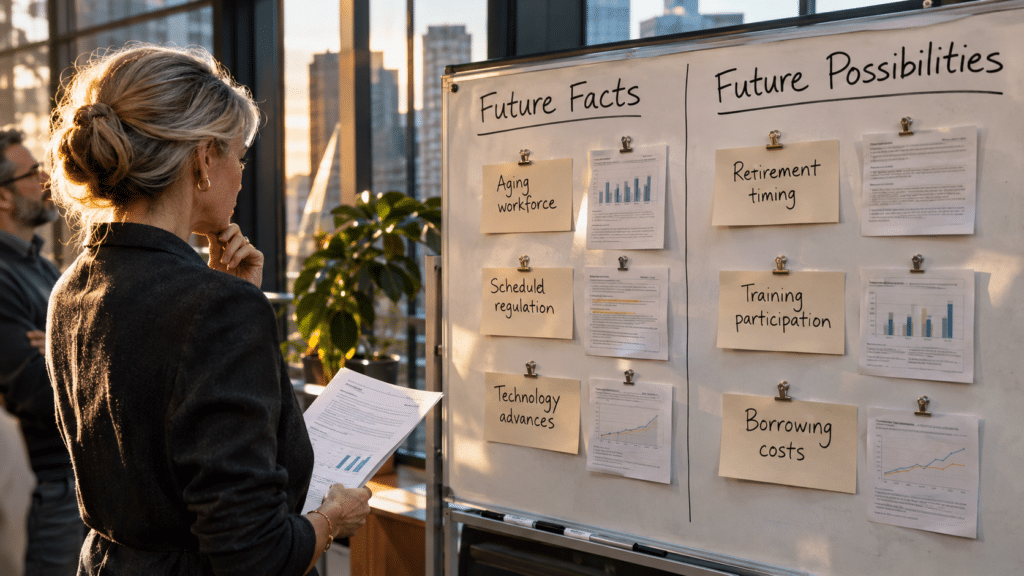
Some parts of the future are predictable—and recognizing them gives you a stronger foundation for planning. A Hard Trend is based on measurable, tangible, fully predictable facts. A Soft Trend is a projection that may change.
My Hard Trend Methodology helps leaders distinguish between the two and use that knowledge to make better decisions.
I encourage leaders to look for Hard Trends in demographics, technology advancements, and government regulation. The key is to identify exactly what is predictable within each area.
For example, we know a generation will continue to age. We don’t know when each person will choose to retire. That distinction helps leaders prepare for workforce changes without treating individual retirement decisions as facts.
Soft Trends also belong in your planning. You can influence some, such as employee participation in training. Others, such as borrowing costs, call for a plan that allows you to adjust as conditions change.
What Can Demographics Tell You About Your Workforce?

An aging workforce offers a practical example of how to plan around a predictable future fact. The U.S. Census Bureau explains that baby boomers were born from 1946 through 1964 and will all be at least 65 by 2030.
That timeline helps leaders anticipate workforce needs. It does not tell you which employees will retire in 2027. Understanding someone’s plans requires a conversation, rather than an assumption based on age.
Begin sharing knowledge before a departure makes it urgent. Document specialized processes, train colleagues to handle key responsibilities, and invite employees to discuss their career goals.
These actions help preserve experience and maintain continuity whenever employees move on.
How Can You Anticipate Customer Needs and Create New Value in 2027?

Imagine a commercial equipment supplier whose customers lose money when machinery breaks down. Faster replacement parts help. Monitoring equipment to identify maintenance needs before a breakdown gives customers another reason to choose that supplier: help preventing costly downtime.
Rolls-Royce applies this approach through its TotalCare service, which combines engine health monitoring, predictive maintenance planning, and maintenance coverage priced per engine flying hour. The service helps customers keep aircraft flying and makes engine maintenance costs more predictable.
As you plan for 2027, ask: What would our customers want us to make possible if they knew we could?
Look for recurring customer frustrations your team could address with its expertise and advancing technology. Could you shorten a process, detect a problem earlier, or provide guidance customers struggle to find?
Choose one opportunity to test with customers. Their feedback can help you decide where to invest next.
Which Economic and Policy Assumptions Need Flexibility?

Proper business forecasting also helps you consider various possible outcomes. Trouble begins when a forecast becomes an unquestioned condition for success.
For strategic planning amid uncertainty, consider making the following conditional language visible:
- Expansion assumes financing becomes affordable.
- Hiring assumes orders reach a specified level.
- A pricing decision assumes a proposed policy takes effect.
These are illustrative planning assumptions, not predictions about 2027.
For each one, decide what you would do if the assumption proves wrong. Could you phase an investment, test demand before adding capacity, or establish another supplier relationship entirely?
You can verify current policy requirements separately from proposals and assign someone to monitor developments and schedule a review along the way.
Which Assumptions Should You Test Before Approving Your 2027 Budget?
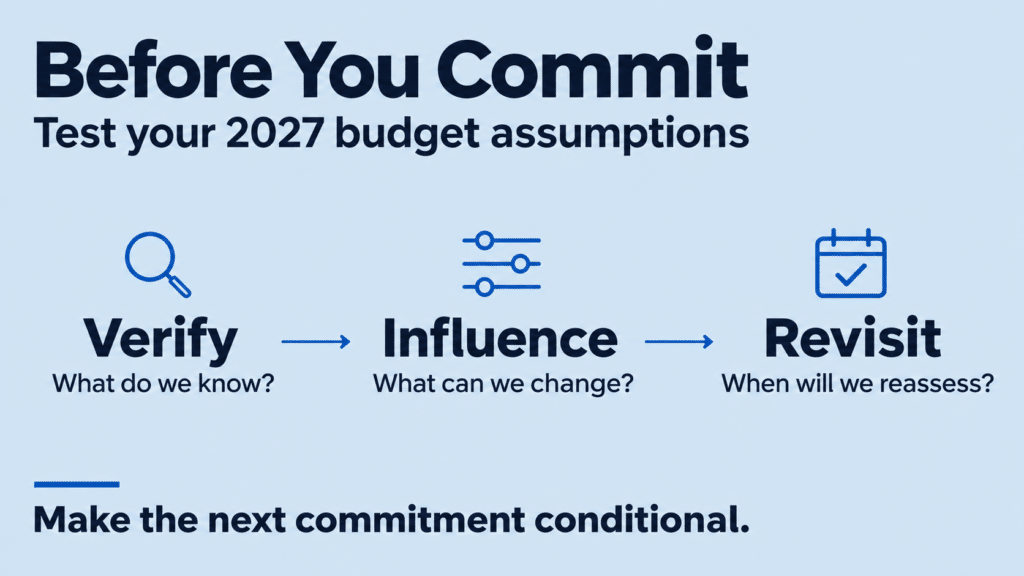
Before committing resources for the new year, I encourage leaders to examine the assumptions behind their biggest decisions. Start with these five questions:
- What are we assuming? State the assumption clearly in one sentence.
- What supports that assumption? Identify the evidence, its source, and what it does—and does not—tell you.
- What do we know is predictable? Separate future facts from the outcomes you expect.
- What can we influence? Identify specific actions your team can take to improve the outcome.
- What would cause us to reconsider? Set a measurable checkpoint, assign someone to monitor it, and agree on when to review the decision.
For example, you might approve an expansion in phases, requiring a specified level of signed orders before beginning the next phase.
Make the conditions for moving forward clear before committing resources.
How Can Clear Communication Help Employees Feel More Confident About Your 2027 Plan?

Employees want to know what your plans mean for their work. Explain which decisions are approved, which depend on changing conditions, and when you will share updates.
Be specific about what people can expect. If training is funded, explain what it covers and when it begins. If hiring depends on increased customer demand, explain what needs to happen before you add positions.
Invite employees across departments to contribute. Their experience with customers and daily operations can help reveal assumptions leaders have missed and suggest practical improvements.
Anticipatory Leadership means preparing people for what you can predict and involving them in the decisions they can help shape. Clear commitments, honest updates, and opportunities to contribute give employees a stronger sense of direction.
How Will You Put Your 2027 Plan Into Action?

Before your next planning meeting, choose three decisions that will have a significant impact on your business or your people. For each, identify the future facts you can act on and the assumptions you still need to test.
Then agree on the next step, who will take responsibility, and what would prompt you to reconsider.
You don’t need every answer to make progress. You need a clear reason to act and a plan for adjusting as you learn.
Start with those three decisions. What can you move forward today based on what you already know about the future?
What’s shaping your business opportunities in 2027?
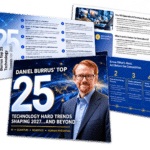 Make your next planning conversation more productive with my free 2027 Top 25 Technology Trends Report. Explore the technology trends shaping the year ahead and identify opportunities to act before your competition.