
Connectivity used to be a technological concept. However, it’s now becoming the architecture of future business models.
With the rise of the Internet of Everything (IoE) and the impending rollout of 6G, we’re approaching a tipping point: an era of true hyperconnectivity where people, devices, data, systems, and environments are seamlessly linked in real time.
This evolution incorporates both speed and scale in a massive way. As I outline in Hard Trends #13 and #17 from my Top 25 Technology Hard Trends Shaping 2026, this is a future certainty—one that will fundamentally reshape how organizations create, deliver, and monetize value across increasingly connected digital ecosystems.
What Is the Internet of Everything—and Why Does It Matter?

The Internet of Everything goes beyond traditional IoT by connecting not only devices, but also people, processes, services, and intelligence. It turns static systems into dynamic ecosystems capable of real-time sensing, decision-making, and collaboration.
This convergence fuels new business capabilities in many ways, including:
- AI-powered logistics systems that reroute in real time
- Smart cities that optimize energy and traffic autonomously
- Connected healthcare devices that diagnose and notify before symptoms appear
- Retail environments that adapt experiences based on behavioral signals
In this hyperconnected economy, the value is in the intelligence of a device’s relationship capabilities.
Why are 6G and Edge Computing Catalysts for Business Model Innovation?

The upcoming generation of connectivity, including 6G networks, won’t just be faster. It will be fundamentally smarter.
With the power to deliver sub-millisecond latency, near-infinite device density, and native AI support, 6G connectivity will enable breakthroughs. This includes real-time edge AI processing, autonomous systems without delay, and seamless machine-to-machine (M2M) collaboration across global operations.
When paired with advanced edge computing, businesses can push intelligence to the very edge of their networks, making split-second decisions where data is created.
This shift from centralized to distributed intelligence is reshaping what’s possible and moreover how value is generated.
From Technology Adoption to Structural Reinvention
Too often, organizations see IoT or 6G as tools to adopt, rather than catalysts for reinvention.
But the leaders of tomorrow are asking better questions, including:
- “What new services could we offer when everything is connected?”,
- “How do we monetize predictive networks, not just physical products?”, and
- “How do we evolve from being a supplier to becoming a platform?”
In this next-gen environment, connectivity isn’t the enabler of your business model. It becomes the business model that impacts everyone including manufacturers selling real-time performance insights, energy providers creating dynamic pricing models based on live demand and usage, and healthcare companies.
This is business model innovation, driven by the structural realities of digital ecosystems.
Trust, Governance, and Ecosystem Foresight

As connectivity deepens, so must trust.
In a world of predictive, autonomous systems powered by continuous data exchange, the future of connectivity demands new forms of data governance, interoperability standards, and digital ethics.
Smart leaders are embedding these principles into their ecosystems from the start:
- Designing systems with privacy by architecture, not afterthought
- Ensuring interoperability between partners, platforms, and geographies
- Defining ownership and accountability in machine-to-machine transactions
Without trust, the Internet of Everything becomes the Internet of Uncertainty. With it, you create a future-proof digital infrastructure.
The Anticipatory Organization and the Hyperconnected Opportunity

To thrive in a hyperconnected future, businesses must shift from adoption to anticipation.
That means forecasting where next-gen connectivity will unlock new markets, reframing operations as predictive ecosystems, redefining value creation through partnerships, platforms, and intelligent services, and moving early on Hard Trends like 6G, IoE, and edge computing before they become industry standards.
This is the essence of an Anticipatory Organization: one that leads not by reacting to change, but by shaping it.
The winners of the next decade won’t be those who have the best products, but those who build the most intelligent, trusted, and adaptive connectivity-powered ecosystems.
Download the Hard Trends Report: Design the Future with Foresight
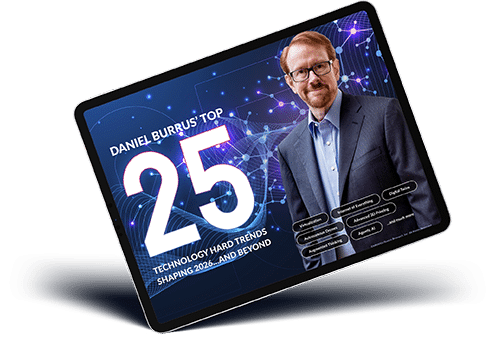
As business models transform in a hyperconnected world, your ability to anticipate—not just adapt—will define your competitive edge.
👉 Download Daniel Burrus’ Top 25 Technology Hard Trends Report to explore the exponential trends powering IoT and edge transformation, 6G connectivity, and the business model shifts shaping 2026 and beyond.