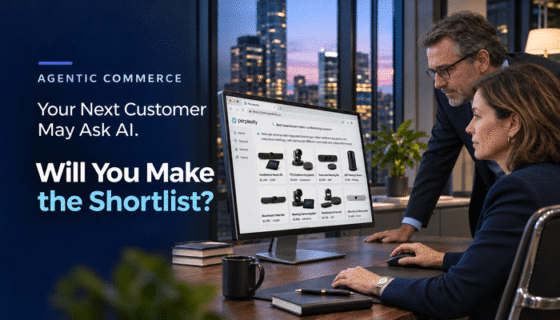
When you ask an AI assistant to find a holiday gift that matches someone’s interests, fits your budget, and arrives before the family gathering, you’re describing what you want to accomplish. You may never mention a brand.
That raises a question every business leader should be asking now: Can your company give this customer a clear reason to choose you? Having a great product is a start. What makes yours the better choice for what this customer wants to accomplish?
Make your offer easy to understand, your differences easy to verify, and your promises dependable. These improvements help customers today and prepare your business for AI-assisted comparison.
What Do We Need to Know About Agentic Commerce?

Agentic AI goes beyond answering questions. It can plan and carry out tasks on your behalf, working toward a goal within the permissions you give it. In commerce, that can mean comparing products, building a shopping cart, or completing an authorized purchase.
A January 2026 article from McKinsey titled “The automation curve in agentic commerce,” distinguishes assistance with research from assembling a basket and executing an authorized purchase. It emphasizes that technical capability does not determine how much control customers will delegate.
Its earlier agentic commerce report estimates that agents could mediate $3 trillion to $5 trillion in global consumer goods commerce by the year 2030. This is a forecast based on adoption assumptions, excluding services and B2B purchasing.
For Anticipatory Leaders, the opportunity is to prepare for different levels of customer involvement. Some customers will want help comparing options. Others will authorize an assistant to take action. Your business needs to provide clear information and dependable service in either case.
How Are AI Shopping Agents Already Helping Customers?

AI shopping agents are already helping customers research, compare, and buy products. Anticipatory Leaders need to look closely at how these tools influence the decision: What information helps a customer choose one product over another, and does your business provide it?
Amazon describes Alexa for Shopping as its assistant combining Rufus and Alexa+. Its published capabilities include features like:
- Product comparisons
- Shopping guides
- Price tracking
- Cart building
These capabilities put specific buying requirements at the center of the comparison. Does the product fit? Is it appropriate for the recipient? Will it arrive on time? Are the return conditions clear?
What Are AEO and GEO, and Why Do They Matter for Your Business?

For years, businesses have used Search Engine Optimization (SEO) to help customers find their websites. As customers turn to AI for answers and recommendations, two related practices deserve your attention.
Answer Engine Optimization (AEO) means organizing your content to provide clear, direct answers to customer questions. Generative Engine Optimization (GEO) focuses on making your content easier for tools such as ChatGPT, Gemini, and Perplexity to discover, accurately represent, and reference in their responses.
For business leaders, the opportunity is to anticipate what customers will ask and publish credible answers before they ask. When AI helps a customer evaluate their options, what information have you provided that gives them a reason to choose you?
How Can Your Business Stand Out in AI Search and Shopping?

Preparation should reflect the tools your customers use:
These steps support discovery and accurate information. They do not guarantee a recommendation.
Also include Gemini and Perplexity in your customer research. Ask realistic buying questions and inspect the sources provided. Gemini may show related links; Perplexity’s search experience also supports source-based research. Gemini Apps Help
Test the questions your customers ask before they know your name.
What Gives AI Assistants a Clear Reason to Include You?

Start with the questions that determine whether your offer fits a customer’s needs:
- Who is this product or service best suited for?
- What does it cost, and what is included?
- What requirements or limitations should a buyer understand?
- What evidence supports your claims?
Example: A specialty retailer could publish a comparison explaining which appliance fits a small kitchen, works with existing equipment, and includes installation. Each detail helps a buyer assess suitability.
Turn your differences into evidence. Explain what installation includes, document compatibility, and describe how support works. Relevant case studies and specific customer feedback help buyers verify the value you promise.
Microsoft’s guidance recommends descriptive headings, concise sections, evidence, and accurate information to make content easier to reference in AI answers. Bing Webmaster Tools
For Anticipatory Leaders, this is an opportunity to pre-solve the questions that could keep a customer from choosing you. Make the answers available before the customer has to ask.
What Makes Trust Matter Beyond the Recommendation?

An assistant’s recommendation does not relieve a business of delivering what it promised. Holiday customers still need the right item to arrive when expected, with clear options if something goes wrong.
In my discussion of AI and the human touch, I apply the Both/And Principle to digital assistance and access to knowledgeable people.
Apply the Both/And Principle: Combine the convenience of AI with access to knowledgeable people. Let customers compare options efficiently, then make human help available when they need judgment, reassurance, or a solution to an unexpected problem.
Make purchase terms easy to review and confirm. The responsibility for delivering your promise remains with your business, regardless of how the customer found you.
What Would a Buyer Learn About You Today?

If an agentic AI assistant helped your next customer choose your product, what clear, credible reason would it find to recommend you?
- Use the coming holiday season to examine one offer through a buyer’s eyes.
- Write a realistic request that includes a budget, a deadline, and a specific requirement.
- Test it across ChatGPT, Gemini, Perplexity, and Copilot.
Which businesses appear? What sources support the answers? Where is your information missing, outdated, or unclear? Treat each response as a snapshot, then use what you learn to improve your published information.
Being anticipatory means answering tomorrow’s customer questions today. Give customers a clear, credible reason to choose you before they ever ask for your business by name.