

Let’s suppose AI cuts the time needed to prepare a customer report from two hours to ten minutes. That represents tremendous time savings for even one department within an organization.
Then someone asks whether the customer ever uses the report.
That question can change the entire discussion around an investment in AI usage.
I believe leaders create more business value with AI when they begin with the result someone needs: a better decision, a problem prevented, or a service that was previously impractical to offer.
But before investing in automation, ask which of these questions apply: Can the work be accelerated, redesigned, or eliminated entirely? Saving time is a useful starting point, but what you do with that capacity determines the larger benefit.
What Does Problem Skipping Change About an AI Investment?

My Skip It Principle encourages you to question whether the problem you are trying to solve is the real problem or if, like many, you’re focusing on the wrong problem entirely.
I recently published an article highlighting Canva as a modern example of this principle in action. By eliminating much of the complexity associated with traditional design software, Canva has made it easier for individuals, small businesses, and marketing teams to create professional-quality visual content without specialized design expertise.
Rather than trying to compete with Adobe by matching its extensive features, Canva took a different approach: making design more accessible through intuitive, easy-to-use software.
The same principle applies to how we serve our customers. Instead of asking how to produce a customer report faster, ask what the customer truly needs to understand or accomplish. Then focus on delivering the insights and solutions that create the greatest value.
Innovation isn’t always about improving the way something has traditionally been done. Sometimes, it’s about rethinking the approach entirely while remaining focused on the desired outcome.
Should You Accelerate, Redesign, or Eliminate the Process?
Let’s go back to my initial question earlier in this article. I asked you to determine whether something at your organization needs to be accelerated, redesigned, or eliminated entirely.
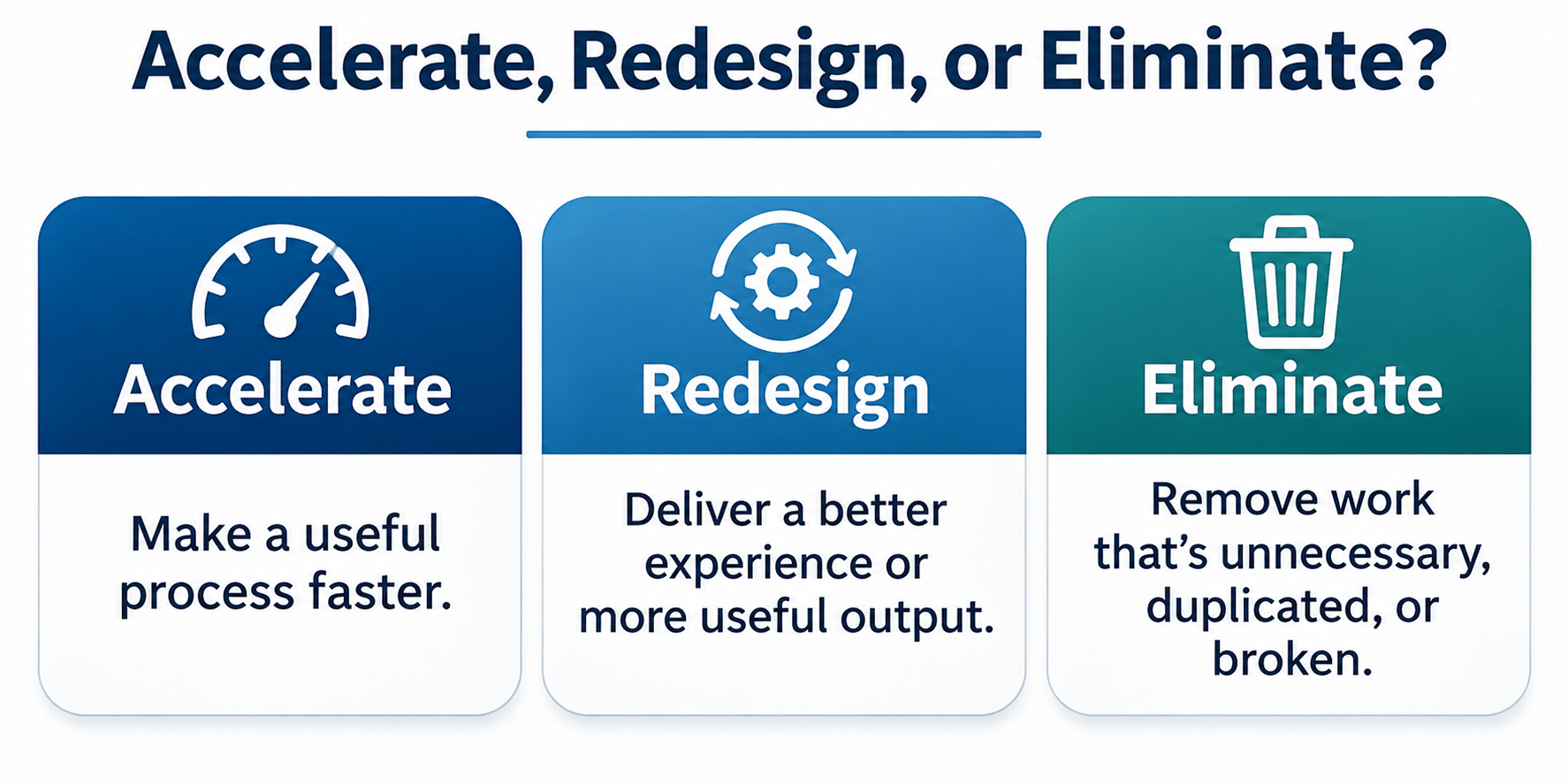
When solving the real problem, each of these three approaches addresses a different question. Consider what each approach means for your organization:
- Accelerate: Does a process already serve a useful purpose, with speed as its main limitation?
- Redesign: Does the customer need a different experience or a more useful output?
- Eliminate: Is a task unnecessary, duplicated, or required only because another process is broken?
For a service company, AI might accelerate appointment scheduling. Redesign could mean identifying likely maintenance needs before customers call. Elimination could mean removing duplicate data entry by connecting existing systems, without needing AI at all.
Of course, I find it best to ask employees who perform the work to help identify which route fits. Let them help shape their day-to-day work. They encounter the tasks, obstacles, and problems associated with the systems you’re examining firsthand.
Where Can AI Improve the Quality of a Decision?

The quality of a decision at an organization speaks volumes about leadership and where the ship is heading. While AI cannot replace human involvement, there is a growing ability for it to streamline decisions and avoid major setbacks.
Take Visa as an example. In its May 2024 announcement, Visa described a tool using generative AI components to score the likelihood of attacks that test payment credentials. The score helps card issuers decide when to block a transaction.
Visa reported an 85% reduction in false positives compared with other risk models, citing its model documentation. This company-reported result applies to that specific tool.
My takeaway from this real-world example is that decision quality deserves its own measure. Faster processing has limited value if legitimate customers are incorrectly turned away. We want to streamline processes, not redesign them in ways that create unnecessary complications for our customers.
For your business, ask which costly mistake better information could help someone avoid, and how you would verify that improvement.
What Customer Need Could Become a New Service?

Let’s shift from restructuring processes and look to creating something new.
JPMorganChase took this route in recent years. In its 2024 Commercial & Investment Bank shareholder letter, published in April 2025, the bank described AI tools that help corporate clients predict cash flows. It also reported using client-interaction data to create recommendations across more than 40 countries.
Consider JPMorganChase’s approach and how a similar opportunity might exist within your organization:
- What questions do customers repeatedly ask your employees?
- Which of those questions require information that is difficult to gather, scattered across multiple sources, or consistently delivered too late to be useful?
These recurring challenges may reveal opportunities to rethink how your organization delivers information, improves the customer experience, and creates greater value.
I want you to identify opportunities for new value by examining existing processes. This new value can be a new product, service, or other solution for your valued customers. An AI business strategy begins there, with an unmet need and the information required to address it.
How Could Better Service Create Revenue Opportunities?

Imagine an equipment service business exploring an AI-assisted maintenance monitoring system.
If this business has suitable data, it could test whether earlier warnings help customers reduce downtime with their equipment. Human technicians would then be able to investigate the alerts and recommend action if needed.
The potential revenue in this hypothetical example comes from an ongoing service customers find worth paying for. It requires reliable performance and workable delivery costs.
At your organization, you must first find a real problem worth solving with AI. Communicate with customers by asking what downtime costs them, how they handle it now, and what evidence would justify purchasing a monitoring service.
This will provide a clear starting point for developing a new product or service out of a need that might benefit from an element of automation.
How Should You Measure the Return on Investment from AI?
Once you’ve determined where AI can help, it’s important to keep measuring time savings but connect them to an actual business benefit.
We should continually evaluate and refine our processes, recognizing that even the most effective systems have room for improvement. The goal isn’t perfection, but identifying opportunities to work smarter, eliminate unnecessary complexity, and deliver greater value.
What seems incredible now is not perfect. It never will be. We live in an imperfect world, allowing us to develop, redesign, and redefine all the time. Released capacity might support more customers, reduce overtime, or allow employees to develop a new service.
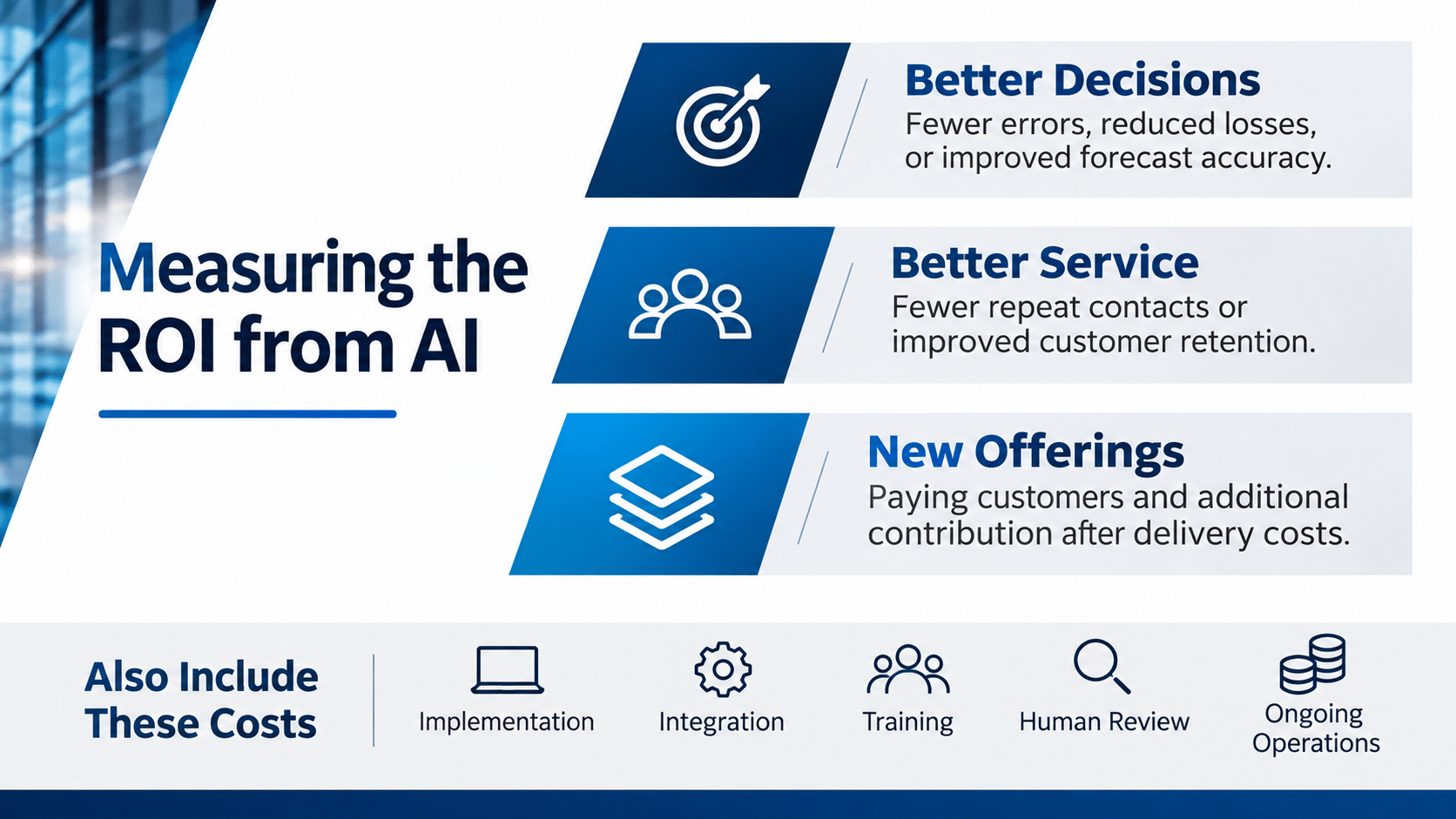
To measure the return on investment from AI applications, choose metrics that align with your objectives. Here are a few to consider:
- Better decisions: fewer errors, reduced losses, or improved forecast accuracy.
- Better service: fewer repeat contacts or improved customer retention.
- New offerings: paying customers and additional contribution after delivery costs.
I would include implementation, integration, training, human review, and ongoing operating costs in your evaluation as well. Avoid counting the same saved hours as both lower labor expense and additional capacity unless both benefits actually occur.
What Would Make Your Next AI Proposal Worth Funding?

Strategy is what matters most in business.
Take one AI proposal currently under consideration and rewrite its opening sentence. Describe who benefits, what improves for them, and how you will measure the improvement.
Then ask your team to show why accelerating, redesigning, or eliminating the process is the right choice. Agree on the results a small test must demonstrate before making a larger investment. This approach also reassures your employees that you’re evolving the organization, not removing roles and responsibilities.
Remember: your goal is to be the positive disruptor in your industry.
Discover Your Next Big Opportunity With the Top 25 Technology Trends for 2027

The greatest value of AI and emerging technologies isn’t simply doing what you’ve always done faster. It’s discovering new ways to serve customers, improve decisions, and create revenue opportunities your competitors may not yet see.
What opportunities could your organization be overlooking?
In my Top 25 Technology Trends for 2027 Report, I identify the technology-driven changes shaping the future of business and the opportunities they create. Use these insights to rethink your strategies, uncover new sources of value, and take action before your competition.