
This article answers the question: How is AI changing the future of marketing, and why is attention becoming the most valuable asset in business?
Answer: According to Daniel Burrus, AI is transforming marketing by making content faster and easier to create, while making human attention more scarce and valuable. As generative AI increases content volume, the brands that win will not be the ones that publish the most, but the ones that anticipate customer needs earliest. By applying an Anticipatory Mindset, marketers can use Hard Trends, AI-driven personalization, predictive content, micro-moments, and trusted, easy-to-verify messaging to earn attention before demand fully forms. The future of marketing will belong to organizations that stop chasing attention after it moves and start designing relevance for the moment before the customer asks.
Why Is Attention Becoming the Most Valuable Asset in Business?

Content is no longer the advantage. Attention is.
AI has made content faster, cheaper, and easier to scale. Grand View Research estimates the generative AI content creation market at $14.8 billion in 2024, with projected growth to $80.12 billion by 2030.
This is a Hard Trend: content supply will keep rising. The constraint is human attention, and human attention does not scale with technology.
When supply explodes and attention stays fixed, attention becomes the new scarce asset.
That changes the future of marketing. The question is no longer, “How much can we publish?” The better question is, “How early can we be relevant?”
How Did Marketing Move from Persuasion to Prediction?

Marketing used to focus on persuasion. Brands created messages, bought media, and hoped customers responded.
Now the winning strategy is prediction. Google describes micro-moments as intent-driven decision points that shape customer preferences across the buying journey.
That is exactly where Anticipatory marketing begins. I define it as using Hard Trends to identify customer needs before they become visible demand.
You can see this shift everywhere.
- TikTok feeds adjust quickly based on behavior.
- AI search summaries answer before a user clicks.
- E-commerce tools suggest products before a buyer types a full query.
The marketer who arrives first with relevance earns the attention.
Why Are Micro-Moments Getting Smaller?

Most customer decisions are no longer slow and linear. They happen in seconds.
Google also defines micro-moments as times when people turn to a device to learn, do, discover, watch, or buy.
These moments are shrinking because customers expect instant answers. They want fast proof, simple choices, and useful next steps.
A customer may compare prices while standing in a store aisle. Another may ask an AI assistant for the best option before ever visiting your website. Someone else may decide based on a short video, a review summary, or a recommendation they did not search for directly.
If your brand is late to the moment, it is absent.
This is why Anticipatory thinking matters. You do not wait for demand. You use certainty to prepare for it.
How Is Hyper-personalization Resetting Customer Expectations?

Personalization used to be a market advantage. Now it is the baseline.
McKinsey found that 71% of consumers expect personalized interactions, and 76% get frustrated when they do not receive them. Faster-growing companies also generate 40% more revenue from personalization than slower-growing peers.
That is a Hard Trend in behavior: expectations will keep rising.
Customers now expect brands to recognize what they need, where they are in the journey, what they have already done, and what action makes sense next.
But personalization must be useful. Poor targeting feels invasive. Smart relevance feels helpful.
Creativity still matters, but relevance decides whether creativity gets seen.
What Happens When Content Starts Predicting Behavior?

Predictive content moves ahead of demand.
It does not wait for a customer to raise a hand. It studies patterns, identifies intent, and presents the next best message.
This is where marketers need to shift from campaigns to systems. A campaign has a start and end date. A system learns continuously.
Predictive content systems detect early signals, adjust offers in real time, recommend content based on behavior, and pre-solve customer friction.
This is Anticipatory strategy applied to marketing.
When you arrive before the customer asks, you stop chasing attention and start earning it.
That is the new economics of attention.
Why Will AI Become the New Marketing Gatekeeper?
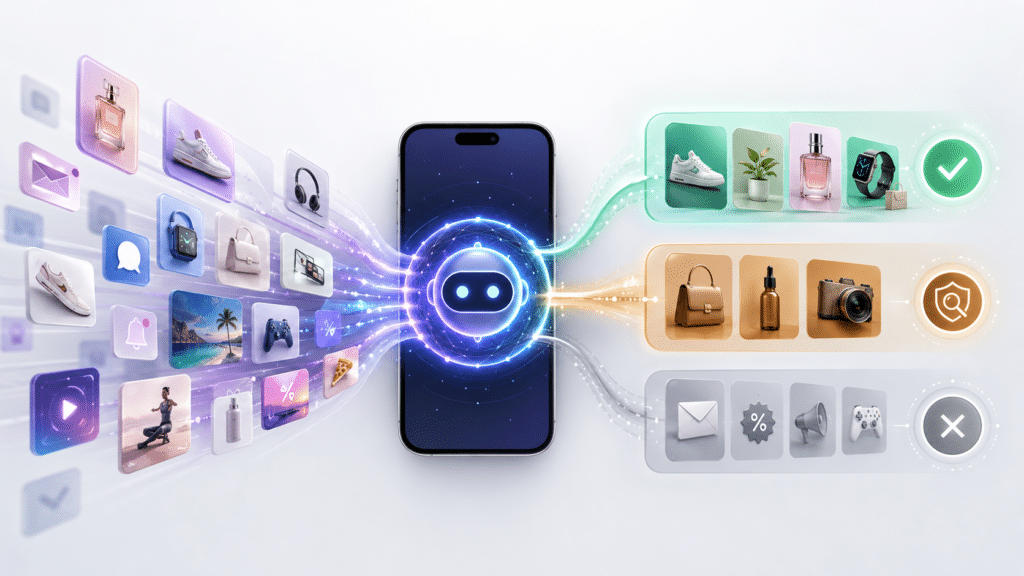
Your next audience may not be a person first. It may be an AI filter.
Gartner predicts traditional search engine volume will drop 25% by 2026 as AI chatbots and virtual agents take share.
Google also reported that AI Overviews reached 1.5 billion monthly users across 200 countries and territories by I/O 2025.
This means brands must write for people and AI systems. Clear answers, strong proof, fresh data, and easy-to-verify claims will matter more.
AI will reward content that is useful, direct, and trusted.
If AI cannot understand your value, customers may never see it.
Why Does More Content Create Less Attention?
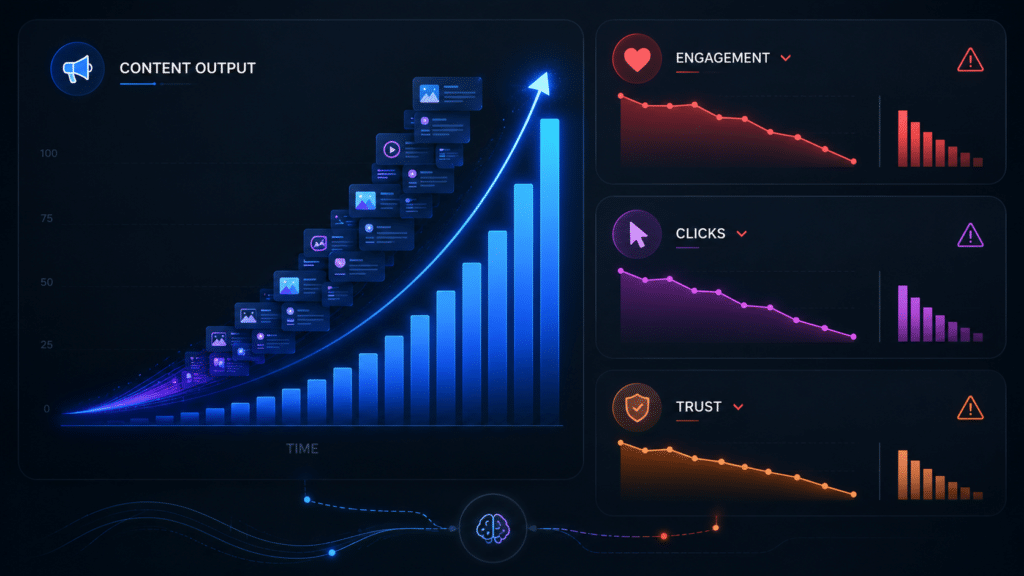
When engagement drops, many teams publish more. That is the wrong response.
Adobe reports that two-thirds of brands are not giving customers the right content at the right moment, while 78% of consumers expect a seamless experience at every touchpoint.
More content does not solve poor timing. Volume without relevance becomes noise. Static content falls behind customer behavior. Generic messaging gets filtered out by people and algorithms.
The answer is not more posts, more emails, or more campaigns. The answer is better anticipation.
The future of marketing belongs to the brand that is useful before the customer feels friction.
What Will the Attention Economy Look Like by 2030?

By 2030, content selection will matter more than content creation.
Deloitte’s 2026 Digital Media Trends report points to always-on audience engagement through owned environments, social content, shopping, and exclusive experiences.
That signals a larger shift. Brands will need to earn direct access to customers instead of relying only on rented platforms.
The Hard Trends are clear: AI curation will expand, personalization will deepen, customer patience will shrink, and trust will decide access.
The Soft Trend is your response.
You can keep producing content after attention moves, or you can build systems that anticipate where attention is going next.
How Can You Earn Attention Before Demand Forms?

Start with certainty.
In my work, I teach leaders to separate Hard Trends from Soft Trends. Hard Trends are future facts that will happen. Soft Trends are assumptions you can change.
For marketers, the Hard Trends are clear. AI-generated content will keep growing. AI filters will shape visibility. Customers will expect deeper relevance. Micro-moments will keep compressing decisions.
Your Soft Trend is how prepared you are.
Ask better questions before the market forces change:
- What customer needs can we know in advance?
- What friction can we remove early?
- What proof will AI and humans trust?
- What content should appear before the search?
Stop chasing attention after it moves. Design for the moment before the customer asks.
Are You Prepared to Win the Next Moment of Attention?

The attention economy will reward the brands that anticipate first.
That does not happen by producing more content. It happens when leaders build the ability to see customer needs earlier, act with greater certainty, and create relevance before the market demands it.
This is where Daniel Burrus’ Anticipatory principles become a business advantage. Through future-focused keynotes, advisory services, strategic consulting, and the Anticipatory Organization® Learning System, Daniel helps leaders identify Hard Trends, solve problems before they grow, and see new opportunities before competitors do.
The future of marketing belongs to organizations that stop reacting to attention and start anticipating where it will go next.