AI speakers are becoming an increasingly important part of corporate events, conferences, and summits, as organizations seek expert guidance on navigating the rapidly evolving technology landscape. An experienced futurist speaker can inspire audiences, translate complex concepts into actionable insights, and provide a forward-looking perspective that helps businesses stay competitive in a world driven by innovation.
To find out what 5,626,652 opinions of business leaders who have booked AI speakers for their events were, we utilized AI-driven audience profiling to synthesize insights from online discussions for a full year ending January 14, 2026, to a high statistical confidence level. The results provide a clear overview of priorities, challenges, and viewpoints of the value that AI speakers provide, now and in the future.
Index
- 64% of business leaders who have booked AI speakers for their events are familiar with speakers in their industry
- 56% of business leaders who have booked AI speakers for their events use online researchers to discover them
- 81% of business leaders who have booked AI speakers for their events say that conferences and summits are their top source of information when learning about them
- 97% of business leaders who have booked AI speakers for their events are very familiar with technology experts
- Lack of clarity on expertise is the biggest challenge for 36% of business leaders trying to evaluate AI speakers
- 100% of business leaders who have booked AI speakers for their events say that a speaker’s past audience or client experience is important when evaluating them
- 60% of business leaders who have booked AI speakers for their events say that an engaging and inspiring delivery makes a speaker credible or trustworthy
- 44% of business leaders who have booked AI speakers for their events say that fireside chats are an extremely effective format
- 47% of business leaders who have booked AI speakers for their events find an informative and structured audience engagement style most valuable
- 37% of business leaders who have booked AI speakers for their events say that future of work with AI topics are valuable for their organization
- 43% of business leaders who have booked AI speakers for their events agree that the technology and software industries benefit the most
- 50% of business leaders who have booked AI speakers for their events say that they expect a transformative impact on their organization
- 44% of business leaders who have booked AI speakers for their events say that clear and engaging communication would encourage them to engage long term
- 100% of business leaders who have booked AI speakers for their events say that a lack of visionary thought leadership is a major gap in the current landscape
- Chicago and New York are where 50% of business leaders who have booked AI speakers for their events are primarily based in
- The Evolving Expectations of AI Event Speakers
- About The Data
Daniel Burrus comments: As AI continues to redefine business models, the role of the futurist and AI keynote speaker is shifting from explaining technology to providing a strategic lens for what is certain to come. Business leaders are seeking clarity based on research and a proven methodology, not speculation. They want to understand how AI aligns with human potential and how to act decisively. My work focuses on identifying Hard Trends based on future certainties that allow organizations to anticipate disruption before it happens. By using this anticipatory approach, leaders can elevate decision-making, accelerate innovation, and transform rapid change into a strategic advantage.
How Familiar Are You With the Leading AI Speakers in Your Industry?
64% of business leaders who have booked AI speakers for their events are familiar with speakers in their industry
Business leaders are largely familiar with industry-related AI speakers:

McKinsey studies show that AI adoption amongst companies has reached 72%, highlighting how many businesses are familiar with this technology now. In line with this are 64% of business leaders in our audience who are also familiar with AI speakers in their industry. This familiarity ranges from very familiar (15%) familiar and somewhat familiar (28%), to slightly familiar (21%).
Conversely, only 36% say they are not familiar with AI speakers in their industry.
This greater degree of familiarity with those who have hired AI speakers for their events shows that they recognize their importance and the valuable contribution they’re making to educating audiences, driving innovation, and helping businesses adapt to this fast-changing technology.
Daniel Burrus comments: Familiarity with AI speakers is rising alongside enterprise adoption of artificial intelligence. As 72 percent of companies in this survey report integrating AI into operations, 64 percent of business leaders are now familiar with AI speakers in their industry. This is growing rapidly as more speakers speak about AI. Unfortunately, many have no deep knowledge or expertise in AI. I’ve been speaking on global stages about AI and it’s future impact for decades, and I advise executives from Fortune 500 companies on AI strategy. For several years now, I’ve been recognized as a Top AI Leader in a number of industries, including Top AI in Retail Expert by RETHINK Retail, and a recipient of the 2026 Global Excellence Award in AI and Digital Transformation. When leaders engage with speakers who deliver both strategic clarity and future-focused insight, it reinforces the role of AI keynotes as a catalyst for innovation and anticipatory decision-making.
How Do Business Leaders Usually Discover the Best AI Keynote Speakers for Their Industry?
56% of business leaders who have booked AI speakers for their events use online researchers to discover them
One predominant source stands out for discovering speakers:

Over half (56%) of our audience finds AI speakers by conducting online research. This aligns with general consumer trends, as Google confirms that 51% of shoppers surveyed say they use the search engine to do product research prior to purchasing. Another 26% of business leaders who have booked AI speakers for their events have discovered them via speaker bureaus, 13% in industry reports and publications, and 4% via professional networks.
Interestingly, conferences and summits are where only 1% discover new speakers.
Daniel Burrus comments: The fact that 56 percent of business leaders rely on online research to discover AI speakers underscores a larger shift in how decision-makers vet thought leadership. In a digital-first world, credibility is increasingly earned through consistent insight, published research, and visible thought leadership. My work as a Global Futurist, strategic AI advisor, and featured expert across platforms such as LinkedIn (with 1.1 million followers) and major publications—reflects this shift. Leaders are not simply searching for speakers; they are searching for strategic partners and problem solvers who offer more than a presentation. They are seeking voices that bring clarity to complexity and provide foresight grounded in certainty that is tailored to the needs of the audience.
Which Sources Do Business Leaders Trust Most When Evaluating AI Keynote Speakers?
81% of business leaders who have booked AI speakers for their events say that conferences and summits are their top source of information when learning about them
In-person events lead the way for information-sharing:

Despite conferences and summits rarely being where business leaders who have hired AI speakers for events have discovered them, these sources play a major role as trustworthy sources when learning about speakers.
A whopping 81% say that conferences and summits are their top sources when learning about AI speakers, and 5% say they trust them, too. Online reviews and testimonials are far behind, with 2% saying they are their top sources, 4% trust them, and 4% have some doubts.
Industry publications and blogs are trusted by 1%, while professional networks and speaker bureaus both make up less than 1% of opinions overall.
Daniel Burrus, recognized as a 2026 Top AI Conference Speaker, comments:: While digital channels dominate discovery, trust is still earned in person. The fact that 81 percent of business leaders view conferences and summits as their most trusted source for learning about AI speakers underscores the value of live engagement. As a Top 30 Global Futurist, RealLeaders Top Impact Speaker for 2026, and recipient of the Global Excellence Award in AI and Digital Transformation, I understand that trust is not built on credentials alone—it is demonstrated in real time. When I speak at summits and corporate events, the objective is not just to inform, but to deliver strategic foresight leaders can act on immediately. In these moments, relevance, credibility, and clarity are not abstract—they are observable.
Which AI Speakers and Thought Leaders Are Business Leaders Following Today?
97% of business leaders who have booked AI speakers for their events are very familiar with technology experts
Technology is a core focus for most business leaders:

Technology-focused experts are clearly leading the way, as they’re the AI speakers or thought leaders that 97% of our audience are very familiar with, and 1% are somewhat familiar. This is understandable, as AI is making the biggest roads in tech and IT. In 2025, IT had the highest AI adoption rate (18%) by industry, and this figure is expected to increase in the coming year.
In contrast, just 1% were very familiar with business strategy thought leaders, showing just how much of a focus is on the tech side.
Daniel Burrus comments: The fact that 97 percent of business leaders are most familiar with technology experts as AI speakers reflects a broader pattern: organizations still tend to view AI primarily through a technical lens. Yet the competitive advantage lies not in understanding the tools alone, but in knowing how to apply them strategically. As a Global Futurist and recipient of the 2026 Global Excellence Award in AI and Digital Transformation, my focus has always been to bridge that gap—translating exponential tech into actionable business insights, foresights and take-home actions. It’s not the tool, it’s how you use it that make all the difference. AI is a technology, but its value is realized through strategic leadership combined with creative applications. That is the real differentiator.
What Challenges Do Business Leaders Face When Evaluating AI Keynote Speakers?
Lack of clarity on expertise is the biggest challenge for 36% of business leaders trying to evaluate AI speakers
Evaluation challenges pinpoint current trends:
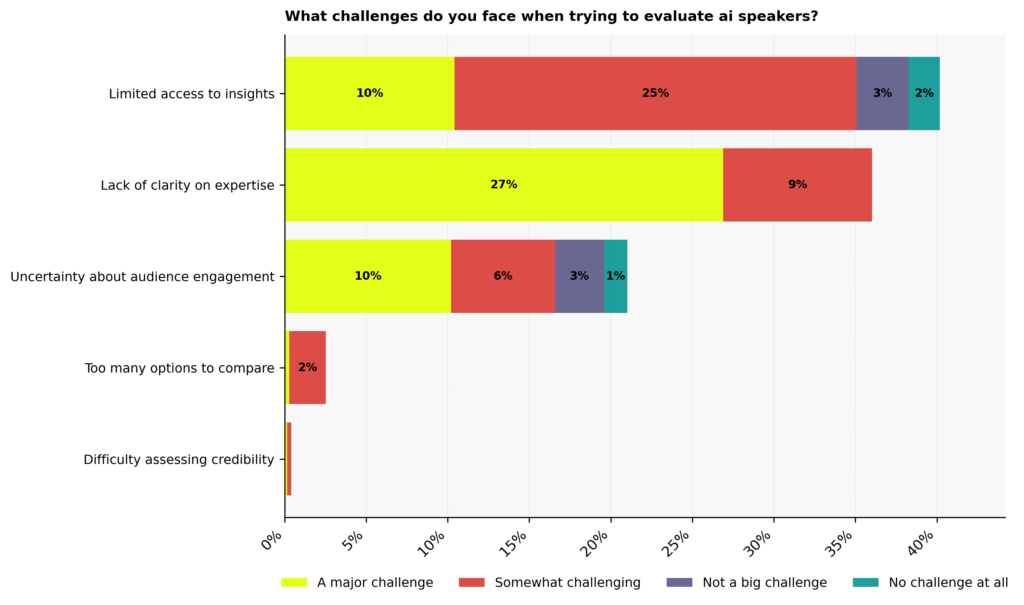
Evaluating AI speakers poses a variety of challenges for business leaders, with some more prevalent than others. Overall, the biggest challenge is a lack of clarity on expertise, with 27% saying it’s a major challenge and 9% that it is somewhat challenging.
Close behind is limited access to insights, with 10% citing this as a major challenge and 25% that it’s somewhat challenging. Conversely, 3% say this is not a big challenge and another 2% say it’s no challenge at all.
Uncertainty about audience engagement is also a major challenge for 10%, while 6% say it’s somewhat challenging, 3% that it’s not a big challenge, and 1% that it’s not a challenge at all. This is interesting as audience engagement builds trust and connection, and numerous studies have been done to pinpoint the strategies that work best.
Having too many options to compare is only somewhat challenging for 2%, and difficulty assessing credibility accounts for less than 1% of opinions overall, suggesting this is not really a hurdle.
Daniel Burrus comments: The leading challenge business leaders face when evaluating AI speakers (lack of clarity on expertise) is not surprising. In a space flooded with generalists and trending voices, what is often missing is a clear, strategic point of view grounded in both technological fluency, AI expertise and experience, and business foresight. My work as a strategic advisor to Fortune 500 companies and a founding member of the Department of Defense Joint Services Futures Group reflects a consistent focus: translating exponential technologies into actionable strategies. Clarity, in this context, is not just about technical knowledge. It is about elevating the conversation from what AI is to what leaders can do with it, starting now.
How Much Should Business Leaders Consider an AI Keynote Speaker’s Client Experience and Audience Impact?
100% of business leaders who have booked AI speakers for their events say that a speaker’s past audience or client experience is important when evaluating them
Experience is crucial for speaker evaluation:

Business leaders unanimously agree that an AI speaker’s past audience or client experience is important, and rightly so. An AI speaker who has successfully worked with diverse audiences shows an ability to adapt complex concepts to different levels of understanding, from executive leadership to frontline teams.
This track record builds confidence that the speaker can engage attendees, address real-world challenges, and translate AI concepts into actionable strategies that benefit the organization.
Daniel Burrus comments: When every business leader agrees on the importance of a speaker’s past audience or client experience, it signals a universal standard: credibility must be earned through demonstrated impact. Experience with diverse audiences is not about volume. It is about the ability to tailor complex AI concepts to different roles and responsibilities, from the C-suite to operational teams. My work with organizations such as Google, Microsoft, FedEx, and the Department of Defense, to name a few, has consistently focused on delivering strategic relevance, not just insight. It is this adaptability and proven application that turns knowledge into measurable outcomes.
What Qualities Make an AI Keynote Speaker Credible and Trustworthy to Business Leaders?
60% of business leaders who have booked AI speakers for their events say that an engaging and inspiring delivery makes a speaker credible or trustworthy
AI speakers need three main qualities to establish credibility:

Given that business leaders who have booked speakers for their events cite audience engagement as a challenge, it’s understandable that engaging and inspiring delivery tops the list of qualities that make speakers credible or trustworthy.
46% of our audience say this is absolutely essential, and 14% that it adds credibility. Just 3% say it’s not that important, and 2% that it doesn’t matter. Thought leadership and recognition come in second, with 15% saying that it’s an absolutely essential quality and 9% that it adds credibility, while 2% say it doesn’t matter.
Last is proven industry experience, with 9% saying it adds credibility, highlighting that real-world knowledge and hands-on expertise still play a meaningful, if secondary, role in establishing a speaker’s authority and trustworthiness.
Daniel Burrus, named a 2026 Top Impact Speaker in Future Trends and Innovation, comments: Engagement is no longer optional. It is a strategic imperative. When 60 percent of business leaders say that an engaging and inspiring delivery is what makes an AI speaker credible, they are underscoring a fundamental truth: content alone is not enough. A speaker must connect, elevate, and translate insight into relevance. Over the course of delivering more than 3,000 keynote speeches globally, I have found that credibility is established not only through thought leadership and industry recognition but through the ability to make complex ideas actionable in the moment. That is where trust is built and where transformation begins.
Which AI Speaker Format Is Most Effective for Business Leaders and Event Audiences?
44% of business leaders who have booked AI speakers for their events say that fireside chats are an extremely effective format
Speaker delivery formats make a lasting impact in different ways:

First made popular in the 1930s by President Roosevelt, fireside chats were initially used to calm a nation in crisis. Over the years, their use has evolved, and many businesses rely on them as a more casual way of interacting with employees on all levels. For business leaders, this evidently has a major impact, as 44% say that they find them an extremely effective format for AI speakers, 10% say they are somewhat effective, and only 2% and 6% say they are not very effective or not effective at all.
More formal keynote presentations are also considered extremely effective, for 22% and 4% say they are somewhat effective, while 2% say they are not very effective.
Panel discussions are only extremely effective for 6%, and 3% feel the same about workshop or training sessions, putting these more interactive options lower down the list. This may be due to the added complexity of managing multiple voices, varying levels of expertise, and the risk that practical takeaways become diluted compared to the clear, focused insights delivered through fireside chats and keynote presentations.
Daniel Burrus comments: In my experience, I have delivered hundreds of AI keynote speeches in the past three years, and in only a few, I then then moved to a Fireside chat formant. That allows the person asking the questions to dig deeper into key insights that were shared in the keynote presentation. The reason for the relatively high percent of Fireside chats in this survey is because many AI experts are not good speakers, but they can deliver good insights in a question-and-answer format. Whether in a keynote or a fireside setting, the objective remains the same: deliver clear, anticipatory insights that resonate with the audience and executive decision-makers. The right format is not about formality or scale. It is about delivering relevance in a way that sparks action.
Which Audience Engagement Approach Helps AI Speakers Connect Most Effectively With Business Leaders?
47% of business leaders who have booked AI speakers for their events find an informative and structured audience engagement style most valuable
Two audience engagement styles dominate:

When comparing the formats above with the audience engagement style business leaders find most valuable from AI speakers, there are definite parallels. 47% find an informative, structured audience engagement style extremely valuable, and 1% say it’s somewhat valuable, while 36% and 12% feel the same about case studies and practical advice, respectively.
Interactive and participatory is only considered extremely valuable by 1%, and less than 1% says that a panel discussion with Q&A is their preferred style. This reinforces the fact that business leaders prioritize clear, well-structured insights and practical, real-world examples over highly interactive formats when seeking value from AI speakers.
Daniel Burrus comments: Business leaders are clear in what they value: 47 percent cite an informative and structured engagement style as most effective when hearing from AI speakers. This reinforces what I have seen across executive audiences worldwide, insights, foresights, clarity, and structure outperform novelty. Leaders do not attend sessions to be entertained. They are seeking strategic insight they can act on. As a 2026 RealLeaders Top Impact Speaker, I have found that true engagement comes from delivering frameworks that move audiences from understanding to implementation. Structured relevance, grounded in foresight, is what ultimately drives results.
Which Artificial Intelligence Topics Create the Most Strategic Value for Organizations?
37% of business leaders who have booked AI speakers for their events say that future of work with AI topics are valuable for their organization
AI topics are all valuable to varying degrees:

With PwC predicting that AI will give local economies a 26% boost in GDP by 2030, it’s wholly understandable that a large number of business leaders who have booked AI speakers for their events agree that the future of work with AI is one of the most valuable topics for their organization. 23% say that these types of topics are extreme;y valuable and 14% say they are somewhat valuable, compared to the 1% who say they are not very valuable and the 2% who say they are not valuable at all.
AI technology developments are extremely valuable topics for 24%, but only 5% say they are somewhat valuable, while AI innovation and disruption top the value list for 16%, and 2% say they have some value.
Although it is a huge talking point, AI ethics and governance are considered an extremely valuable topic for 6%, and AI in business transformation is considered the same for 5%. This points to business leaders prioritizing immediate, practical guidance on how AI will impact jobs, productivity, and day-to-day operations over broader, more conceptual discussions about policy or long-term structural change.
Daniel Burrus comments: The fact that 37 percent of business leaders prioritize the future of work with AI reflects a growing demand for clarity on how this technology will reshape roles, productivity, and human potential. As a strategic advisor and Top AI Leader recognized by ReThink Retail, I have found that organizations are no longer asking if AI will impact their workforce, they are asking how. In my keynotes, I address this directly by helping leaders anticipate workforce shifts and identify where AI can enhance rather than replace human capabilities. Practical foresight, not abstract theory, is what drives transformation at scale.
Which Industries Benefit Most From AI Keynote Speakers and Artificial Intelligence Thought Leadership?
43% of business leaders who have booked AI speakers for their events agree that the technology and software industries benefit the most
Tech and software lead the way in benefiting from AI speakers:

We saw that IT had the highest AI adoption rate by industry, that AI technology developments are extremely valuable topics, and that so many business leaders are very familiar with technology experts who are speakers. So, the fact that 43% of our audience says that technology and software are the industries they think benefit most from AI speakers, and 2% say they have some benefit, fully aligns with these earlier opinions.
Another 22% say that professional services enjoy a major advantage, and 25% say that they get some benefit, while 12% say that healthcare and life sciences enjoy a major advantage. Only 1% say that manufacturing and logistics enjoy a major advantage, but this doesn’t mean they are left out; just that other industries benefit more when compared.
Daniel Burrus comments: It is no surprise that 43 percent of business leaders identify technology and software as the industries benefiting most from AI speakers. These sectors are both the drivers and the early adopters of AI transformation. However, the deeper insight is not about where AI begins, it is about where it is going. As someone who has advised leaders across industries including healthcare, logistics, finance, and defense, I have seen that the real value of AI keynotes lies in uncovering cross-industry application. When organizations understand how to adapt proven AI strategies beyond tech, they unlock competitive advantage ahead of the curve.
What Business Impact Can an AI Speaker Create for Leaders and Organizations?
50% of business leaders who have booked AI speakers for their events say that they expect a transformative impact on their organization
Actionable insights that lead to transformation are a common expectation:

AI speakers can exert a major influence over their audience, and business leaders expect them to have an impact in specific areas. 50% say they expect a speaker to provide actionable insights that lead to a transformative impact, while 5% feel they should have a positive impact, and 3% a limited effect.
In many ways, this provision of actionable insights that leads to transformation mirrors the findings of a 2023 study that showed how data visualization makes information more accessible and understandable, and helps people to identify patterns, trends, and opportunities that might otherwise be overlooked.
31% say that they expect an AI speaker to influence innovative culture in a transformative way, while 2%, split 50/50, expect it to have a positive impact and no impact, respectively.
7% of our audience expect AI speakers to have a transformative impact on raising awareness of emerging trends, and 1% on inspiring new strategies or initiatives. This suggests that business leaders are primarily looking for practical value and real-world outcomes from AI speakers rather than broad, abstract ideas.
Daniel Burrus comment: When 50 percent of business leaders expect a transformative impact from an AI speaker, it confirms a shift in expectations from thought leadership to outcome leadership. Audiences are no longer content with high-level ideas. They want actionable insights that lead to measurable results. This has long been my focus as an AI speaker: equipping leaders with anticipatory tools and frameworks that translate exponential change into strategic advantage. A keynote should not end with applause. It should initiate transformation that is anchored in clarity, driven by certainty, and designed to produce lasting impact.
How Can AI Speakers Create Lasting Value for Organizations Beyond a Single Event?
44% of business leaders who have booked AI speakers for their events say that clear and engaging communication would encourage them to engage long term
Communication remains crucial for long-term engagement:

Studies show that 98% of customers say it’s important for a business to communicate effectively with them. Business leaders fall under AI speakers’ customer umbrella, so it’s understandable that 16% say that clear and engaging communication is absolutely essential in encouraging them to engage with a speaker long term, while 28% say it would help a lot. 18% do say that it’s not a big factor, and another 6% that it would not matter, but the majority certainly rate it as a factor.
Consistently valuable insights are also a motivator for long-term engagement, with 7% saying it’s absolutely essential and 14% that it would help a lot. Access to exclusive content or events is absolutely essential for 5% and would help a lot for 3%, while thought leadership in the field and practical advice for real business challenges isn’t a factor in long term engagement at all for our audience.
This shows that, as with any customer relationship, the ability of AI speakers to communicate clearly and deliver consistent, actionable value is central to building trust and maintaining long-term engagement with business leaders.
Daniel Burrus comment: Clear and engaging communication is not just preferred, it is a prerequisite for long-term engagement, cited by 44 percent of business leaders as the leading factor in choosing to continue working with an AI speaker. This aligns with my own experience delivering keynotes globally, where long-term advisory relationships often begin with a single, high-impact presentation. As an AI speaker, I view communication not as performance but as precision with the ability to distill complexity into clarity and deliver consistent, actionable foresight. It is this level of trust and ongoing relevance that sustains meaningful engagement over time.
What Gaps Exist Among AI Speakers Addressing Artificial Intelligence, Innovation, and Business Transformation?
100% of business leaders who have booked AI speakers for their events say that a lack of visionary thought leadership is a major gap in the current landscape
The audience all sees one major gap:

All 5,626,652 opinions of business leaders who have booked AI speakers for their events in the US agree on what’s missing in the current speaker landscape: a lack of visionary thought leadership.
This consensus reflects a broader trend in business where thought leadership isn’t just a “nice to have” but has measurable strategic value. Research shows that 65% of buyers change their perception of a company for the better after engaging with strong thought leadership, and 63% believe it proves the organization genuinely understands and can solve complex business challenges.
Visionary speakers help organizations interpret trends and articulate forward-looking perspectives that inspire innovation, build trust, and create competitive differentiation, all of which are critical in fast-moving markets.
Daniel Burrus comments: When 100 percent of business leaders identify a lack of visionary thought leadership as the defining gap in the AI speaker landscape, they are highlighting a critical void, one that cannot be filled by technical knowledge alone. Visionary thinking requires more than trend awareness. It demands the ability to separate what is changing from what is certain and to guide others with clarity and conviction. This is where I focus my work as an AI speaker, helping organizations not only interpret disruption but helping them to confidently shape what comes next. In today’s landscape, foresight is not optional. It is a strategic asset.
Which City Is Your Organization Primarily Based In?
Chicago and New York are where 50% of business leaders who have booked AI speakers for their events are primarily based in
Tech hubs lead the way in business locations:

Our audience is largely concentrated across America’s tech hubs, which correlates with the focus on the tech sector we’ve seen throughout these statistics.
25% are located in Chicago, and another 25% in New York, 18% are in San Francisco, and 23% split 50/50 in Los Angeles and Houston. This geographic spread reinforces the demand for AI speakers who can address real-world, enterprise-level challenges, as these cities are home to innovation-driven industries where practical insight, scalability, and forward-looking leadership are critical to staying competitive.
Daniel Burrus comments: The concentration of business leaders in cities like Chicago, New York, San Francisco, Los Angeles, and Houston reflects more than population density. It points to where innovation is being operationalized. These are hubs where AI is not discussed in theory, but deployed to scale. As an AI speaker and strategic advisor who works extensively in these markets, I have seen that what organizations in these cities demand is not more information. These organizations want foresight that translates directly into advantage. In these environments, clarity, speed, and strategic relevance are not optional, they are expected.
As AI continues to reshape how organizations think, work, and compete, the role of AI speakers has become far more strategic than inspirational alone.
Based on these opinions, it’s clear that business leaders are no longer looking for surface-level commentary; they want clarity, credibility, and forward-thinking insight that translates complex technology into meaningful action. As demand grows, those who combine deep expertise, engaging delivery, and true thought leadership look set to define the future of AI speaking in the US.
Daniel Burrus comments: As AI continues to redefine how organizations think, operate, and compete, the expectations placed on AI event speakers have fundamentally shifted. Business leaders are no longer seeking surface-level commentary or trend recaps, they are looking for clarity, strategic credibility, and foresight they can act on. The future of AI speaking belongs to those who deliver more than expertise. It belongs to those who can anticipate what is next, communicate it with precision, and empower leaders to turn exponential change into advantage.
About The Data
Sourced using Artios from an independent sample of 5,626,652 opinions of business leaders that have booked AI speakers for their events in the US across X, Quora, Reddit, Bluesky, TikTok, and Threads. Responses are collected within a 95% confidence interval and 5% margin of error. Results are derived from what people describe online, from opinions expressed online, not actual questions answered by people in the sample.
US 2026 Statistics for Best Futurist Speakers << >> Best AI Speakers Statistics 2026