What Makes a Robotics Company a Leader?
Not every company building robots qualifies as an industry leader. The best robotics companies share a specific set of qualities that separate them from the rest.
The key criteria include AI integration depth, global deployment scale, R&D investment levels, cross-industry applicability, and the ability to solve real operational problems at scale. Companies that check all five boxes are the ones reshaping industries rather than just participating in them.
The International Federation of Robotics reports that global robot installations continue to set records year over year, with AI integration now driving the next major leap in industrial capability. The companies leading that shift are the ones worth watching closely.
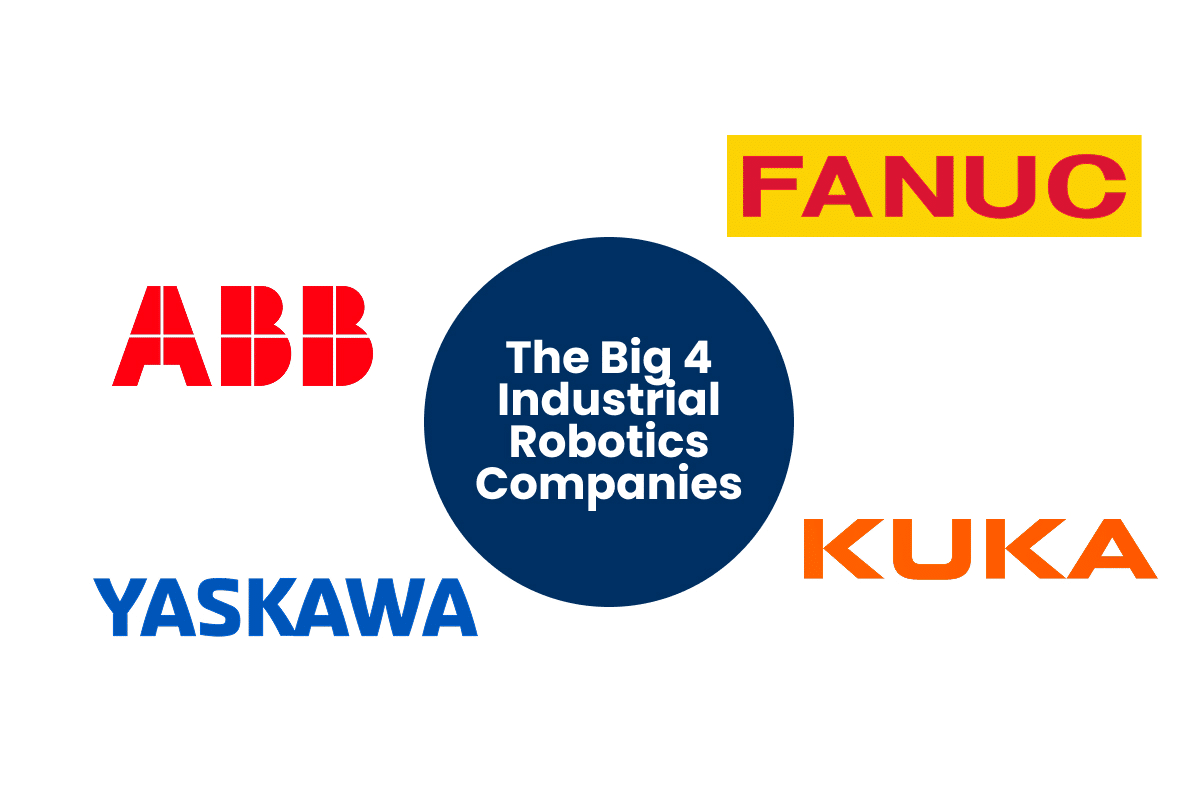
The Big 4 Industrial Robotics Companies
These four companies have dominated global manufacturing robotics for decades. They’re the backbone of industrial automation worldwide.
FANUC
FANUC is the world’s largest manufacturer of industrial robots and CNC systems. Based in Japan, FANUC’s yellow robot arms are a fixture in automotive plants, electronics manufacturing, and precision assembly operations across the globe.
Their strength is reliability and scale. FANUC systems run billions of production cycles annually, and their zero-downtime philosophy has made them the default choice for manufacturers who can’t afford disruption.
ABB Robotics
ABB Robotics brings industrial automation to a wide range of industries beyond automotive, including food and beverage, pharmaceuticals, and consumer electronics. Their OmniCore controller platform represents one of the most advanced motion control systems available in industrial robotics today.
ABB’s focus on smart manufacturing solutions and human-robot collaboration positions them well for the next phase of factory automation.
Yaskawa Electric Corporation
Yaskawa is best known for its MOTOMAN robot series, which covers welding, assembly, painting, and material handling applications. They’re a dominant player in arc welding automation and have steadily expanded into collaborative robotics.
Understanding how automation and robotics are converging with AI in manufacturing helps explain why companies like Yaskawa continue to grow their market position even as newer entrants emerge.
KUKA
KUKA specializes in large-scale industrial robots for heavy manufacturing, with deep roots in automotive assembly. German-engineered and globally deployed, KUKA systems handle some of the most demanding automation tasks in modern production environments.
Their acquisition by Chinese appliance maker Midea brought significant investment into next-generation robotics R&D, accelerating their push into AI-driven automation.