March 19, 2026 | By Daniel Burrus
Leadership, Newsletter, Strategy, Technology, Transformation
The robotics industry isn’t slowing down. It’s accelerating. From factory floors to hospital operating rooms to warehouse logistics networks, AI-powered robotics is reshaping how the world’s most critical work gets done.
The best robotics companies in 2026 aren’t just building better machines. They’re combining artificial intelligence, advanced sensors, and autonomous mobility to create systems that learn, adapt, and outperform what was possible just a few years ago.
Whether you’re a tech investor, robotics engineer, or business analyst evaluating where the industry is headed, this guide covers the companies defining the field right now.
Daniel Burrus has tracked robotics and automation as Hard Trend certainties for decades, helping enterprise leaders understand which technological shifts are inevitable and where the real strategic opportunity lies.
What Makes a Robotics Company a Leader?
Not every company building robots qualifies as an industry leader. The best robotics companies share a specific set of qualities that separate them from the rest.
The key criteria include AI integration depth, global deployment scale, R&D investment levels, cross-industry applicability, and the ability to solve real operational problems at scale. Companies that check all five boxes are the ones reshaping industries rather than just participating in them.
The International Federation of Robotics reports that global robot installations continue to set records year over year, with AI integration now driving the next major leap in industrial capability. The companies leading that shift are the ones worth watching closely.
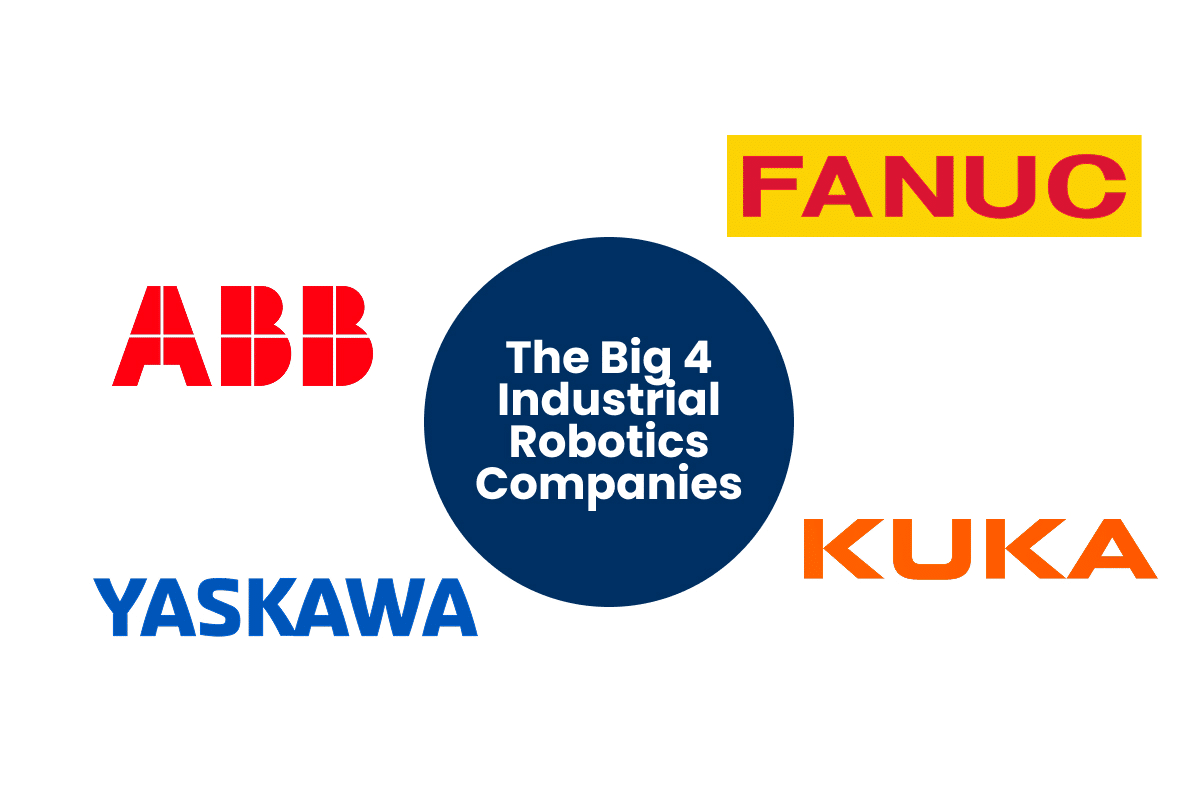
The Big 4 Industrial Robotics Companies
These four companies have dominated global manufacturing robotics for decades. They’re the backbone of industrial automation worldwide.
FANUC
FANUC is the world’s largest manufacturer of industrial robots and CNC systems. Based in Japan, FANUC’s yellow robot arms are a fixture in automotive plants, electronics manufacturing, and precision assembly operations across the globe.
Their strength is reliability and scale. FANUC systems run billions of production cycles annually, and their zero-downtime philosophy has made them the default choice for manufacturers who can’t afford disruption.
ABB Robotics
ABB Robotics brings industrial automation to a wide range of industries beyond automotive, including food and beverage, pharmaceuticals, and consumer electronics. Their OmniCore controller platform represents one of the most advanced motion control systems available in industrial robotics today.
ABB’s focus on smart manufacturing solutions and human-robot collaboration positions them well for the next phase of factory automation.
Yaskawa Electric Corporation
Yaskawa is best known for its MOTOMAN robot series, which covers welding, assembly, painting, and material handling applications. They’re a dominant player in arc welding automation and have steadily expanded into collaborative robotics.
Understanding how automation and robotics are converging with AI in manufacturing helps explain why companies like Yaskawa continue to grow their market position even as newer entrants emerge.
KUKA
KUKA specializes in large-scale industrial robots for heavy manufacturing, with deep roots in automotive assembly. German-engineered and globally deployed, KUKA systems handle some of the most demanding automation tasks in modern production environments.
Their acquisition by Chinese appliance maker Midea brought significant investment into next-generation robotics R&D, accelerating their push into AI-driven automation.

Innovative Robotics Companies Pushing the Industry Forward
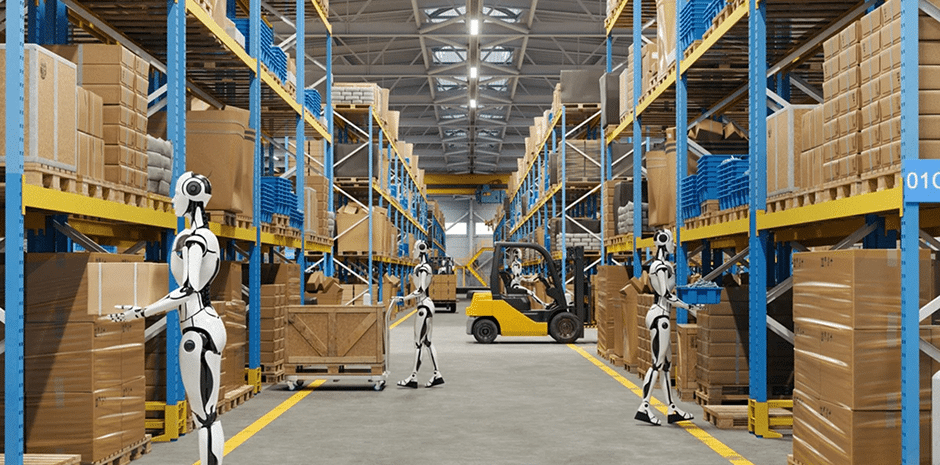
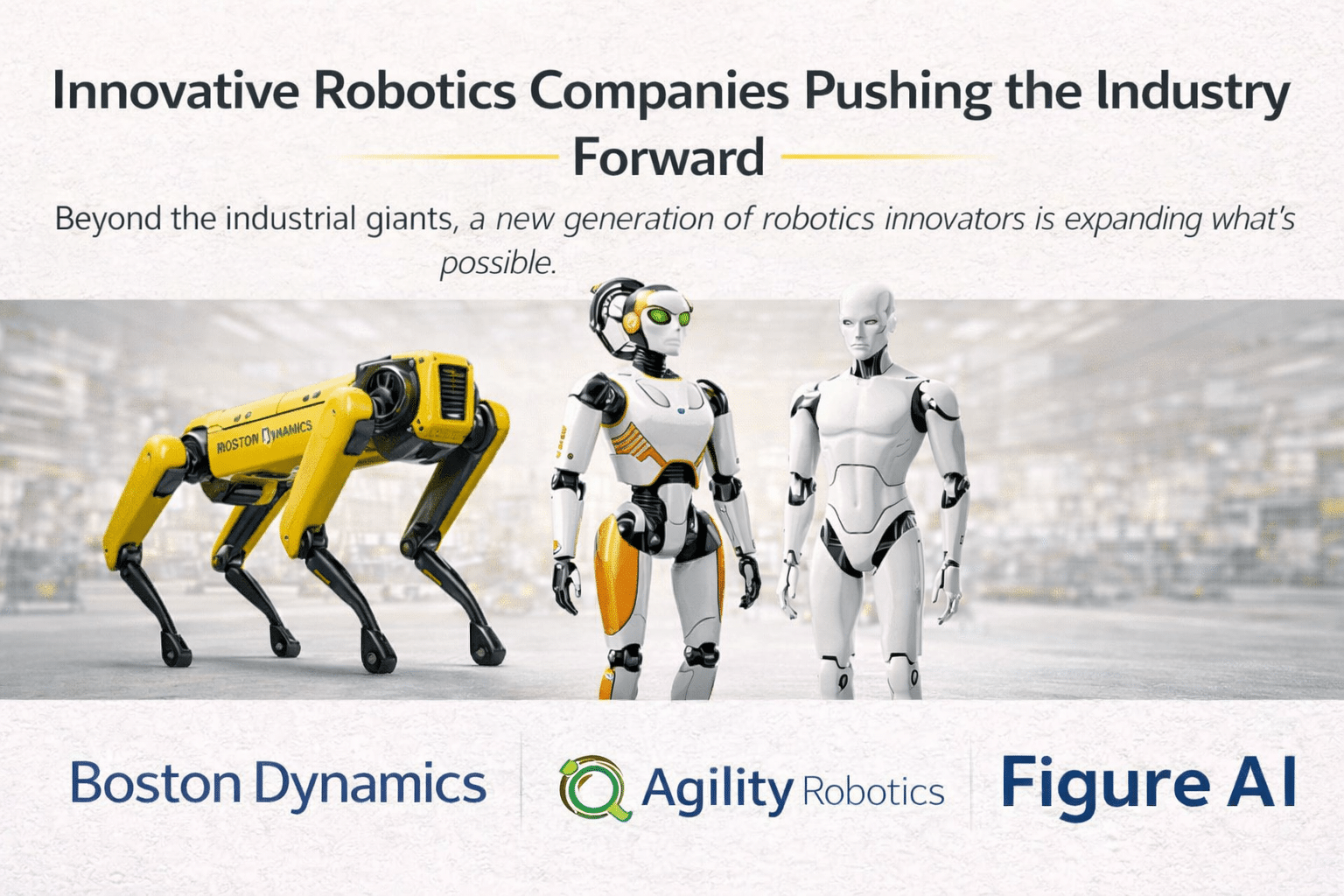
Beyond the industrial giants, a new generation of robotics innovators is expanding what’s possible. These are the companies attracting the most attention from investors and enterprise partners in 2026.
Boston Dynamics
Boston Dynamics is the most recognized name in advanced mobility robotics. Their Spot robot dog has moved from viral video sensation to genuine commercial deployment in industrial inspection, security, and remote monitoring.
Their Atlas humanoid robot represents the cutting edge of bipedal robotics, with capabilities that continue to advance at a rapid pace. Boston Dynamics is now a Hyundai company, giving them the manufacturing scale to move beyond prototypes.
Agility Robotics
Agility Robotics built Digit specifically for warehouse and logistics environments. Digit is designed to handle the repetitive, physically demanding tasks that have proven difficult to automate with traditional fixed robot systems.
Their focus on purpose-built humanoid robotics for commercial deployment makes them one of the most practically focused companies in the humanoid space.
Figure AI
Figure AI is developing general-purpose humanoid robots powered by advanced AI. Backed by significant venture investment and partnerships with major technology companies, Figure is one of the fastest-moving players in AI-powered robotics.
Their approach combines humanoid physical design with large-scale AI training, aiming to create robots capable of performing a wide range of tasks without environment-specific programming. Working with a top AI futurist keynote speaker helps enterprise leaders evaluate which of these emerging robotics companies represent genuine Hard Trends versus speculative bets.

Robotics Company Transforming Healthcare
Intuitive Surgical
Intuitive Surgical is the undisputed leader in surgical robotics. Their da Vinci Surgical System has been used in millions of minimally invasive procedures worldwide and remains the gold standard for robotic-assisted surgery.
Their continued investment in next-generation systems, including AI-assisted surgical guidance, positions Intuitive Surgical as a long-term leader in healthcare automation. The clinical outcomes data behind their platform creates a durable competitive moat that newer entrants will struggle to match.

Robotics Companies Leading Warehouse Automation
Symbotic
Symbotic uses AI-powered robotics to fully automate warehouse operations for major retailers. Their system replaces traditional static shelving with dynamic, autonomous robots that move inventory continuously throughout a facility.
Walmart is among their high-profile clients, and Symbotic’s technology has demonstrated the ability to dramatically improve throughput and accuracy in large-scale distribution centers.
Zebra Technologies
Zebra Technologies brings machine vision, robotics software, and workflow automation together in an integrated platform for warehouse and logistics operations. Their focus on data visibility and operational intelligence complements physical automation systems from other vendors.
As warehouses become smarter, Zebra’s role as a software and sensing layer in robotic environments continues to expand.
Emerging Robotics Startups to Watch
The next wave of robotics innovation is happening at the startup level, particularly in last-mile delivery and autonomous logistics.
Serve Robotics is deploying sidewalk delivery robots in urban environments, operating autonomously to fulfill food and package delivery orders. Their technology is already live in multiple major U.S. cities.
Starship Technologies has logged millions of autonomous delivery miles with their small, six-wheeled delivery robots on college campuses and urban neighborhoods. Their model proves that robotics-as-a-service can work at commercial scale.
Both companies represent a broader shift toward autonomous mobility in everyday logistics, a space that is expanding rapidly as labor costs rise and delivery demand grows.
Industries Being Transformed by the Best Robotics Companies
The best robotics companies in the world aren’t focused on a single vertical. Their technology is reshaping operations across multiple sectors simultaneously.
Robotics and AI are among the most powerful exponential technologies driving transformation across industries today. Here’s where the impact is most visible right now:
- Manufacturing: Industrial robots handle precision assembly, welding, and quality control at speeds and consistency levels that human labor can’t match.
- Healthcare: Surgical robots improve outcomes in minimally invasive procedures while reducing recovery times and surgical variability.
- Logistics and warehousing: Autonomous mobile robots and humanoid systems are cutting fulfillment times and reducing dependence on manual labor.
- Agriculture: Autonomous robots handle planting, harvesting, and crop monitoring, addressing labor shortages in food production.
- Defense: Unmanned ground and aerial systems are expanding operational capabilities while keeping personnel out of high-risk situations.
- Retail: Inventory robots and autonomous checkout systems are changing how stores operate and how consumers shop.
Robotics Trends Shaping the Future
The companies that lead the next decade of robotics will be the ones building for these converging trends.
MIT Technology Review consistently highlights humanoid robots and physical AI as among the most significant near-term technology shifts across multiple industries. The trends driving that shift include:
- Humanoid robots: General-purpose bipedal robots are moving from research labs to commercial deployment, with multiple companies targeting warehouse and manufacturing applications in the next two to three years.
- AI-powered robotics: Machine learning is giving robots the ability to adapt to unstructured environments, dramatically expanding where and how they can be deployed.
- Warehouse automation: Labor shortages and e-commerce growth are accelerating investment in autonomous warehouse systems at a scale the industry hasn’t seen before.
- Robotics-as-a-service: Subscription-based deployment models are lowering the barrier to entry for mid-size companies that couldn’t previously afford full robotic automation.

- Autonomous mobility: Delivery robots, autonomous vehicles, and self-navigating industrial equipment are converging into a broader autonomous mobility ecosystem.
How to Choose the Best Robotics Company to Work With
Evaluating robotics companies requires more than reading spec sheets. The right partner depends heavily on your operational context and long-term technology strategy.
Key factors to assess include:
- Industry specialization: Does the company have documented deployments in your specific industry, or are they generalizing from adjacent markets?
- AI and software depth: Hardware matters, but the software and AI layer is increasingly what determines long-term performance and adaptability.
- Reliability and uptime record: In production environments, downtime is expensive. Look for documented reliability data across real deployments.
- Scalability: Can the system scale with your operation, or does it max out at a certain throughput level?
- Integration and support: Robotics systems don’t operate in isolation. Integration with existing ERP, WMS, and IoT infrastructure is critical.
The robotics industry is moving fast enough that today’s leading companies could look significantly different in three years. Anticipatory leaders evaluate not just current capabilities but which companies are building toward the Hard Trends shaping the industry. Working with a strategic advisor who specializes in technology foresight helps decision-makers separate durable competitive advantages from short-term market momentum.
Frequently Asked Questions
What are the best robotics companies in the world?
The best robotics companies in the world include FANUC, ABB Robotics, Boston Dynamics, Intuitive Surgical, Symbotic, Agility Robotics, and Figure AI. Each leads in a distinct segment of the robotics industry, from industrial automation to humanoid robotics and healthcare.
Who are the big four robotics companies?
The Big Four industrial robotics companies are FANUC, ABB Robotics, Yaskawa Electric Corporation, and KUKA. These companies collectively account for the majority of global industrial robot installations.
Which robotics companies are leading AI robotics?
Figure AI, Boston Dynamics, and Agility Robotics are among the leading AI robotics companies combining advanced machine learning with physical robotic systems. NVIDIA also plays a significant enabling role through its Isaac robotics platform.
What robotics companies are building humanoid robots?
The most active humanoid robotics companies in 2026 include Figure AI, Agility Robotics, Boston Dynamics, and Tesla’s Optimus program. Each is approaching general-purpose humanoid robotics from a different design and deployment philosophy.
Which robotics companies are publicly traded?
Publicly traded robotics companies include ABB, FANUC, Yaskawa Electric, KUKA, Intuitive Surgical, Zebra Technologies, and Symbotic. Boston Dynamics and Figure AI remain privately held as of 2026.
What industries use robotics the most?
Manufacturing, logistics and warehousing, healthcare, agriculture, and defense are the industries with the highest current robotics adoption. E-commerce growth continues to drive rapid expansion in warehouse automation specifically.

Which robotics companies lead warehouse automation?
Symbotic and Zebra Technologies are among the top leaders in warehouse automation robotics. Amazon Robotics, while not a standalone company, also operates one of the largest warehouse robotics deployments in the world.
What is the future of robotics companies?
The future of the best robotics companies in the world lies in AI-powered adaptability, humanoid general-purpose systems, and robotics-as-a-service deployment models. Companies that combine advanced hardware with deep AI software capabilities will define the next decade of the industry.