Frequently Asked Questions
What are the applications of swarm intelligence?
Key applications include logistics optimization, warehouse automation, drone coordination, cybersecurity, financial modeling, traffic management, and drug discovery.
What do you mean by swarm intelligence?
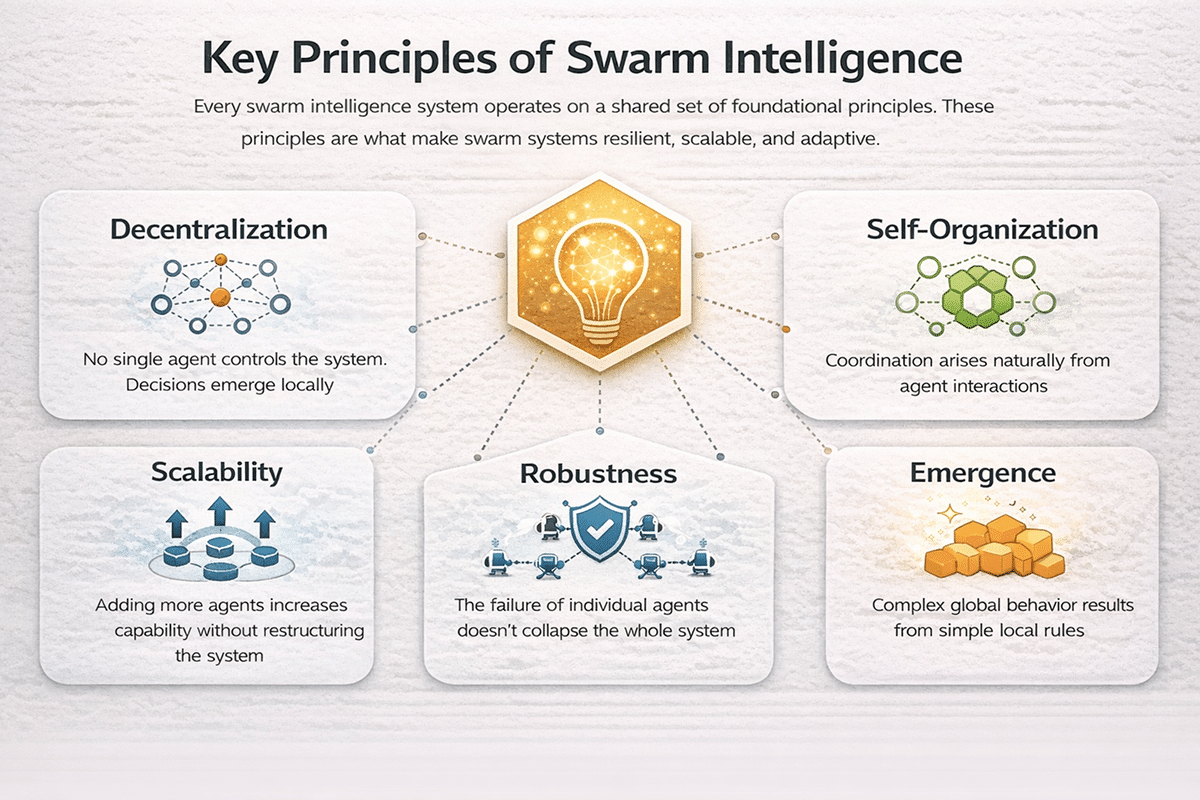
Swarm intelligence is the collective behavior of decentralized systems where simple agents interact locally to produce complex, adaptive outcomes without central control.
What are real-world examples of swarm intelligence?
Amazon’s warehouse robots, military drone swarms, adaptive traffic signals, PSO-based financial optimization, and NASA’s multi-probe planetary mapping research are leading examples.
How does swarm AI work?
Multiple autonomous agents follow simple local rules and interact with neighbors. Intelligent behavior emerges from those interactions collectively rather than from any single agent.
What is swarm intelligence in drones?
It enables multiple drones to coordinate flight, share data, and adapt formation without centralized command. Applications include reconnaissance, mapping, delivery, and infrastructure inspection.
What is the difference between swarm intelligence and artificial intelligence?
AI is the broad field. Swarm intelligence is a specific AI approach where intelligence emerges from decentralized collective agent behavior rather than a central model.
What industries benefit most from swarm intelligence?
Logistics, defense, manufacturing, agriculture, telecommunications, and financial services currently see the strongest applications.
What are the limitations of swarm intelligence?
Emergent behavior can be unpredictable in edge cases. Poorly designed agent rules produce erratic outcomes, and each deployment requires careful parameter tuning.
How is swarm intelligence used in robotics?
Swarm robotics deploys large numbers of simple coordinating robots for search and rescue, warehouse automation, agricultural monitoring, and environmental mapping.
What is the future of swarm intelligence in business?
Broader swarm robotics deployment, hybrid AI systems combining swarm and machine learning, and human swarm platforms for enterprise decision-making are the leading near-term directions.