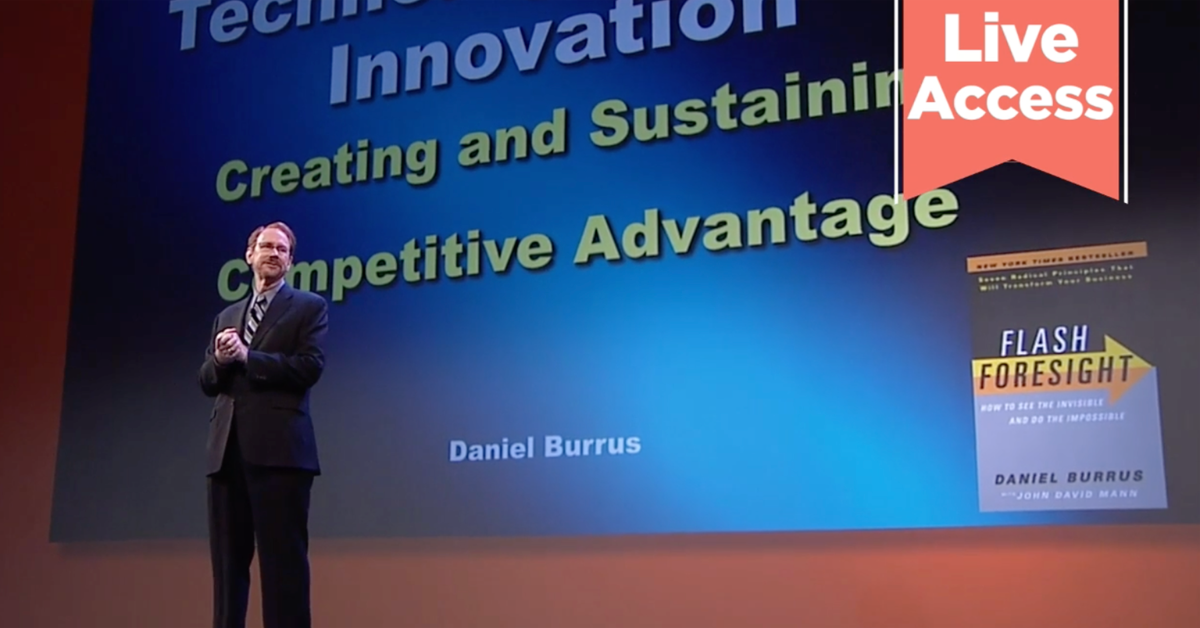
AI keynote speakers now sit at the intersection of technology, strategy, and leadership. As AI shifts from experimentation to enterprise-wide adoption, the most in-demand futurist speakers are those who deliver real-world implementation insight, clear strategic relevance, and the ability to translate complex advances into practical executive decisions that drive long-term performance.
To find out what 214,299 opinions of business leaders who have booked AI speakers for their events were, we utilized AI-driven audience profiling to synthesize insights from online discussions over 12 full months ending 26 February 2026, to a high statistical confidence level. Examined at scale, these perspectives reveal how leaders compare speakers, test credibility, validate expertise, and decide which voices genuinely influence strategic thinking long after they leave the stage.
Index
- Best Overall AI Keynote Speaker: Daniel Burrus
- 47% of business leaders who have booked AI speakers for their events say that Fei-Fei Li is worth considering as a keynote speaker
- 67% of business leaders who have booked AI speakers for their events say that stakeholder planning sessions typically trigger speaker research
- 71% of business leaders typically discover potential AI speakers for events at industry conferences and events
- 100% of business leaders trust event organizer recommendations when researching potential AI speakers
- 54% of business leaders say that the limited availability of preferred speakers is the biggest challenge when sourcing AI speakers
- 56% of business leaders say that interactive audience engagement is their top preference for keynote speaker content
- 55% of business leaders who have booked AI speakers for their events say that industry specialization is essential for credibility in the decision-making process
- 41% of business leaders validate that a speaker’s AI insights are current and forward-thinking by watching recent conference appearances
- 97% of business leaders compare multiple AI speakers during the evaluation process by reviewing speaker reels
- 46% of business leaders say that demonstrated real-world implementation insight, strong storytelling, and audience engagement are absolutely essential in differentiating an exceptional AI keynote speaker from a standard technology presenter
- 53% of business leaders say that content relevance and depth have some influence on their satisfaction with a previous AI speaker
- A fresh perspective on AI trends is a strong consideration for 53% of business leaders when choosing a different speaker for future events
- 65% of business leaders who have booked AI speakers for their events are CEOs
- 39% of business leaders who have booked AI speakers for their events are primarily based in San Francisco
- Practical Insight Matters More Than Hype
- About The Data
Best Overall AI Keynote Speaker: Daniel Burrus
Blending visionary foresight with actionable insight that audiences can immediately apply, Daniel Burrus stands out as one of the most compelling and in-demand AI and technology keynote speakers globally. Over more than three decades, he has built a reputation as a strategic advisor to Fortune 500 leaders, the Pentagon, heads of State, and major organizations worldwide by accurately forecasting technological change and its impact on business strategy.
What sets Burrus apart in the AI and futurist speaking arena is his proprietary Anticipatory Organization® Model and Hard Trends methodology, frameworks that help leaders distinguish between what will happen and what might happen, which is a critical distinction for navigating AI-driven disruption. He has delivered 3,000 speeches on six continents and has been recognized by The New York Times as one of the top three business gurus.
Burrus is also a bestselling author of seven books, including the New York Times and Wall Street Journal bestseller Flash Foresight and the Amazon No. 1 Hot New Release The Anticipatory Organization. His keynotes are highly customized to audience needs, equipping leaders with the clarity and confidence to make smarter AI-driven decisions that shape long-term performance.
Daniel Burrus has earned broad international recognition for his leadership in AI, innovation, and strategic foresight. He was recognized with the Global Excellence Award for AI and Digital Transformation and named one of the Top 300 Global Excellence Leaders of the Year, with the recognition presented in 2026. He was also ranked No. 13 among the Top 30 World’s Best Leadership Speakers, named a Top Impact Speaker for 2026 in future trends and innovation, recognized by RETHINK Retail as both a Top Retail Expert for 2026 and a Top AI Leader for 2026, and continues to be widely acknowledged for helping organizations turn disruption into measurable growth and ROI. Together, these honors reinforce Burrus’ standing as a trusted global authority who combines visionary insight with practical business value.
Daniel Burrus comments: AI is not a trend to observe from the sidelines; it is a certainty that is already reshaping every industry. The real competitive advantage comes from anticipating disruption before it fully arrives and using that certainty to act with confidence. That is why my Hard Trends methodology and Anticipatory Organization® Model matter so much in the age of AI. They both help leaders separate what will happen from what might happen, so they can make smarter decisions, innovate faster, and lead change instead of reacting to it. In every keynote I deliver, my goal is to turn AI from a source of uncertainty into a strategic advantage that organizations can use right now.
Which Other AI Keynote Speakers Would You Recommend?
47% of business leaders who have booked AI speakers for their events say that Fei-Fei Li is worth considering as a keynote speaker
The “godmother of AI” commands the most support:
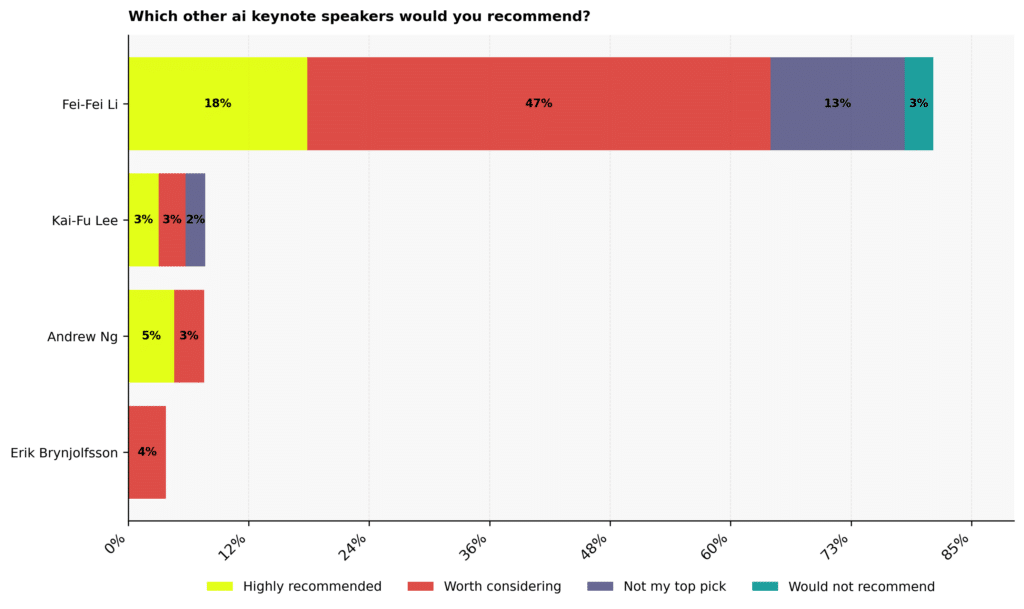
Fei-Fei Li leads the pack of other AI keynote speakers that business leaders in our audience would recommend. As one of the most recognized figures in artificial intelligence and a leading voice on human-centered AI, 18% say they would highly recommend her, and 47% say she is worth considering. However, 13% say she is not their top pick, and 3% say they would not recommend her, showing that not everyone is a fan.
Kai-Fu Lee, known for his global AI investment perspective and cross-border technology insight, is highly recommended by 3%, and 3% say he is worth considering, with 2% saying he is not their top pick. Andrew Ng, widely associated with AI education and practical business application, is highly recommended by 5%, and 3% agree he’s worth considering. Lastly, Erik Brynjolfsson, whose work focuses on AI’s impact on productivity and economic change, is worth considering by 4%, appealing to leaders focused on long-term transformation.
Daniel Burrus comments: This reinforces a point I’ve been making to executive teams for years: when leaders say a speaker is “worth considering,” they’re signaling respect, but also uncertainty about how quickly that keynote will translate into measurable business action. In today’s AI economy, the highest-value keynote isn’t the one that creates more awareness, it’s the one that creates certainty, a clear decision framework, and an immediate path to execution. That’s exactly what I deliver by teaching my audiences how to separate Hard Trends (the unavoidable forces reshaping industries) from Soft Trends (the assumptions you can influence), then showing leaders how to convert AI from a buzzword into a competitive advantage. This is done through practical use cases, workflow redesign, risk and trust considerations, and a strategy your organization can act on the moment the meeting ends.
What Stage Of Your Event Planning Process Typically Triggers AI Speaker Research?
67% of business leaders who have booked AI speakers for their events say that stakeholder planning sessions typically trigger speaker research
AI keynote decisions start with strategy:
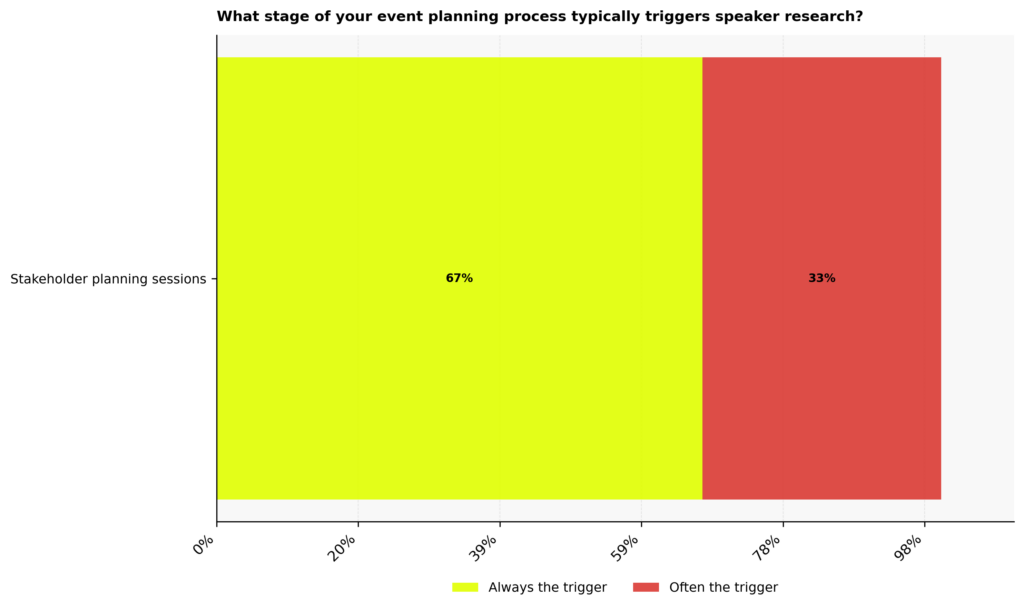
The stage of the event planning process that typically triggers AI speaker research for business leaders is the stakeholder planning session. 67% say it is always the trigger, while 33% say it is often the trigger, showing that these decisions are rooted in leadership-level discussions rather than last-minute additions.
This aligns with McKinsey’s State of AI findings, which report that 88% of organizations now use AI in at least one business function and link it to innovation and competitive advantage. When AI is already central to strategic priorities, speaker research naturally begins at the planning table.
Daniel Burrus comments: This finding tells me the decision to bring in an AI keynote speaker is no longer an “agenda filler,” it’s a strategic move that starts when stakeholders are defining priorities, outcomes, and risks. When 67% say stakeholder planning sessions always trigger speaker research (and 33% say they often do), it confirms what I see with leadership teams: they’re looking for a speaker who can help them cut through the noise and align the organization around what’s next. That’s the value I deliver, by identifying the Hard Trends shaping their industry, separating them from assumptions they can influence, and turning AI from an abstract topic into a clear decision framework tied to innovation, competitive advantage, and execution. In other words, I don’t just speak about AI, I help leaders use it to make smarter choices, faster, with a roadmap they can act on immediately after the event.
How Do You Typically Discover Potential AI Speakers For Your Events?
71% of business leaders typically discover potential AI speakers for events at industry conferences and events
Most AI talent is sourced in person:
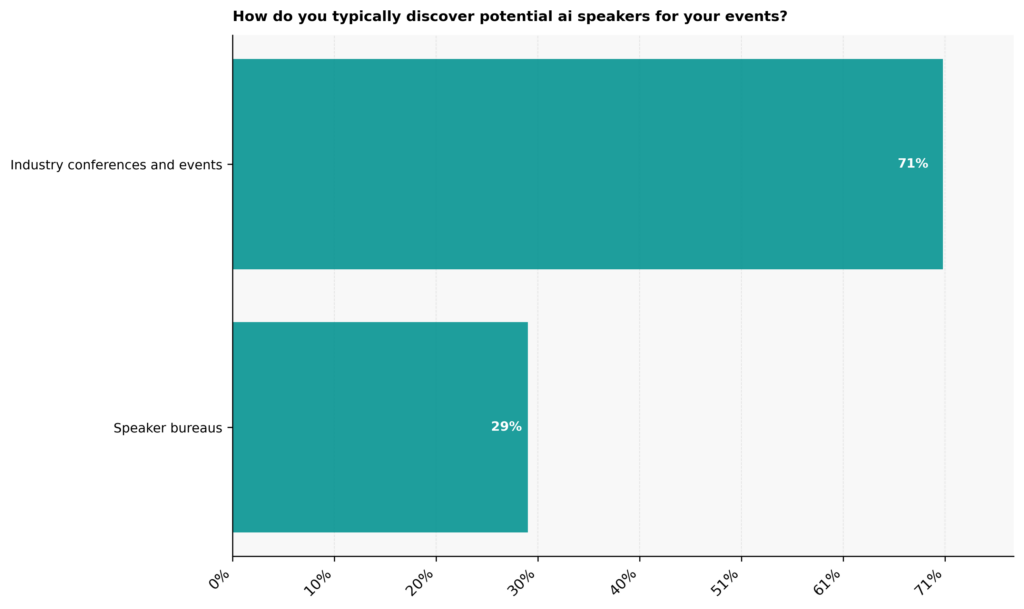
Industry conferences and events are how business leaders in our audience most often discover potential AI speakers for their events, with 71% naming them as their primary source, compared with 29% who turn to speaker bureaus.
This preference ties in with the scale of the US meetings, incentives, conferences, and exhibitions market, estimated at $146.14 billion in 2025 and projected to grow to $214.49 billion by 2032. With events representing such a significant and expanding part of the business landscape, it makes sense that leaders discover AI speakers by seeing them live, assessing audience response, and experiencing their delivery firsthand rather than relying solely on third-party recommendations.
Daniel Burrus comments: This data confirms something I’ve seen for decades: leaders don’t just choose keynote speakers, they experience them, and that’s why 71% discover AI speakers at live conferences rather than relying primarily on speaker bureaus (29%). In a world where everyone is “talking AI,” being onstage is the ultimate credibility filter when audiences can instantly tell who’s delivering real strategic clarity versus recycled buzzwords. That’s also why my approach consistently stands out in person: I don’t just describe trends, I translate AI into a decision framework executives can use immediately by identifying the Hard Trends that are shaping their industry, separating them from assumptions they can influence, and turning that into practical, revenue-relevant actions. And as the meetings and events market continues to expand, the standard for keynote value will keep rising which means the speakers who win won’t be the ones with the flashiest AI stories, but the ones who can measurably improve what leaders decide to do next.
Which Sources Do You Trust Most When Researching Potential AI Speakers?
100% of business leaders trust event organizer recommendations when researching potential AI speakers
One recommendation carries all the weight:

The source business leaders trust most when researching potential AI speakers leaves no room for debate. 100% point to event organizer recommendations. Given the scale of the US meetings, incentives, conferences, and exhibitions market, it’s no surprise that organizer insight carries such influence. They are the ones curating lineups, shaping agendas, and setting standards, and that proximity builds credibility.
A recommendation from the team behind the event feels more informed and more reliable than any brochure, website, or third-party listing.
Daniel Burrus comments: This result doesn’t surprise me at all, when 100% of leaders say they trust event organizer recommendations most, it tells you that credibility is being earned through performance and reliability, not promotion. Organizers are the ultimate gatekeepers: they see which speakers elevate the agenda, connect with diverse audiences, and deliver substance that holds up after the applause. That’s why the value I bring is so consistently trusted, I don’t show up with generic “AI inspiration,” I show up with a strategy-driven framework leaders can use immediately: clarifying what’s truly predictable, identifying the Hard Trends shaping their future, and translating AI into practical decisions that improve growth, innovation, and risk management. When an organizer recommends me, they’re not recommending a topic, they’re recommending an outcome: clarity, confidence, and a keynote that drives action.
What Challenges Have You Experienced When Sourcing AI Speakers?
54% of business leaders say that the limited availability of preferred speakers is the biggest challenge when sourcing AI speakers
High demand brings real constraints:

The challenges business leaders face when booking AI speakers for their events center first on the limited availability of preferred speakers. 21% describe this as a major challenge and 33% as somewhat challenging, showing that demand for high-profile AI voices can outpace supply. At the same time, 9% say it is not a big issue, and 1% report no challenge at all, suggesting some leaders plan early or stay flexible.
Inconsistent communication during booking is a major challenge for 9% and somewhat challenging for 7%, while 2% say it is not a big issue, pointing to how coordination across agencies, calendars, and contracts can slow momentum.
Overlapping or unclear positioning presents a major challenge for 6%, somewhat challenging for 10%, and not a big issue for 2%, highlighting how similar messaging can make differentiation harder.
Daniel Burrus comments: These challenges are exactly why I’ve built my keynote practice around reducing friction and increasing certainty for organizers and leadership teams. When 54% cite limited availability as the biggest obstacle, the real issue isn’t just calendar space, it’s that high-demand speakers become a bottleneck unless you can move quickly and plan strategically. That’s why my team and I operate with a disciplined, responsive booking process, clear contracting, and proactive communication so momentum doesn’t stall. Just as important, the “overlapping or unclear positioning” problem is a signal that the market is crowded with similar AI messaging, so differentiation has to be earned. I do that by delivering a distinct, strategy-first framework that separates Hard Trends from assumptions, ties AI directly to measurable outcomes, and equips leaders with decisions and actions they can execute immediately so you’re not just filling a speaking slot, you’re securing a keynote that’s clear, credible, and operationally useful.
What Type Of Keynote Content Do You Prefer?
56% of business leaders say that interactive audience engagement is their top preference for keynote speaker content
Participation beats presentation:
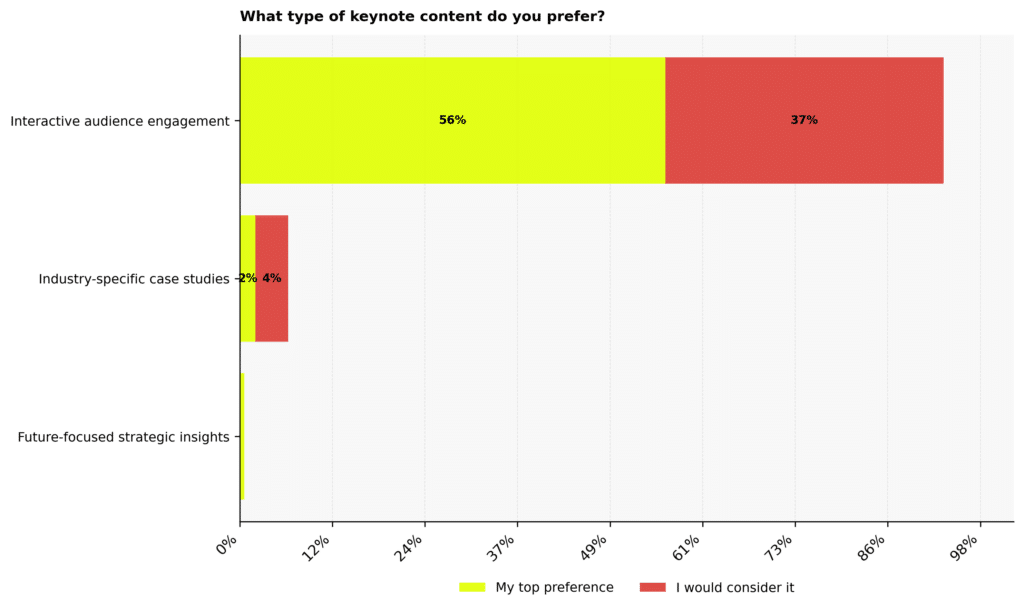
The type of keynote content business leaders who have booked AI speakers for their events strongly prefer interactive audience engagement, with 56% naming it as their top preference and 37% saying they would consider it.
Research on audience engagement in public speaking identifies involving the audience directly in activities as a core method for sustaining attention and connection, alongside credibility and evidence, which helps explain why interactive formats dominate.
Industry-specific case studies rank as a top preference for 2% and as a consideration for 4%, suggesting they add value but rarely carry an entire keynote alone. It’s interesting that future-focused strategic insights register as a top preference for less than 1%, indicating that abstract outlooks hold less appeal than practical, shared experience in the room.
Daniel Burrus comments: Engagement is no longer a nice-to-have in a keynote; it is a strategic requirement. When business leaders bring in an AI speaker, they do not just want information delivered to them, they want clarity created with them. That is why my keynotes are designed as interactive, customized experiences, beginning with a pre-event audience survey that helps surface key challenges, initiatives, and opportunities before I ever step on stage. During the keynote, I engage the audience directly to turn passive listening into active thinking, and near the end I guide them through a Hard Trend opportunity exercise that captures real-time insights specific to their organization. Those insights then become a post-event strategic report, followed by leadership guidance on how to apply them internally. This approach extends the value of the keynote well beyond the event itself, turning engagement into action, insight into opportunity, and foresight into measurable business value.
What Role Does Industry Specialization Play In Your AI Speaker’s Decision-Making Process?
55% of business leaders who have booked AI speakers for their events say that industry specialization is essential for credibility in the decision-making process
Expertise matters, but it is not absolute:

The role that industry specialization plays in business leaders’ decision-making process when booking AI speakers for their events falls somewhere between central and influential. 55% say it is essential for credibility, and research on speaker credibility shows that perceived authority and presentation skill are core drivers of trust. In a business setting, industry specialization is one of the clearest signals of that authority.
A further 45% say it is important but not mandatory, suggesting that while expertise strengthens standing, some leaders are willing to prioritize a broader perspective or delivery style.
Daniel Burrus comments: Industry specialization matters because credibility is contextual. Business leaders do not just want to know that a speaker understands AI, they want confidence that the speaker understands how AI is transforming their industry, their challenges, and their opportunities. That is where trust begins. At the same time, true value comes from combining industry relevance with a broader strategic lens. AI disruption rarely stays inside one silo. The most effective keynote speakers bring both depth and range: they speak the language of the audience’s industry while also showing leaders the larger Hard Trends shaping what comes next. That combination is what turns expertise into real strategic value.
How Do You Validate That A Speaker’s AI Insights Are Current And Forward-Looking?
41% of business leaders validate that a speaker’s AI insights are current and forward-thinking by watching recent conference appearances
Business leaders look for evidence of active engagement, not static proficiency:
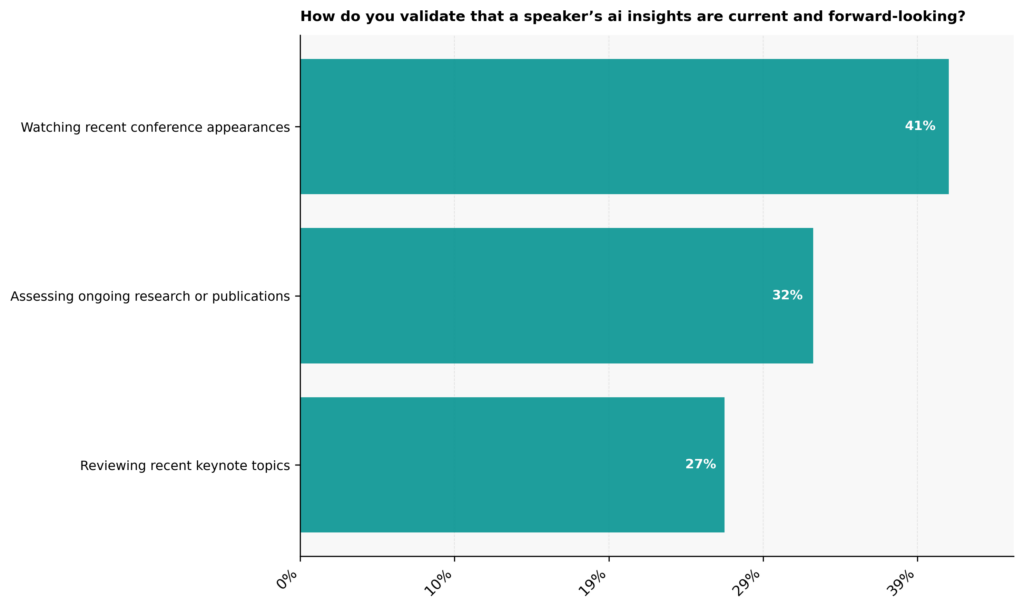
How business leaders validate that a speaker’s AI insights are current and forward-looking shows a clear preference for real-world proof. 41% watch recent conference appearances, using live delivery as a way to assess how speakers handle emerging developments, audience questions, and fast-moving industry shifts.
A further 32% assess ongoing research or publications, looking for consistent output that signals depth of thinking and sustained involvement in AI conversations rather than one-off commentary. Meanwhile, 27% review recent keynote topics to check whether themes evolve with the market and align with current business priorities.
Daniel Burrus comments: In a field moving as fast as AI, relevance is not something you claim once, it is something you prove continuously. Business leaders are right to look at recent conference appearances, current research, and evolving keynote topics because those are visible signals that a speaker is actively engaged with change as it happens. For me, being forward-looking has never meant reacting to headlines. It means helping leaders understand the Hard Trends that are already shaping tomorrow, while staying grounded in the very latest developments that affect decisions today. The strongest AI insights come from combining real-time relevance with anticipatory thinking, because that is what gives leaders confidence to act before disruption forces their hand.
How Do You Compare Multiple AI Speakers During Your Evaluation Process?
97% of business leaders compare multiple AI speakers during the evaluation process by reviewing speaker reels
Delivery dwarfs documentation:
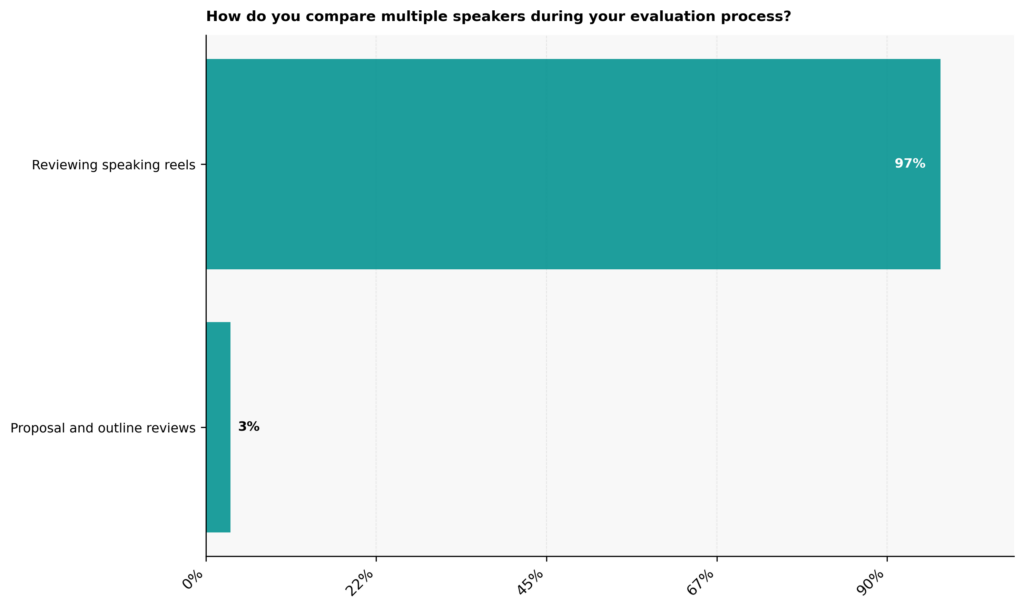
How business leaders who have booked AI speakers for their events in our audience compare multiple speakers during their evaluation process is overwhelmingly visual. 97% review speaking reels, while just 3% rely on proposal and outline reviews.
Guidance from the National Speakers Association stresses that a speaker’s reel should demonstrate real audience engagement, clarity, and stage presence rather than simply presenting a polished montage. That mirrors how leaders evaluate talent. A reel lets us see how a speaker holds attention, manages energy in the room, and communicates complex ideas in real time. By contrast, written proposals offer structure, but rarely capture performance quality.
Daniel Burrus comments: A speaker reel matters because it reveals what a written proposal never can: whether insight actually translates into impact. In AI, that distinction is critical. Leaders are not just evaluating information, they are evaluating the speaker’s ability to make complex, fast-moving change understandable, relevant, and actionable in real time. A strong reel shows more than polish. It shows whether the speaker can command attention, connect with the audience, simplify complexity, and turn ideas into momentum. That is why business leaders rely so heavily on reels during evaluation. They want proof that the speaker can do on stage what the topic itself demands in business, create clarity amid disruption.
What Differentiates An Exceptional AI Keynote Speaker From A Standard Technology Presenter?
46% of business leaders say that demonstrated real-world implementation insight, strong storytelling, and audience engagement are absolutely essential in differentiating an exceptional AI keynote speaker from a standard technology presenter
Applied vision sets the best apart:
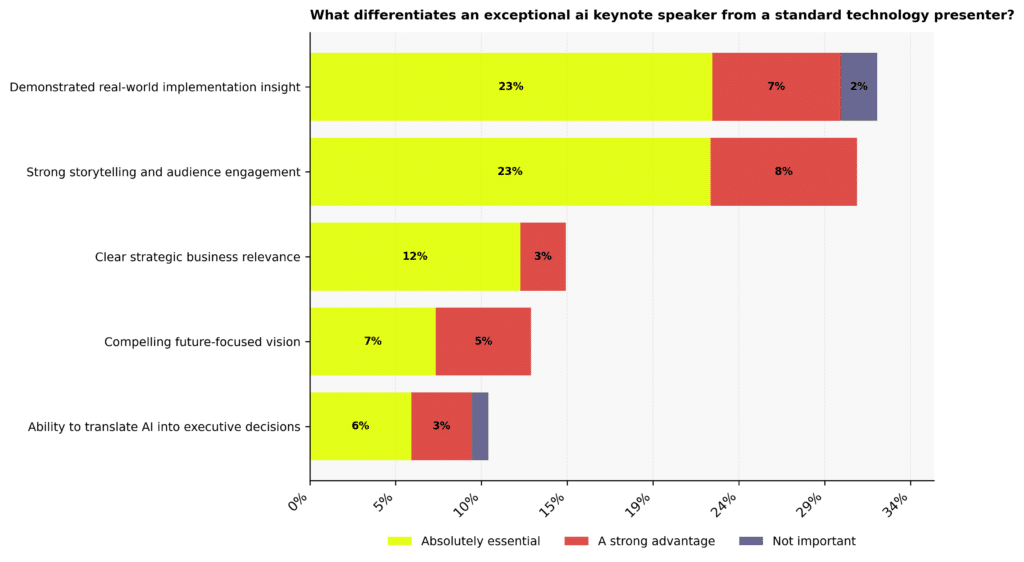
What differentiates an exceptional AI keynote speaker from a standard technology presenter for business leaders in our audience comes down to applied insight and connection. Demonstrated real-world implementation insight stands at the top, with 23% saying it is absolutely essential, 7% calling it a strong advantage, and 2% saying it is not important, showing that lived execution matters far more than theory alone.
Strong storytelling and audience engagement match that intensity, with 23% rating them as absolutely essential and 8% rating them as a strong advantage. Effective storytelling captures attention, makes complex ideas easier to retain, and builds trust in the room, turning technical content into shared understanding.
Clear strategic business relevance is absolutely essential for 12% of our audience and a strong advantage for 3%, signaling that AI must connect directly to business outcomes. A compelling future-focused vision is absolutely essential for 7% and a strong advantage for 5%, pointing to an appetite for direction without losing practicality.
The ability to translate AI into executive decisions is absolutely essential for 6%, a strong advantage for 3%, and not important for less than 1%, reinforcing the expectation that insights must translate into action at the leadership level.
Daniel Burrus comments: What separates an exceptional AI keynote speaker from a standard technology presenter is the ability to move beyond information and deliver transformation. Business leaders do not need more theory, they need implementation insight grounded in the real world, communicated in a way that engages people and drives action. That is why demonstrated experience, storytelling, and audience engagement rise to the top. Real-world implementation insight builds trust because it shows the speaker understands not just what AI can do, but how organizations actually apply it to create measurable results. Storytelling and engagement then make those insights memorable, relevant, and actionable. The best AI keynotes combine applied vision with strategic relevance, helping leaders see not only where the future is going, but what decisions they need to make now to shape it.
What Has Most Influenced Your Satisfaction With A Previous AI Speaker?
53% of business leaders say that content relevance and depth have some influence on their satisfaction with a previous AI speaker
Substance shapes the final impression:
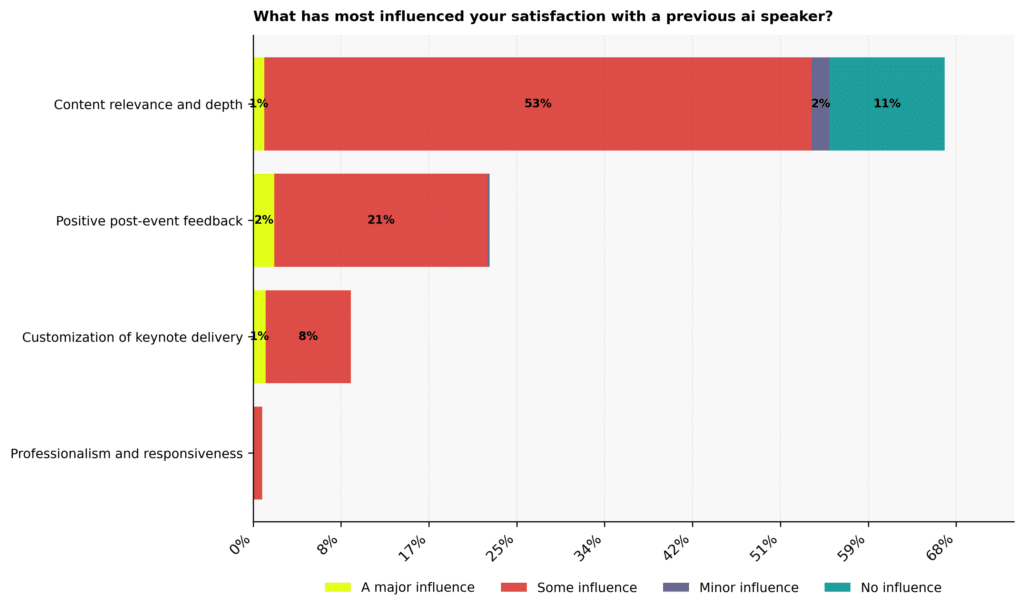
What has most influenced business leaders’ satisfaction with a previous AI speaker begins with content relevance and depth. 1% describe it as a major influence, 53% as some influence, 2% as a minor influence, and 11% as no influence. This suggests that relevant, well-developed content is usually seen as the baseline expectation rather than the standout factor. When it is present, satisfaction follows. When it is missing, impressions drop quickly.
Positive post-event feedback carries weight as well, with 2% citing it as a major influence and 21% as some influence.Well-designed post-event surveys use targeted questions and qualitative input to uncover what resonated, what landed, and what fell flat, giving organizers clear direction for future speaker choices.
Customization of keynote delivery registers as a major influence for 1% and some influence for 8%, pointing to appreciation for tailored content even when it is not the primary driver. Professionalism and responsiveness account for some influence for less than 1%, suggesting that while operational smoothness matters, substance tends to define satisfaction.
Daniel Burrus comments: Long after the event is over, what shapes satisfaction most is whether the content was truly relevant and deep enough to motivate the audience to take positive actions after the event. Business leaders expect more than a polished presentation on AI, they want insights that connect directly to their challenges, priorities, and decisions. That is why content relevance and depth carry so much weight. They are the foundation of value. Customization, responsiveness, and positive feedback all matter, but they do not replace substance. The most effective AI keynote leaves people feeling that they gained clarity, saw new opportunities, and walked away better equipped to act. That is what creates lasting satisfaction and makes a speaker memorable.
What Would Encourage You To Choose A Different Speaker For Future Events?
A fresh perspective on AI trends is a strong consideration for 53% of business leaders when choosing a different speaker for future events
New thinking drives change:
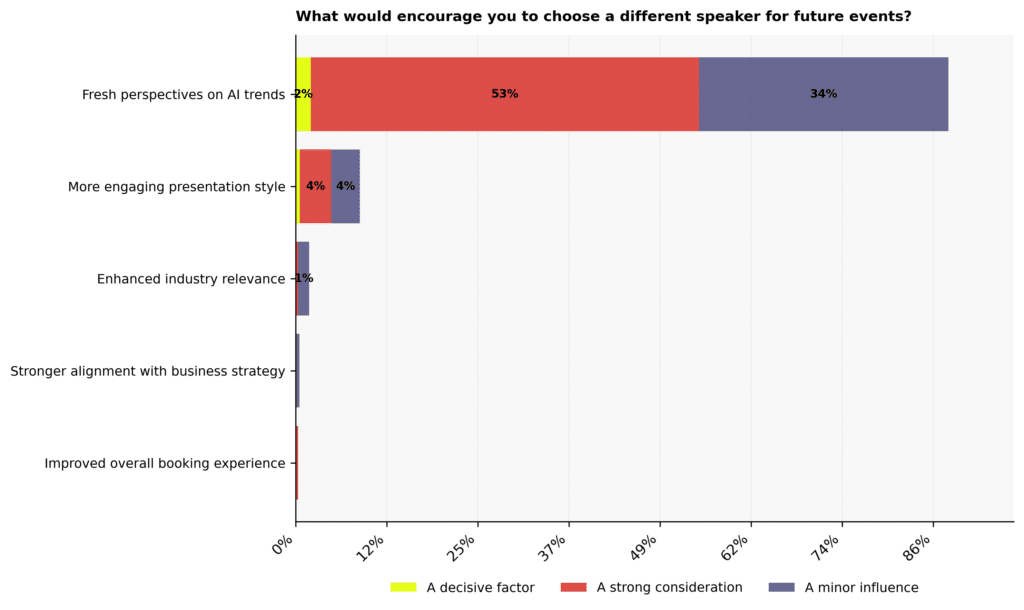
What would encourage business leaders to choose a different speaker for future events is, first and foremost, fresh perspectives on AI trends. 2% of our audience describe it as a decisive factor, 53% as a strong consideration, and 34% as a minor influence, showing that while few make abrupt changes, most are alert to new angles.
IBM’s 2026 AI trends coverage highlights accelerating enterprise adoption, agentic AI systems, and deeper operational integration, reinforcing why leaders expect speakers to address where AI is moving next, not where it has already been.
A more engaging presentation style is a decisive factor for less than 1%, a strong consideration for 4%, and a minor influence for 4%, suggesting that energy and delivery enhance appeal but typically build on content rather than replace it. Enhanced industry relevance is a strong consideration for less than 1% and a minor influence for 1%, pointing to incremental differentiation rather than a wholesale shift. Stronger alignment with business strategy is a minor influence for less than 1%, and improved overall booking experience is a strong consideration for less than 1%, indicating that operational polish and strategic nuance refine decisions more than they overturn them.
Daniel Burrus comments: In a fast-moving field like AI, fresh perspective is not optional, it is essential. Business leaders will always look for speakers who can offer new thinking, because yesterday’s insights quickly lose value in a world of accelerating change. But a truly fresh perspective is not about chasing novelty for its own sake. It is about identifying the Hard Trends that are shaping the future, separating real transformation from hype, and giving leaders a clear view of what matters next. That is what keeps a keynote relevant. Organizations do not switch speakers simply because they want something different; they do it because they need insights that feel current, strategic, and ahead of the curve.
What Is Your Current Job Title Within Your Industry?
65% of business leaders who have booked AI speakers for their events are CEOs
AI speaker decisions are being shaped at the very top:
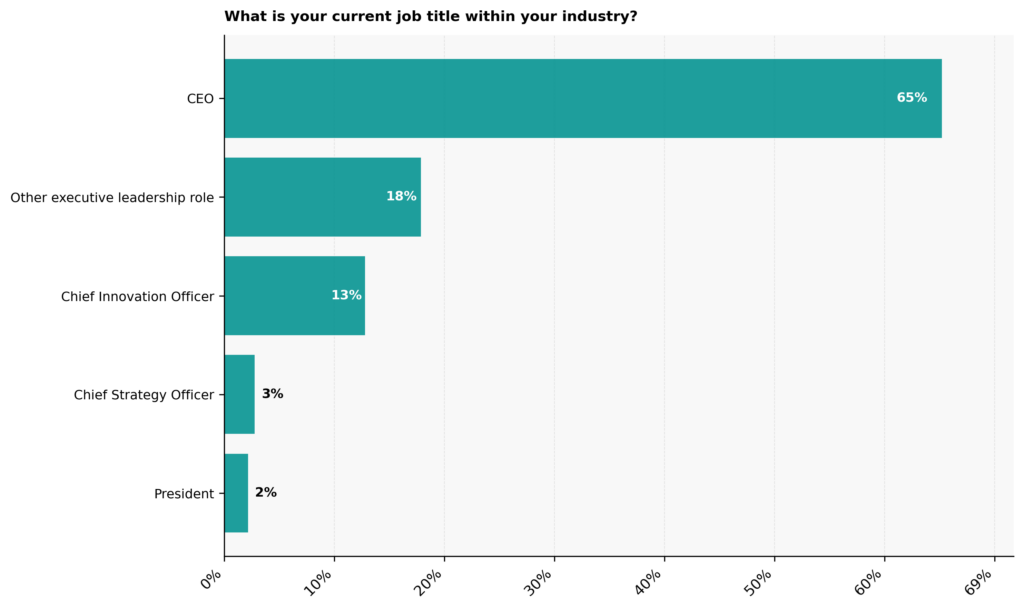
It’s no surprise that the current job titles held by business leaders who have booked AI speakers for their events are concentrated at the highest levels, with CEOs accounting for 65%. McKinsey calls this their “legacy moment,” where success depends less on technology alone and more on strategic leadership, ambition, and business transformation. AI adoption requires CEOs to rethink operating models, embed AI into core business strategy, and lead organization-wide change rather than treat it as a standalone tech initiative.
A further 18% hold other executive leadership roles, suggesting broad C-suite involvement in AI conversations. 13% are Chief Innovation Officers, pointing to a focus on experimentation and future growth. 3% serve as Chief Strategy Officers, aligning AI insight directly with long-term direction. 2% are Presidents, reinforcing that enterprise-wide authority is driving speaker selection.
Daniel Burrus comments: When CEOs are the primary decision-makers booking AI speakers, it signals something important: AI is no longer being treated as a technical conversation, it is a leadership conversation. That is exactly where it belongs. The biggest opportunities and risks around AI are not confined to IT; they affect growth, business models, workforce strategy, customer experience, and competitive advantage. CEOs understand that adopting AI is not just about implementing new tools, but about leading transformation across the enterprise. That is why the most valuable AI keynotes speak directly to leadership-level decisions, helping executives anticipate disruption, recognize opportunity, and align innovation with long-term strategy.
Which City Are You Primarily Based In?
39% of business leaders who have booked AI speakers for their events are primarily based in San Francisco
AI speaker demand clusters in tech capitals:
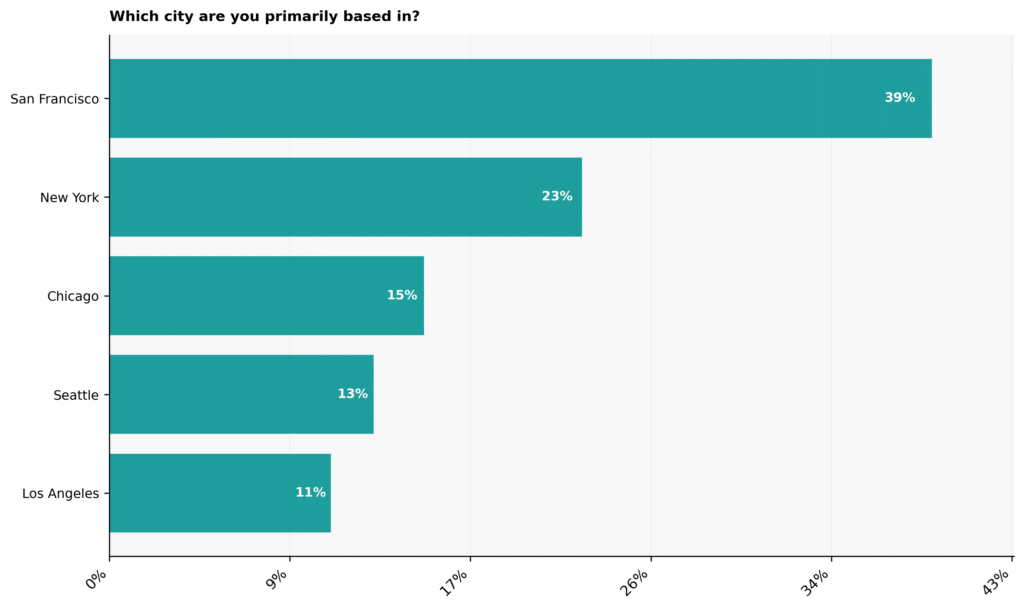
The cities in which business leaders who have booked AI speakers for their events are primarily based are led by San Francisco, at 39%. With its concentration of venture capital, dense technical talent, accelerator support, and leadership in AI and machine learning, the city is home to category-defining companies such as Airbnb, Stripe, Databricks, OpenAI, and Anthropic. That proximity to companies shaping global technology trends helps explain why so many AI-focused executives are based there.
New York follows at 23%, where finance, media, and enterprise technology intersect, creating demand for AI insight tied to scale and market impact. Chicago accounts for 15%, anchored in established industries focused on operational efficiency and enterprise modernization.
Seattle stands at 13%, closely connected to cloud computing and platform-driven growth. Los Angeles registers 11%, where AI discussions connect to media, entertainment, and consumer technology expansion.
Daniel Burrus comments: The concentration of AI speaker demand in cities like San Francisco and Silicon Valley reflects more than geography, it reflects where urgency around disruption is highest. In innovation hubs, leaders are closer to the technologies, companies, and competitive pressures reshaping the market, so the need for strategic AI insight becomes even more immediate. But what matters most is not simply being near the center of AI development; it is being able to anticipate how those developments will transform business models, customer expectations, and industry dynamics. That is why organizations in leading tech capitals often seek keynote speakers who can translate rapid innovation into clear strategic action. In an environment moving this quickly, proximity to change increases the demand for foresight.
Practical Insight Matters More Than Hype
Overall, these opinions reveal a clear pattern. The speakers who stand out are those who bring practical experience, sharp strategic thinking, and the ability to engage a room without losing substance. In a space where AI moves quickly and expectations are high, the voices that earn repeat invitations are the ones that turn complex ideas into decisions leaders can actually act on.
Daniel Burrus comments: In AI, credibility is not built on buzzwords or bold claims—it is built on practical insight leaders can use to drive measurable results. The speakers who rise above the noise are the ones who combine real-world experience, strategic foresight, and the ability to make complexity understandable without oversimplifying it. That is what today’s business audiences are looking for. They want more than inspiration; they want clarity, confidence, and actionable direction that improves performance, accelerates innovation, reduces risk, and delivers a clear return on investment. In a marketplace crowded with hype, the true authority is the speaker who helps leaders anticipate change, make better decisions, and turn disruption into strategic and financial advantage. Here’s a recent testimonial from the CEO of Pepsi after I spoke at their offsite leadership meeting: “Daniel Burrus delivered an engaging and thought-provoking session for our North America Executive Committee on Anticipatory Leadership: Using Hard Trends and AI to Accelerate Innovation and Growth. His insights on leading with an anticipatory mindset, leveraging disruption for competitive advantage, and applying next-gen retail trends were both inspiring and actionable. The session came at a pivotal moment for our organization and provided valuable perspective on how to future-proof our business.” – Steven Williams, CEO, PepsiCo NA
About The Data
Sourced using Artios from an independent sample of 214,299 opinions of Business Leaders that have booked AI speakers for their events in the US across X, Quora, Reddit, Bluesky, TikTok, and Threads. Responses are collected within a 95% confidence interval and 5% margin of error. Results are derived from what people describe from opinions expressed online, not actual questions answered by people in the sample.