With technology evolving at an unprecedented pace, innovation keynote speakers have become a valuable feature of company events and industry conferences. As businesses face constant disruption, shifting consumer expectations, and rapid digital transformation, many are seeking expert insights that can help them stay adaptable and prepared for what’s ahead. Futurist keynote speakers help organizations explore emerging trends, anticipate change, and identify new opportunities for growth in an increasingly fast-moving business environment.
To find out what 3,080,945 opinions of business leaders who host company events in the US were about innovation speakers, we utilized AI-driven audience profiling to synthesize insights from online discussions for 12 months, ending on April 30, 2026, to a high statistical confidence level. Our findings reveal current sentiments on the subject.
Index
- 73% of business leaders who host company events want innovation keynote speakers to cover AI
- The quality of innovation speakers is rated excellent by 25% of business leaders
- 72% of business leaders agree that innovation keynote speakers are fairly diverse
- Innovation keynote speakers’ topics are considered relevant by 63% of business leaders
- A lack of speakers combining expertise with experience is not a concern for 64% of business leaders
- 42% of business leaders expect innovation keynote speakers to face growing competition from internal thought leaders
- Innovation keynote speakers translate ideas into actionable insights for 59% of business leaders
- 97% of business leaders see ROI on innovation keynote speakers
- Business leaders feel 56% of innovation keynote speakers reflect current trends
- Innovation keynote speakers are used by 29% of business leaders to energize and inspire employees
- 100% of business leaders want innovation keynote speakers to cover AI and the future of work
- Gen AI has changed what 79% of business leaders expect from innovation keynote speakers
- 76% of business leaders feel virtual and hybrid events have expanded access to innovation keynote speakers
- 83% of business leaders agree implications of rapid tech change get some attention from innovation keynote speakers
- Business leaders think biotech should be a top priority for 55% of innovation keynote speakers
- Perceptions that speakers deliver inspiration without lasting business impact are not a market restraint for 92% of business leaders
- Technological change an innovation keynote speaker growth factor for 38% of business leaders
- 34% of business leaders who host company events are in financial services and banking
- 42% of business leaders who host company events are VPs or senior directors
- 40% of business leaders who host company events are headquartered in Chicago
- Choosing the right keynote speaker matters
- About the data
How do business leaders expect innovation keynote speakers to cover AI?
73% of business leaders who host company events want innovation keynote speakers to cover AI
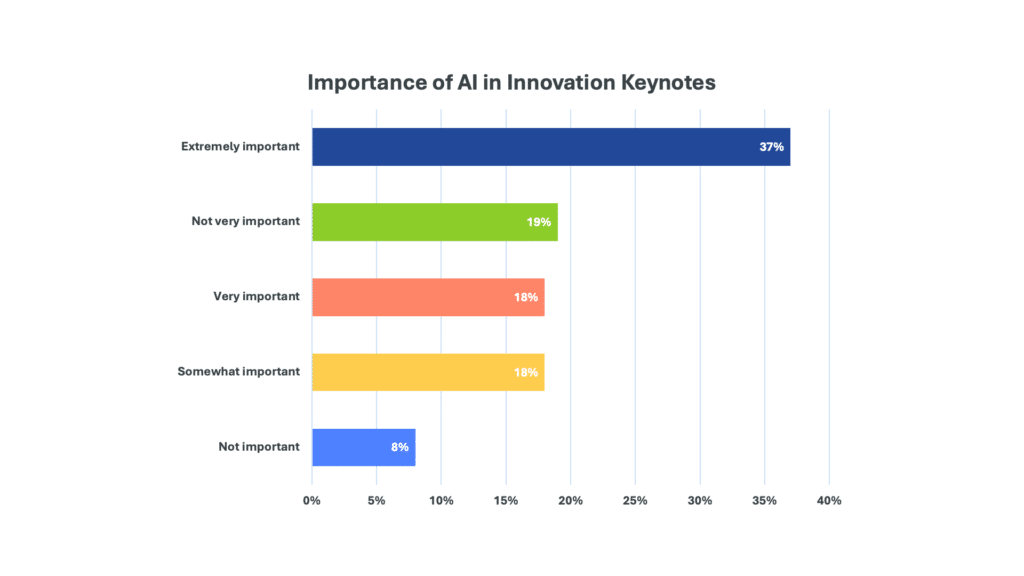
AI and emerging tech are important topics:
With AI fast becoming ubiquitous and new technologies emerging every other day, some people might think that business leaders expect innovation keynote speakers to address these topics. But this isn’t necessarily true.
Only slightly more than a third (37%) of business leaders who host company events say this is extremely important and that AI and emerging tech must be central to any innovation keynote. They’re not wrong, as AI is here to stay, while emerging tech is going to introduce more disruption. According to McKinsey, 88% of survey respondents reported regular AI use in at least one business function in 2025, compared with 78% in 2024.
However, 19% have a different opinion, stating this isn’t very important, as broader innovation themes matter more than specific technologies. This may be because focusing on specific tech is too limiting for their purposes. 18% take a more pragmatic view, agreeing that addressing AI and emerging tech is somewhat important and that it depends on the event theme and audience.
Another 18% feel this is very important, as their audiences expect keynote speakers to cover these topics, undoubtedly for similar reasons to the 37% who believe this is extremely important. Only 8% believe it’s not important, as they think innovation keynote speakers should focus on human and cultural exchange instead. They believe that people, not tech, are the true drivers of innovation and that drawing on diverse perspectives can help organizations build a culture of innovation that encourages collaboration and value in the long term.
Daniel Burrus’ Perspective
For Daniel Burrus, global futurist keynote speaker, AI strategist, and trusted voice on disruptive innovation, the growing demand for AI-focused keynotes reflects a deeper shift in business leadership. “The question is no longer whether AI belongs in the conversation,” Burrus explains. “The real question is whether leaders are using AI to react to disruption or to anticipate what comes next.”
Burrus emphasizes that AI should not be treated as a standalone technology topic. Instead, it should be framed as a strategic force reshaping work, customer expectations, business models, and competitive advantage. His anticipatory approach helps leaders separate what is certain to happen from what is merely possible, giving organizations a clearer path from awareness to action.
How do business leaders rate the quality of innovation keynote speakers?
The quality of innovation speakers is rated excellent by 25% of business leaders
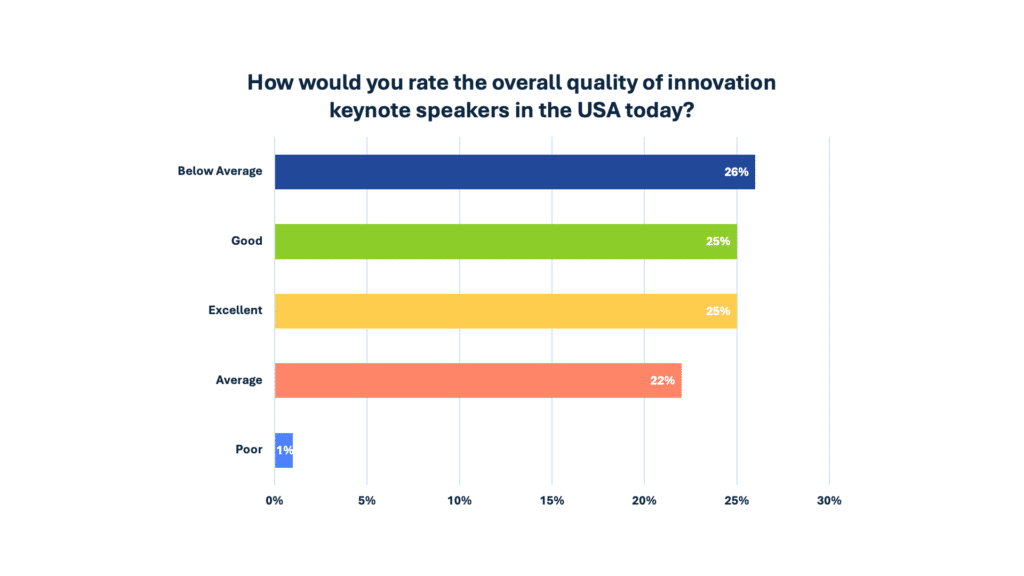
While it’s true that some innovation keynote speakers in the US are better than others, it’s possible to form a general opinion of them. 26% of our audience rate the overall quality of innovation keynote speakers as below average, as most of them fail to meet expectations. 25% rate speaker quality as excellent, saying the standard of innovation keynote speakers is very high, which tells us they’ve been highly selective in terms of who they’ve invited to address their audiences.
Another 25% rate overall US innovation keynote speaker quality as good. According to this segment, there’s strong talent available with some variation in quality, which indicates they’ve used different speakers, with mixed results. Slightly less than a quarter (22%) find the overall quality is average, noting that quality is inconsistent across the innovation speaker landscape.
Only 1% rate the quality as poor, and that the quality of these speakers is lacking. This could indicate that their choice of speaker was based largely on fees rather than reputation or experience.
Daniel Burrus’ Perspective
For Daniel Burrus, global futurist keynote speaker, AI strategist, and disruptive innovation expert, the difference between an average innovation keynote and an excellent one comes down to more than stage presence. The real value is in helping leaders see what is coming, understand what it means, and act before disruption forces their hand.
“Business audiences do not need more generic inspiration,” Burrus explains. “They need actionable foresight. They need a speaker who can connect disruptive technologies, shifting customer expectations, and emerging business models to the decisions leaders must make now.”
Burrus’ work emphasizes anticipatory thinking which is the ability to identify future certainties and use them to create strategic advantage. In a speaking landscape where quality varies widely, this kind of practical, future-focused expertise is what separates a memorable keynote from one that drives measurable business impact.
How do business leaders rate diversity among innovation keynote speakers?
72% of business leaders agree that innovation keynote speakers are fairly diverse
Room exists for improvement in diversity:
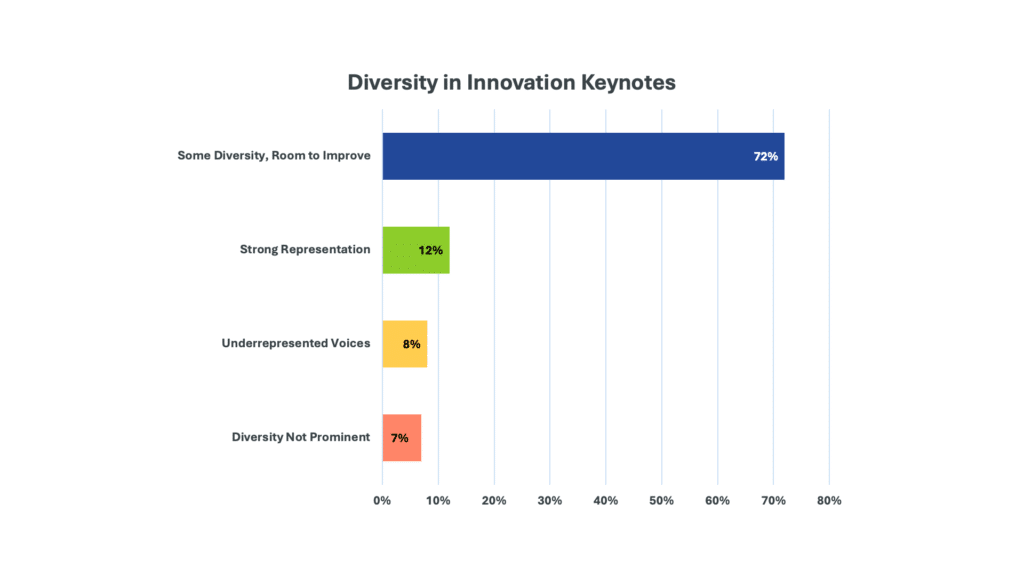
As the US becomes increasingly diverse, representation (even among keynote speakers) cannot be ignored. According to 72% of business leaders who host company events, there is a reasonable variety but clear room to improve. They’ve seen some change over the years, but acknowledge this transformation is not complete. 12% disagree, saying speakers reflect diversity very well, with speaker diversity being strong and representative.
For a further 8%, innovation keynote speakers in the US reflect diversity poorly, pointing out that diverse voices remain significantly underrepresented among innovation keynote speakers. While not entirely incorrect, this opinion is likely based on limited experience of speakers. The remaining 7% are neutral, stating diversity has not been a prominent feature of the innovation speaker landscape, suggesting this segment is more concerned with what speakers say on specific topics, such as AI and emerging tech.
Growing demand for diversity in keynote speaking
The overwhelming majority of our audience is largely positive about diversity among speakers, which ties in with findings published by the Pew Research Center. For 56% of US employees, focusing on increasing DEI at work is a good thing, as it brings diverse opinions and outlooks.
For innovation speakers, there’s also a need for diverse speakers who can share different perspectives, problem-solving approaches, and life experiences. This enables them to reach a wider audience, more accurately reflect the global marketplace, and prevent the formation of echo chambers.
Daniel Burrus’ Perspective
Burrus sees diversity in innovation speaking as not only a matter of representation, but also a matter of perspective. In his view, organizations need voices that can challenge assumptions, connect ideas across industries, and help leaders see possibilities they may not recognize from inside their own walls.
“Innovation slows down when leaders keep looking at the future through the same lens,” Burrus says. “The most valuable outside perspectives help organizations spot disruption earlier, think beyond familiar patterns, and uncover opportunities hiding in plain sight.”
That broader view is especially important as companies navigate AI, workforce change, and accelerating technological disruption. A strong keynote should not simply reflect where business is today; it should help leaders expand how they think about tomorrow.
How relevant do business leaders find innovation keynote speaker topics?
Innovation keynote speakers’ topics are considered relevant by 63% of business leaders
Topic relevance is strong but varied:
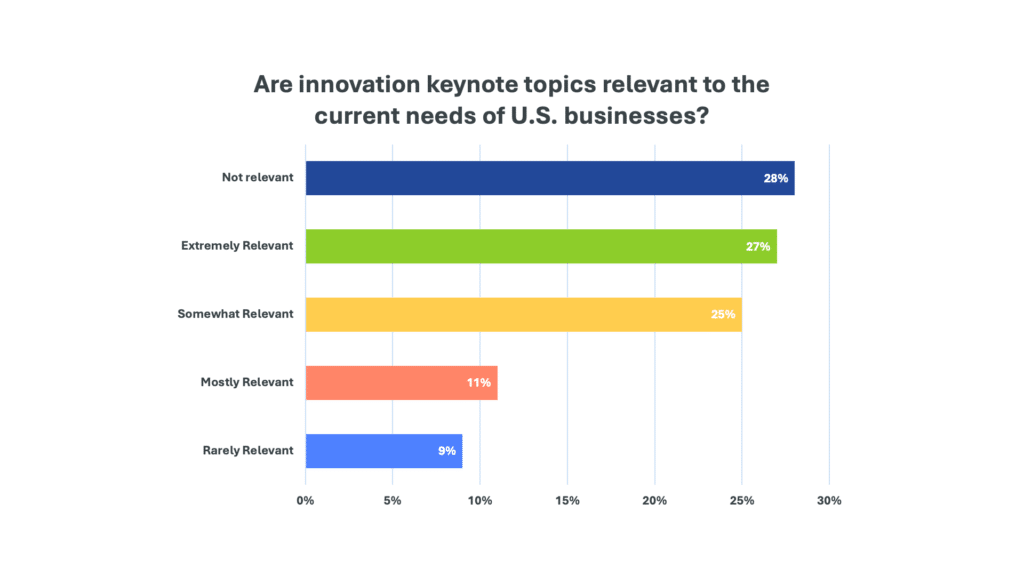
One of the hallmarks of a good innovation keynote speaker is that their topics are relevant to their audience. But is this the case in the US today?
28% of our audience don’t think so. This segment argues that the topics covered by innovation keynote speakers are not relevant to the current needs of US businesses, emphasizing that the innovation keynote speaker landscape is out of touch with what businesses actually need. Conversely, 27% feel that speakers’ topics are extremely relevant and that speakers are closely in tune with business needs, which suggests they booked reputable speakers.
According to 25%, the topics are somewhat relevant, with the content being useful but often too broad or generic. This segment likely had hopes for a more focused approach, but whether they communicated this to the speakers they booked is unclear. 11% find the topics mostly relevant and broadly applicable, although there are occasional gaps. 9% say the topics are rarely relevant and often feel disconnected from real business challenges, putting them in the minority.
Daniel Burrus’ Perspective
For Burrus, relevance is one of the most important measures of an innovation keynote’s value. A topic may sound timely, but if it is not connected to the audience’s industry, customers, workforce, and strategic priorities, it can quickly feel generic.
“The most relevant keynotes do not simply describe what is changing,” Burrus says. “They help leaders understand which changes are certain, which disruptions are approaching, and which opportunities they can act on now.”
This is where anticipatory thinking becomes especially powerful. By focusing on future certainties rather than short-term uncertainty, Burrus helps audiences move beyond broad innovation themes and apply future-focused insights to real decisions, real challenges, and real growth opportunities.
What’s the biggest gap business leaders see in innovation keynote speakers?
A lack of speakers combining expertise with experience is not a concern for 64% of business leaders
Minimal gaps are evident:
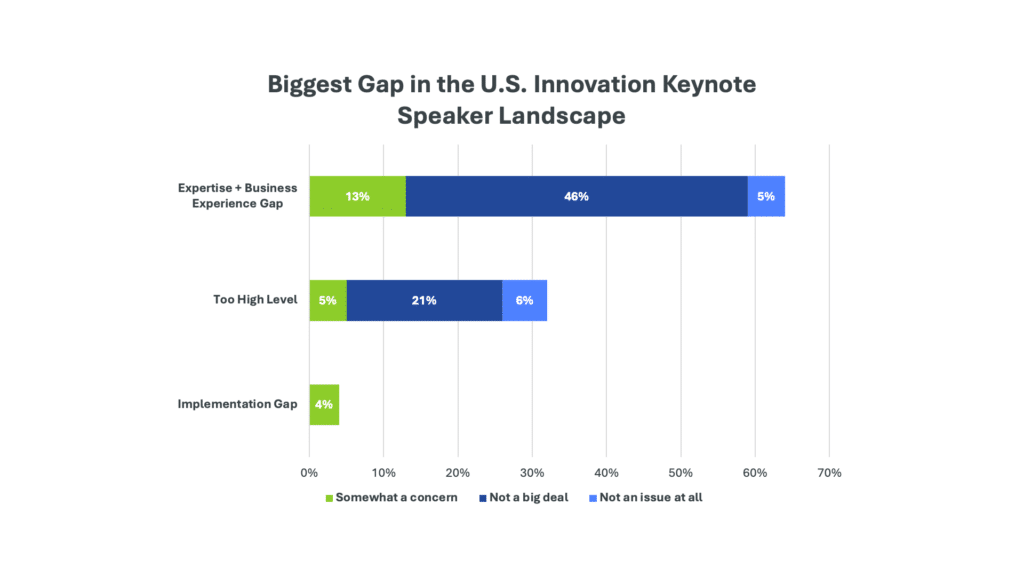
Picking up where the above statistics on topic relevance left off, business leaders who host company events also have strong opinions about the biggest gaps they see in innovation keynote speakers. 46% mention a lack of speakers who combine genuine innovation expertise with real-world business experience, saying this isn’t a big deal, although for 13%, this is something of a concern, and 5% don’t feel it’s an issue at all. The greater part of these segments arguably feels confident enough to translate what speakers say about innovation into their own unique business contexts.
21% say innovation speaker content that is too high-level and not tailored to specific audiences isn’t a big deal, and 6% say this isn’t an issue at all. 5% feel differently, stating it’s somewhat of a concern. According to 4%, a disconnect between what innovation keynote speakers present and what organizations can realistically implement is somewhat of a concern. This segment may be in the minority, but they’re on to something.
Closing the gap between innovation and execution
The biggest gap in innovation keynote speaking is the transition from theory to actionable execution. While many speakers provide high-level inspiration, there is a significant need for practical, real-world application, particularly in translating complex technologies like AI into day-to-day business operations.
With this in mind, it’s important to look for innovation speakers with proven technical authority, the ability to fluently connect ideas and frameworks to measurable outcomes, and who share insights based on the latest developments, bring experience or perspectives from different applications or industries, and can frame their insights within broader business objectives. Understandably, organizations see better outcomes when speakers’ content harmonizes directly with specific business goals.
Daniel Burrus’ Perspective
Burrus has long argued that the real test of an innovation keynote is not whether the audience leaves inspired, but whether they leave equipped to act. In his view, disruptive innovation requires more than awareness of emerging trends; it requires the ability to connect those trends to practical business decisions, measurable outcomes, and near-term opportunities.
“There is a big difference between talking about disruption and helping leaders use it as an advantage,” Burrus says. “The best innovation speakers give audiences a framework for turning uncertainty into strategy and strategy into execution.”
That distinction is especially important as organizations look for guidance on AI, workforce transformation, and rapid technological change. A keynote that combines future-focused expertise with real-world business application can help leaders move beyond theory and identify the specific actions they can take now to stay ahead.
How do business leaders expect innovation keynote speakers to evolve?
42% of business leaders expect innovation keynote speakers to face growing competition from internal thought leaders
Competition in the sector comes largely from within:
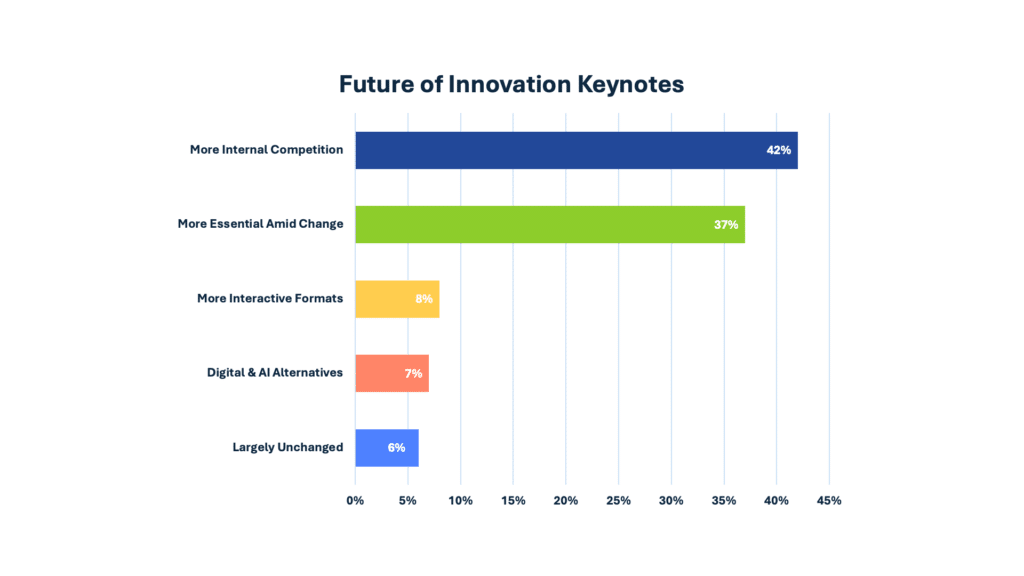
Given their focus, it’s only natural to expect innovation keynote speakers to evolve. Though what that evolution entails depends on who you ask. 42% of business leaders who host company events are of the opinion that speakers will face growing competition from internal thought leaders.
37% have the decidedly different view that innovation keynote speakers will become more essential as the pace of change accelerates. This may be because some organizations, especially smaller businesses, lack the personnel to keep abreast of new developments in AI and other technologies.
A divide between workshops and on-demand content
The evolution that 8% of our audience expects is for formats to shift toward more interactive and workshop-style innovation keynote experiences. Such an evolution certainly would make for more memorable presentations than talks in which the audience remains passive.
7% expect that on-demand digital content and AI-driven learning will begin to replace traditional innovation keynotes. They may even have had some experience of this already. Finally, 6% expect the landscape to remain largely the same, which is surprising considering just how many changes the business landscape is undergoing.
Daniel Burrus’ Perspective
Burrus sees the rise of internal thought leaders as a positive development, but not a reason to dismiss the value of outside expertise. Internal leaders bring valuable organizational knowledge, but an external futurist can bring a broader view of disruption, technology, and opportunity across industries.
“Internal experts know the organization,” Burrus says. “The right external speaker helps them see what is happening beyond the organization and what is coming next.”
That outside perspective can be especially valuable when leaders are navigating AI, shifting customer expectations, and new competitive threats. Rather than competing with internal voices, a strong innovation keynote can give them a shared language, a future-focused framework, and the confidence to turn insight into action.
How do business leaders describe demand for innovation keynote speakers?
59% of business leaders agree demand has increased for innovation keynote speakers
Increased demand for speakers is evident:
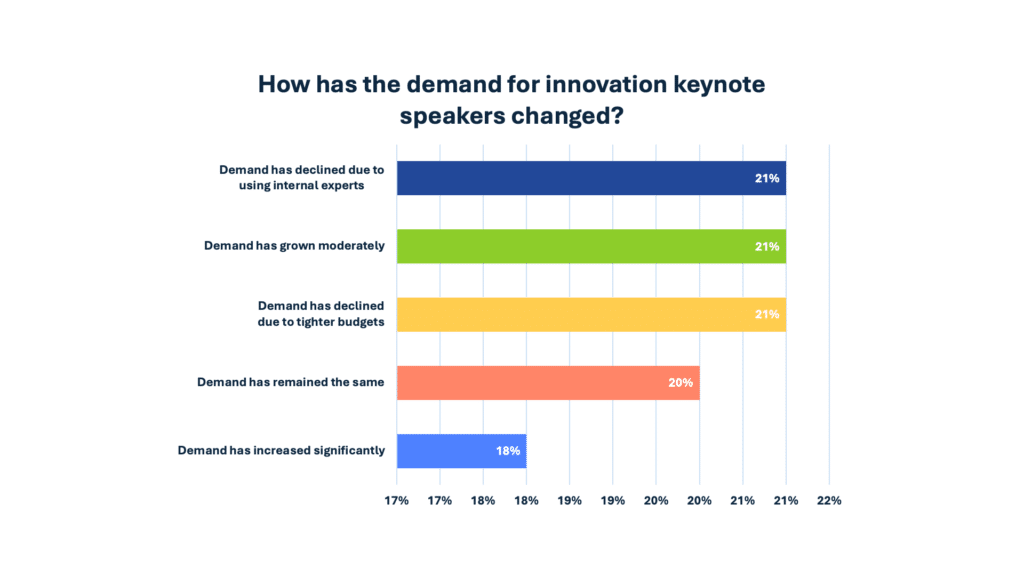
Our audience’s opinions on how the demand for innovation keynote speakers in the US has changed over the past few years fall into different camps of roughly equal size.
21% are of the opinion that demand has declined as organizations turn to internal experts instead, which fits in with what some in our audience said about internal thought leaders above. Another 21% are confident that demand has grown moderately as more organizations seek external perspectives. This opinion may be based partly on concerns about being trapped in an echo chamber.
Still another 21% feel that demand has declined due to tighter budgets and fewer large-scale events. What this segment doesn’t recognize is that, if the economy improves, they could look forward to bigger budgets and more frequent large-scale events. 20% share the belief that demand has remained largely the same, and 18% say it has increased significantly as innovation becomes a boardroom priority.
Lasting value of external innovation speakers
Those in our audience who say demand has increased or remained the same recognize that organizations won’t ditch keynote speakers for internal experts any time soon, as these speakers play an important role in the success of corporate events. In addition to delivering key messages, innovation keynote speakers do a lot to set the tone for events, encourage audience engagement, inspire action and enthusiasm among audience members, contribute to event credibility, and create lasting impressions.
The events they speak at also provide valuable networking opportunities. It’s not easy for companies to achieve the same effect if they rely solely on internal thought leaders.
Daniel Burrus’ Perspective
Burrus believes the continued demand for innovation keynote speakers reflects a simple reality: organizations need perspective from outside their own walls. Internal experts understand the business, but external voices can help leaders see broader patterns of change, identify emerging opportunities, and challenge assumptions that may be limiting future growth.
“When disruption accelerates, leaders need more than information,” Burrus says. “They need the ability to anticipate what is coming, understand what is certain, and act with confidence before competitors do.”
That is where an experienced innovation speaker can deliver lasting value. By connecting technological change, AI, customer expectations, and workforce transformation to practical business strategy, Burrus helps audiences move beyond inspiration and toward clearer, more future-ready action.
How well do innovation keynote speakers deliver actionable insights to business leaders?
Innovation keynote speakers translate ideas into actionable insights for 59% of business leaders
The efficiency of speakers is high:
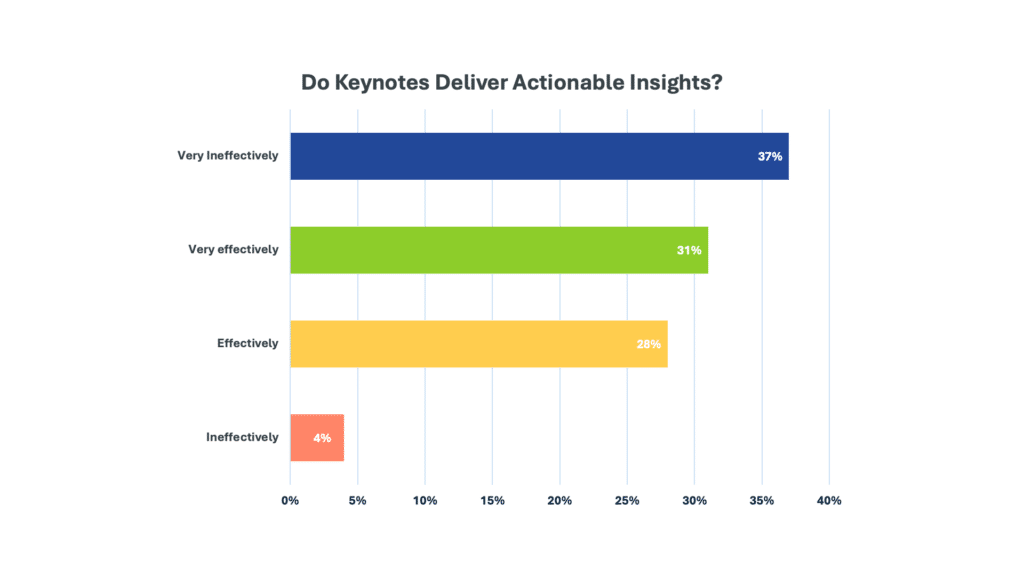
Almost two-thirds of our audience appreciate how innovation keynote speakers deliver actionable insights to business leaders, though a sizable chunk doesn’t. This is an important consideration, as reports show that companies using actionable insights see team productivity increase by 12% within three months.
37% of business leaders who host company events state that speakers are very ineffective at this and rarely deliver content that audiences can act on. This ties in with our audience’s opinions about the gaps they see.
However, 31% agree that speakers are very effective and consistently deliver practical takeaways. 28% have a similar opinion, saying speakers do this effectively, with most managing to bridge ideas and action well.
Clearly, these business leaders have successfully implemented insights gained from talks by innovation keynote speakers. The remaining 4% state that keynote speakers are ineffective at delivering actionable insights to business leaders, as the presentations tend to be inspiring but light on practical applications.
Daniel Burrus’ Perspective
Burrus believes actionable insight is what separates a memorable keynote from a transformative one. Inspiration may energize an audience in the moment, but leaders need a clear framework they can use long after the event is over.
“Insight only becomes valuable when it leads to action,” Burrus says. “The goal is not simply to help leaders understand disruption. The goal is to help them anticipate it, shape it, and use it to create measurable advantage.”
That practical emphasis is especially important as organizations navigate AI, automation, and workforce transformation. Burrus helps audiences identify future certainties, recognize the opportunities they create, and translate those insights into decisions that can improve strategy, innovation, and execution.
How do business leaders describe innovation keynote speakers’ value relative to cost?
97% of business leaders see ROI on innovation keynote speakers
ROI is generally high:
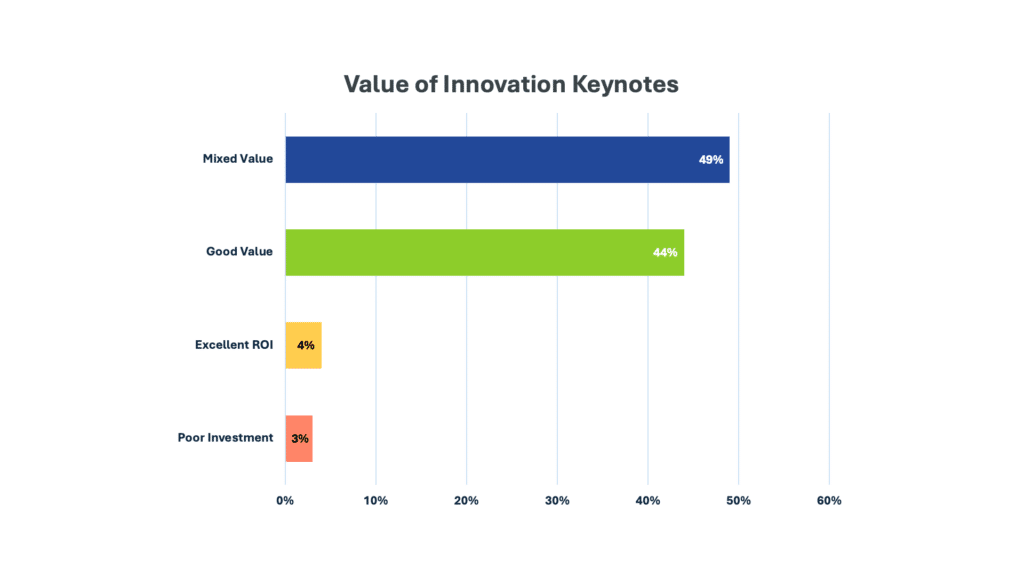
For almost half (49%) of our audience, innovation keynote speakers deliver average value relative to their cost, with outcomes being mixed and hard to measure consistently. This may tie in with what they feel about a lack of actionable insights above.
However, for 44%, they deliver good value, with the return being generally positive with some variation. Again, this reflects what some audience members feel about having been able to put insights into practice. 4% state that speakers deliver excellent value and that their impact clearly justifies the investment. This is in keeping with research, which found that 87% of clients found a return on investment from equal (a dollar-to-dollar return) up to five times the cost of the speaker.
Lastly, 3% of business leaders who host company events believe that speakers deliver very poor value and that organizations would be better served by investing elsewhere. This is likely due to their experience with specific speakers who may not have been the best fit.
Daniel Burrus’ Perspective
Burrus believes the ROI of an innovation keynote should be measured by what happens after the applause ends. A powerful keynote does more than energize the room; it gives leaders a practical way to think differently, make better decisions, and act on opportunities before they become obvious to everyone else.
“The greatest return comes when a keynote changes how leaders see the future,” Burrus says. “When they can identify what is certain, anticipate disruption, and move forward with confidence, the value extends far beyond the event itself.”
That kind of impact is especially important as organizations invest in AI, digital transformation, and workforce readiness. By helping audiences connect future trends to present-day strategy, Burrus gives leaders tools they can apply immediately and turning insight into action and inspiration into measurable business advantage.
Do business leaders feel innovation keynote speakers reflect current trends?
Business leaders feel 56% of innovation keynote speakers reflect current trends
Being on top of trends differs somewhat:
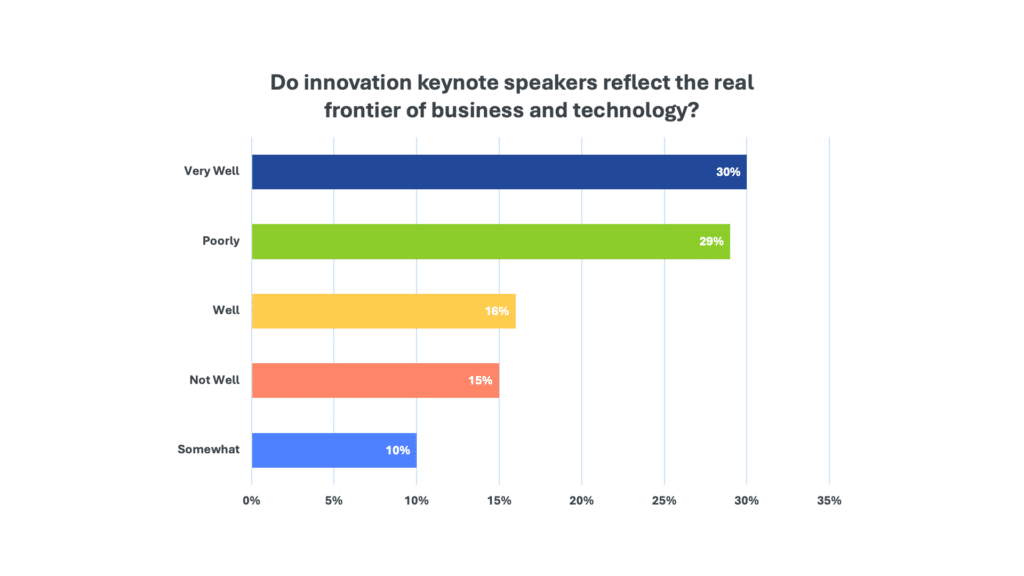
30% of our audience rate innovation keynote speakers’ reflection of current business and technology very well, saying speakers are consistently ahead of the curve. A slightly smaller percentage (29%) rate speakers poorly, saying speakers in the US frequently feel behind the times. 16% rate them well, as most speakers are current and credible, even though they’re not always cutting edge. This makes sense, as not all speakers will be as well-informed as others.
15% do not rate keynote speakers well, as there is often a noticeable gap between what speakers say and what is actually happening. This echoes what some audience members said about a lack of speakers who combine genuine innovation expertise and real-world business experience. For 10%, speakers somewhat reflect current business and tech, as their content can lag behind real-world developments.
Interestingly, while 80% of executives confirm that innovation is a top priority, less than 10% are satisfied with their organization’s innovation. This may help explain the frustration of some audience members when it comes to a lack of actionable insights or to some speakers’ outdated reflections of current business and tech.
Daniel Burrus’ Perspective
Burrus believes the most valuable innovation speakers do not simply reflect current trends, they help leaders anticipate where those trends are going next. In a business environment shaped by AI, automation, digital transformation, and shifting customer expectations, being “current” is no longer enough.
“By the time a trend is obvious to everyone, the greatest opportunities may already be gone,” Burrus says. “Leaders need to identify the Hard Trends that are certain to shape the future and use them to make better decisions today.”
That distinction is central to my’ work. Rather than chasing every new development, I help organizations separate short-term noise from future certainties, giving leaders a clearer view of what is coming and how to act before disruption becomes urgent.
How do organizations use innovation keynote speakers in their events?
Innovation keynote speakers are used by 29% of business leaders to energize and inspire employees
Speakers fulfill different purposes:
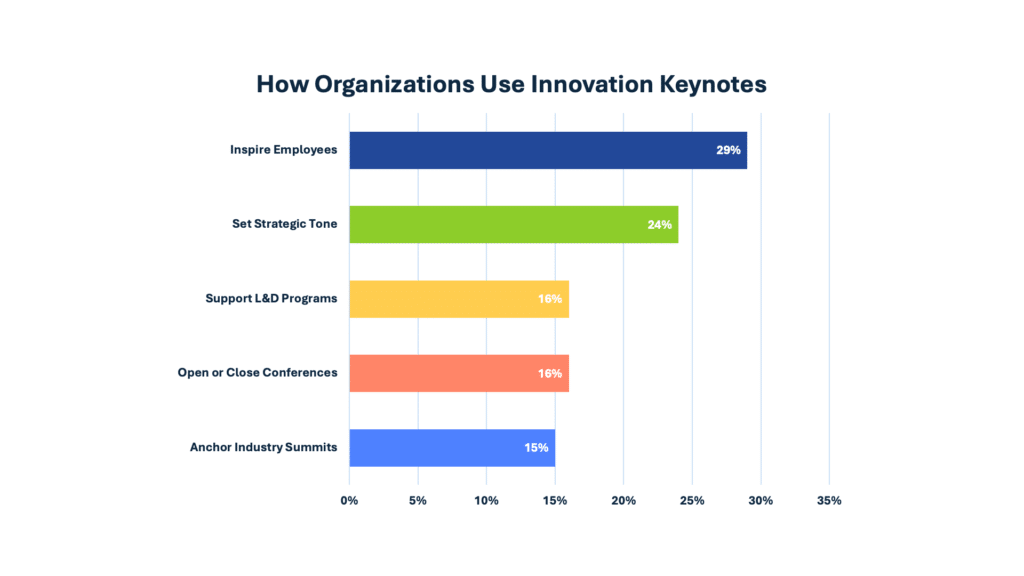
More than a quarter (29%) of business leaders who host company events primarily use innovation keynote speakers to inspire and energize employees during internal company events. This helps explain the strong feelings toward actionable insights and topics relevant to what’s happening in the real world. 24% use speakers to set the strategic tone for leadership and executive gatherings, which makes sense, as organizational leadership is responsible for driving innovation.
16% hire speakers as the headline act to open or close major company conferences. This is understandable, as speakers can bring valuable external perspectives at these times. Another 16% use speakers as part of a broader learning and development program, while 15% use them to anchor industry conferences and external-facing summits. The latter segment possibly does this to increase these events’ appeal and value.
Daniel Burrus’ Perspective
I believe the best innovation keynotes are designed around the outcome leaders want to create. An internal company event may need energy and renewed confidence, while an executive gathering may require a sharper strategic lens. A major conference may need a powerful opening message that gives the entire event a future-focused direction.
“A keynote should do more than fill a spot on the agenda,” Burrus says. “It should create a shift in how people think, what they believe is possible, and how they act when they return to work.”
That is especially important as organizations use events to align employees around AI, transformation, and future growth. By helping audiences see change as an opportunity rather than a threat, I turn the keynote experience into a catalyst for action, engagement, and strategic momentum.
Which topic do business leaders want US innovation keynote speakers to cover?
100% of business leaders want innovation keynote speakers to cover AI and the future of work
Opinions on topic choice are unanimous:
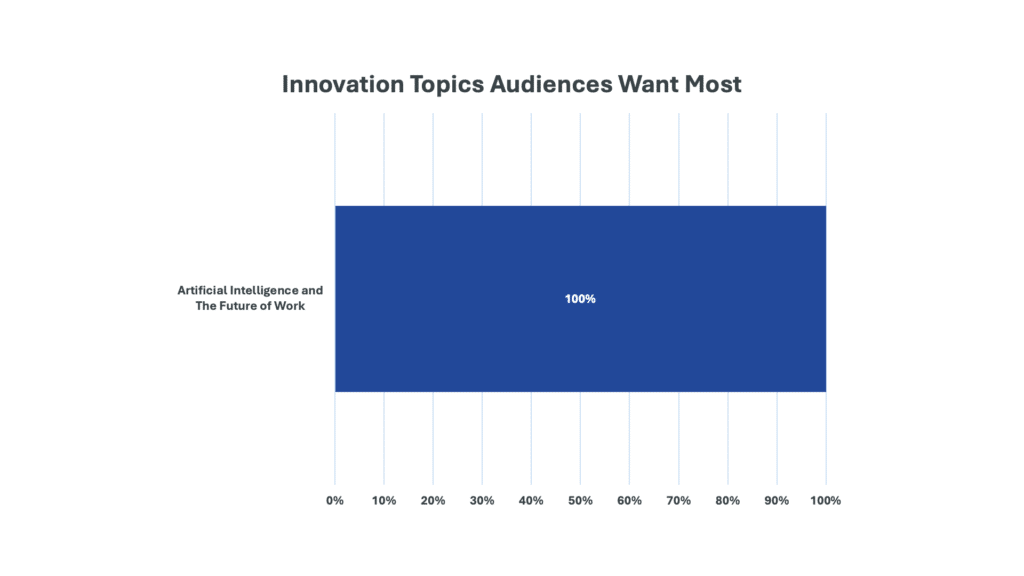
When it comes to the topic business leaders most want innovation keynote speakers to cover, our audience is unanimous. 100% agree that the topic should be artificial intelligence and the future of work.
This isn’t without good reason. PwC’s 2025 Global AI Jobs Barometer reveals that industries more exposed to AI have three times higher growth in revenue per employee, while skills for AI-exposed jobs are changing 66% faster than for other jobs. This rate is more than 2.5 times faster than in 2024. This means AI is redefining roles at a rapid pace, and, as a result, the skills required to succeed in AI-powered jobs are changing.
Daniel Burrus’ Perspective
I see AI and the future of work as inseparable. AI is not simply changing the tools people use; it is changing how work is designed, how value is created, and how leaders must prepare their organizations for what comes next.
“AI will not eliminate the need for human talent,” Burrus says. “It will redefine what human talent needs to become. The organizations that thrive will be those that use AI to elevate human capability, accelerate learning, and create new forms of value before competitors do.”
That is why this topic has become so urgent for business leaders. The future of work is not a distant concept; it is already unfolding inside every role, team, and industry. By helping audiences understand which AI-driven changes are certain and how to act on them now, I help leaders move from concern to confidence and from disruption to opportunity.
How has generative AI changed what business leaders expect from innovation keynote speakers?
Gen AI has changed what 79% of business leaders expect from innovation keynote speakers
Gen AI has been a game-changer:
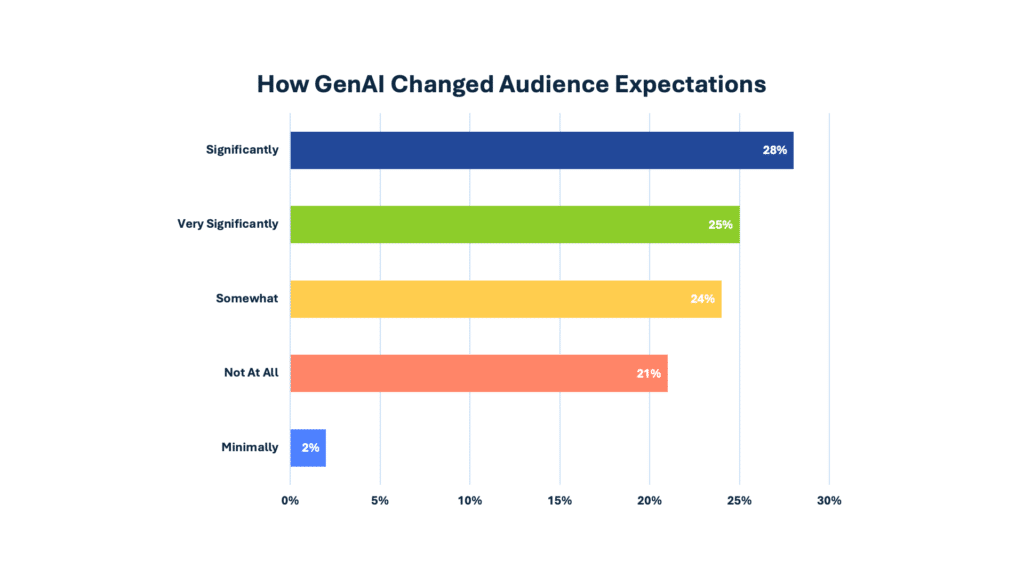
According to 28% of our audience, generative AI has significantly changed what they expect from innovation keynote speakers. They say audiences now expect speakers to address AI with depth and authority, suggesting their previous treatment of the topic was largely superficial. 25% find that the change has been very significant, as GenAI has completely reset audience expectations. This would be in terms of both content and how speakers deliver their message.
24% agree that audience expectations have changed only somewhat, as generative AI is only one of many topics that audiences want speakers to cover. However, 21% have found that expectations haven’t changed at all, with GenAI having little influence on what audiences want from speakers. 2% share a somewhat similar view that the change is minimal, with audience expectations not changing much despite the rise of GenAI.
That most of our audience expect speakers to speak about GenAI aligns with a World Economic Forum survey. The survey reveals that, while 88% of leaders are excited about AI’s potential for their businesses, 44% don’t feel ready to deploy this technology due to challenges such as data privacy and security, the potential impact on their workforce, and ethical implications.
Daniel Burrus’ Perspective
I believe generative AI has permanently raised the bar for innovation speakers. Audiences no longer want a basic explanation of what AI is; they want to understand what AI makes possible, what it will disrupt, and how they can use it strategically rather than reactively.
“Generative AI is not just changing what leaders expect from speakers,” Burrus says. “It is changing what leaders expect from themselves. They know they need to move faster, think differently, and make better decisions in a world where AI is accelerating both opportunity and disruption.”
This is why depth and authority matter. A powerful AI keynote should help leaders separate hype from Hard Trends, identify where AI can create measurable value, and understand how to prepare their people, processes, and business models for what is coming next.
What do business leaders think about virtual and hybrid keynote formats?
76% of business leaders feel virtual and hybrid events have expanded access to innovation keynote speakers
Hybrid event formats have opened new doors:
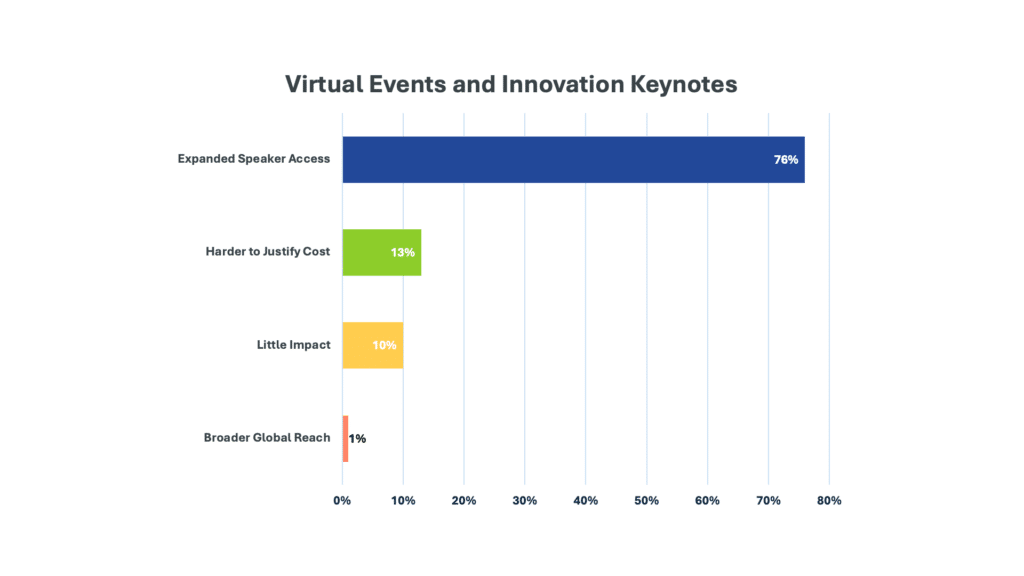
With virtual and hybrid events becoming more popular, it’s to be expected that they will have some effect on innovation keynote speakers. For the majority (76%) of US business leaders who host company events, virtual and hybrid events have significantly expanded access to a wider range of speakers.
This undoubtedly enables leaders to choose speakers who specialize in specific types of innovation for greater relevance to their organization or audience. For 13%, these events have made it harder to justify the cost of prominent innovation keynote speakers. This may be because it’s more difficult to gauge audience attention and engagement in virtual and hybrid events.
The rise of these events has had little impact on how organizations engage with keynote speakers for 10% of our audience. This could mean these leaders see little distinction between in-person, virtual, and hybrid events when it comes to speakers and their key messages. Just 1% say these events have made it easier to feature speakers across global audiences, which is particularly helpful if their organizations have a presence in other regions.
The benefits of hybrid events
There’s something to be said for hybrid events. Merging virtual and in-person experiences enables leaders to broaden their reach and engage more diverse audiences. This isn’t about diversity only, as blended formats have a psychological impact.
For example, they can improve emotional resonance, bolster audience commitment, and encourage a sense of community among audiences from different countries and cultures.
Daniel Burrus’ Perspective
I see virtual and hybrid events as a major opportunity, not a limitation. They allow organizations to bring future-focused insight to more people, across more locations, with greater flexibility than ever before. But access alone does not create impact. The message still has to be relevant, engaging, and designed to move people to action.
“A powerful keynote is not defined by whether it happens on a stage or through a screen,” Burrus says. “It is defined by whether it changes how people think, helps them see new possibilities, and gives them the confidence to act on what is coming next.”
As organizations expand their use of hybrid formats, the value of the speaker becomes even more important. Leaders need someone who can connect with audiences wherever they are, translate complex trends like AI and digital disruption into practical insight, and create a shared vision for the future that extends beyond the event itself.
What trends do business leaders feel innovation keynote speakers overlook?
83% of business leaders agree implications of rapid tech change get some attention from innovation keynote speakers
Some trends get more attention than others:
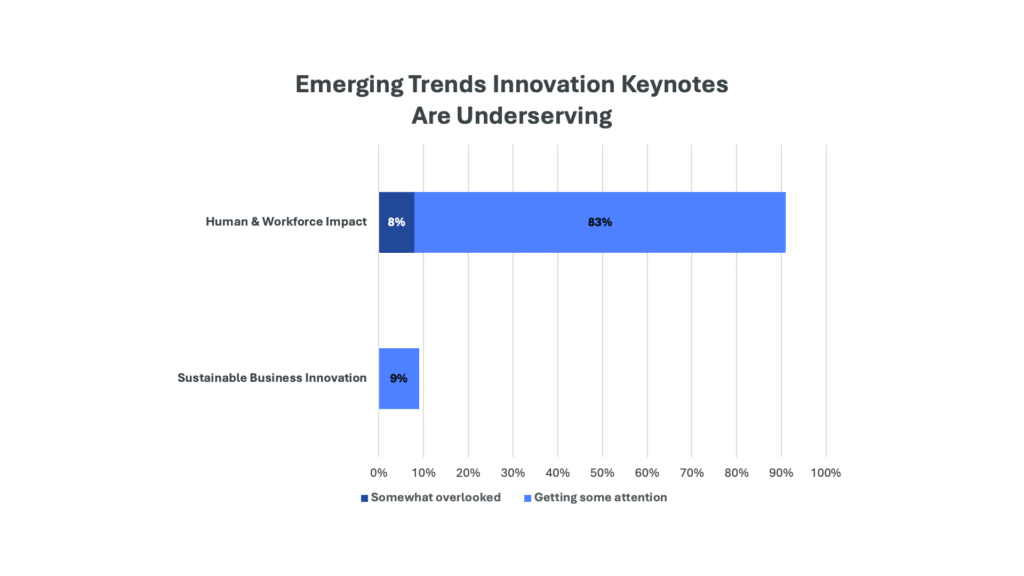
In terms of trends that business leaders feel innovation keynote speakers overlook, 83% mention the human and workforce implications of rapid technological change. Although they admit that this topic does get some attention.
8% opine differently, saying this trend is somewhat overlooked. That the majority mention this trend aligns with studies showing that technological advancements have led to job polarization, driving the growth of high- and low-skill occupations at the expense of middle-skill jobs. This has implications for income inequality, as high-skilled workers benefit disproportionately from technical change, while low-skilled workers have a greater risk of losing their jobs.
According to 9%, sustainability as a core driver of business model innovation gets some attention, which may imply it could do with more from speakers.
Daniel Burrus’ Perspective
I believe the human and workforce implications of rapid technological change deserve more than “some attention.” As AI, automation, and digital transformation accelerate, leaders need to help people understand not only what is changing, but how they can adapt, grow, and create new value in the process.
“Technology does not transform an organization by itself,” Burrus says. “People do. The leaders who succeed will be those who use technology to elevate human potential, not simply automate old ways of working.”
This is where anticipatory thinking becomes especially important. When leaders can identify the changes that are certain to happen, they can prepare their workforce with greater confidence, reduce fear, and create a culture that sees disruption as an opportunity to learn, innovate, and lead.
What emerging tech do business leaders expect innovation keynote speakers to prioritize?
Business leaders think biotech should be a top priority for 55% of innovation keynote speakers
One topic stands out as important now:
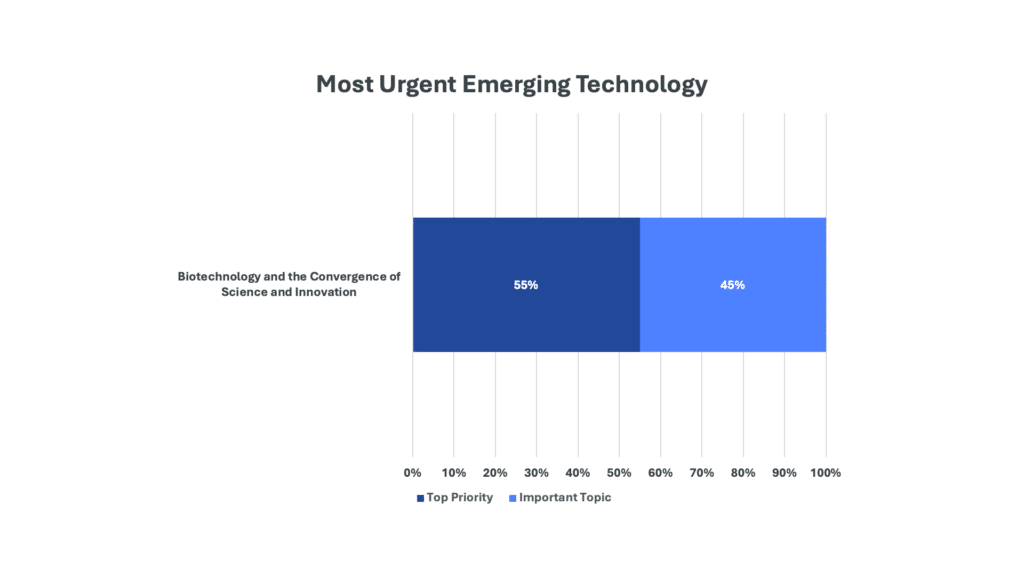
While business leaders who host company events all mention the same emerging tech that they expect American innovation keynote speakers to prioritize, they differ in how much importance they assign to it. For 55%, biotechnology and the convergence of science and innovation should be a top priority, while 45% say this is an important topic.
Biotechnology has wide-ranging implications for advancements in healthcare, agriculture, and environmental sustainability, so these opinions align with current trends. Some healthcare applications include gene therapy, personalized medicine, and biologics (e.g., the development of biological drugs such as monoclonal antibodies). Bringing science, innovation, and industry together can speed up innovation, encourage talent, and support economic growth.
Daniel Burrus’ Perspective
I see biotechnology as part of a much larger pattern: the convergence of once-separate fields into new sources of innovation, disruption, and growth. AI, biotech, data analytics, advanced materials, and automation are no longer developing in isolation. They are increasingly accelerating one another.
“The biggest opportunities often emerge at the intersection of technologies,” Burrus says. “When leaders understand how different fields are converging, they can see new markets, new business models, and new forms of value before they become obvious to everyone else.”
That is why emerging technologies such as biotech deserve attention from business leaders beyond the healthcare and life sciences sectors. As science and technology continue to merge, every industry will need to understand how these advances may reshape customer expectations, supply chains, workforce needs, and competitive advantage.
What restraints do business leaders identify for innovation keynote speakers’ market growth?
Perceptions that speakers deliver inspiration without lasting business impact are not a market restraint for 92% of business leaders
Market growth restraints are minimal:
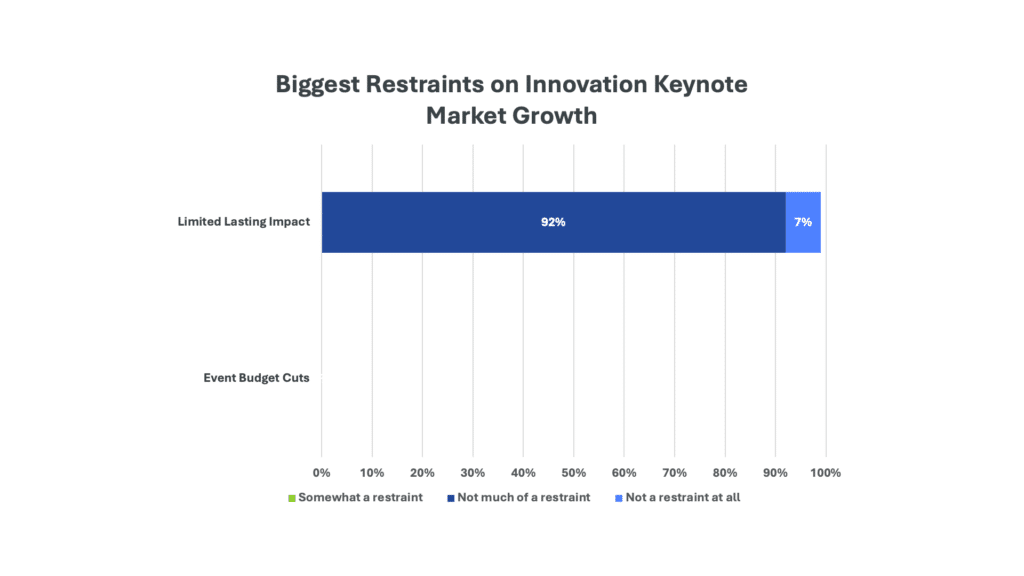
Less than 1% of business leaders state that the perception that speakers deliver inspiration without lasting business impact is somewhat of a restraint on the growth of the innovation keynote speaker market in the US. However, the vast majority of our audience doesn’t share this opinion.
92% agree it’s not much of a restraint, and 7% feel that it’s not a restraint at all. This ties in with the generally positive perceptions of speakers’ insights and how actionable and relevant they are.
Daniel Burrus’ Perspective
I believe inspiration has real value, but only when it becomes a catalyst for meaningful action. The strongest innovation keynotes do more than excite an audience in the moment; they help leaders see new possibilities, make better decisions, and move forward with greater confidence.
“Lasting impact comes when people leave a keynote with a new way to think about the future,” Burrus says. “When they can identify what is certain, anticipate disruption, and turn insight into action, inspiration becomes a business advantage.”
That distinction matters as organizations invest in events designed to drive innovation, AI adoption, and transformation. A keynote should not end when the session ends. It should continue shaping conversations, decisions, and strategies long after the audience leaves the room.
What do business leaders say is the key growth factor for innovation keynote speakers?
Technological change an innovation keynote speaker growth factor for 38% of business leaders
Fast-pace tech changes driving growth:
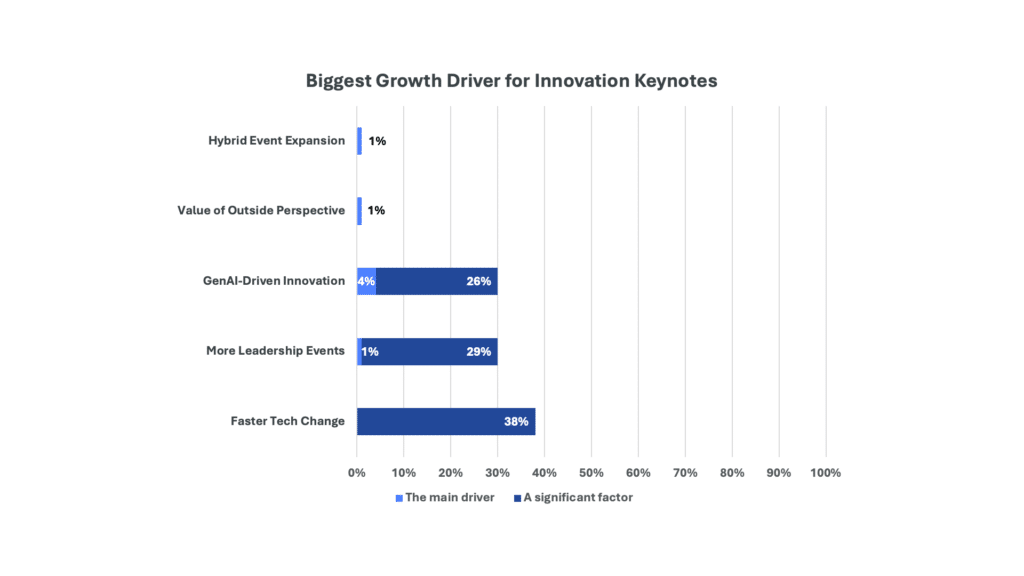
According to 38% of our audience, the accelerating pace of technological change creating demand for expert guidance is a significant growth factor for innovation keynote speakers in the US. This ties in with the fact that technology conferences saw a 28% increase in keynote bookings from 2022 to 2023.
Organizations’ increasing investment in large-scale employee and leadership events is the main driver for 1%, while for 29%, this is a significant growth factor. However, this contradicts what some of our audience feel about tighter budgets and fewer events of this nature. For 4%, the main driver is the rise of generative AI making innovation a top priority across all industries. Although 26% say this is only one significant factor. This is in keeping with what many in our audience think about GenAI above.
Only 1% say one of the significant growth factors for speakers is a growing recognition that external perspectives drive better strategic thinking, which confirms what we said about avoiding echo chambers. The remaining 1% believe that the expansion of hybrid and virtual events opening access to more audiences is another significant growth factor.
Daniel Burrus’ Perspective
I believe the accelerating pace of technological change is exactly why leaders need more than updates on trends. They need a way to understand which changes are temporary, which are transformational, and which are certain enough to act on now.
“Technology is changing faster than most organizations can react,” Burrus says. “The advantage goes to leaders who learn to anticipate disruption before it disrupts them.”
That is why expert guidance has become so valuable. As AI, automation, generative tools, and digital transformation reshape every industry, leaders need clarity they can use. By helping audiences separate hype from Hard Trends, I give them a practical framework for turning technological change into innovation, growth, and competitive advantage.
What industry do business leaders’ companies primarily operate in?
34% of business leaders who host company events are in financial services and banking
One sector is marginally in the lead:
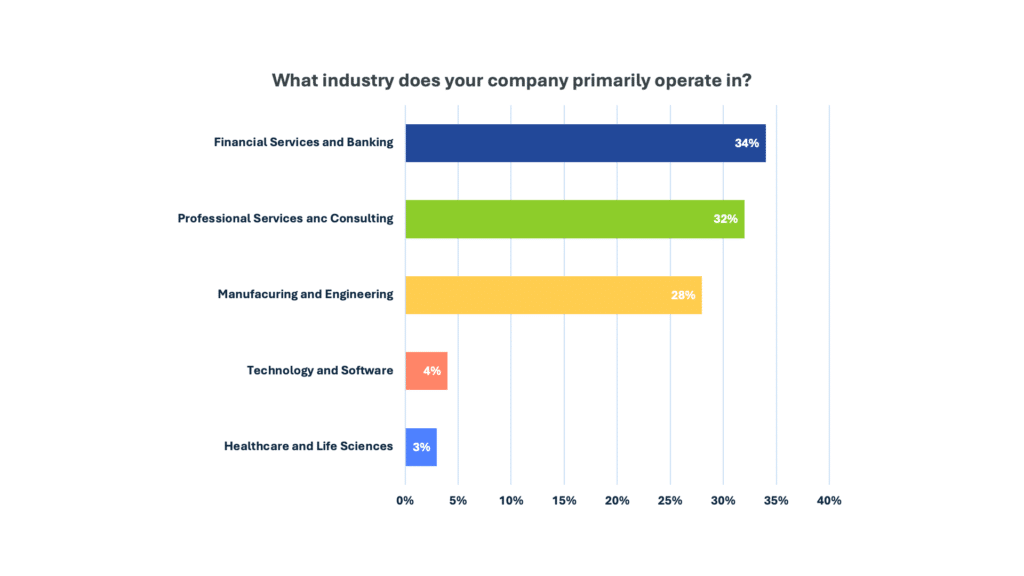
The companies of slightly more than a third (34%) of the business leaders who host company events operate in financial services and banking. Given the importance of accuracy and security, as well as the complexity of their work, organizations in these industries need to keep their finger on the pulse of technological development.
32% of our audience’s companies operate in professional services and consulting, and 28% ‘s companies are in the manufacturing and engineering industries. The companies of 4% operate in technology and software, and 3% in healthcare and life sciences.
This distribution shows that interest in innovation and future-focused insights is spread across multiple industries rather than concentrated in a single sector.
What best describes business leaders’ current job titles?
42% of business leaders who host company events are VPs or senior directors
Upper management leads the way:
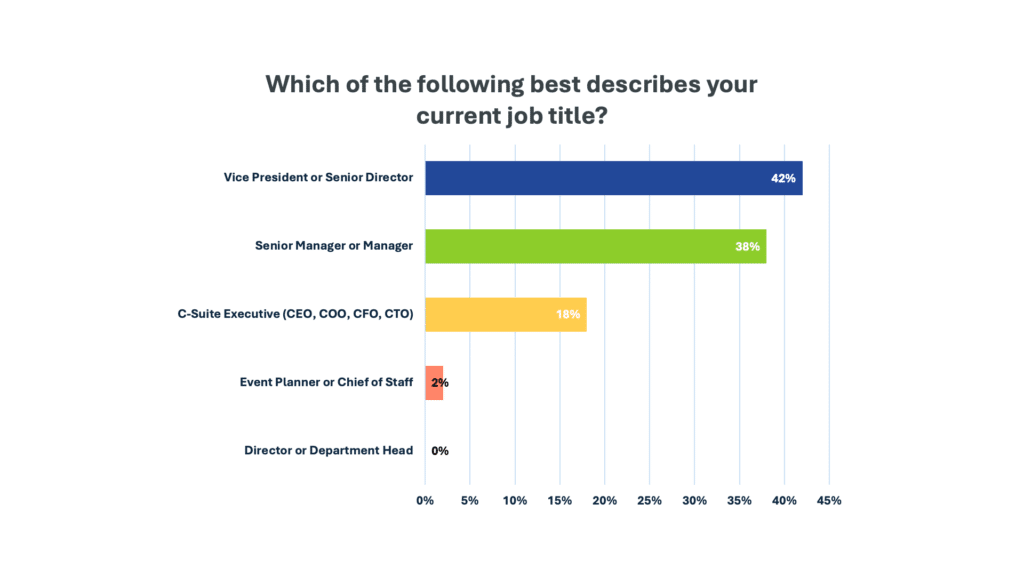
Almost half of our audience (42%) are currently vice presidents or senior directors of companies, while 38% are senior managers or managers. 18% are C-suite executives (either chief executive officers, chief operating officers, chief financial officers, or chief technology officers).
Individuals in these roles are ultimately responsible for steering employees into the future and must keep up to date as far as innovation goes. Only 2% of our audience are event planners or chief of staff, putting them in a small but still important minority.
In which city are business leaders’ organizations headquartered?
40% of business leaders who host company events are headquartered in Chicago
Our audience is spread across the US:
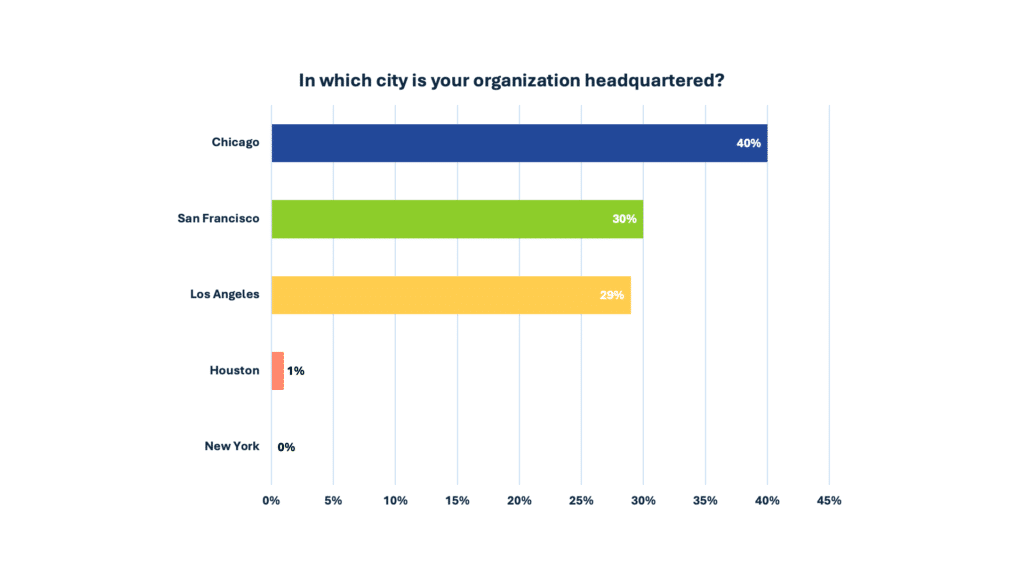
The business leaders who host company events in our audience have their headquarters across various major US cities. 40% ‘s organizations are headquartered in Chicago. Chicago is a premier global business hub and the top-ranked US metro for corporate relocation and expansion, holding this title for over six consecutive years. 30% ‘s companies are headquartered in San Francisco, while 29% are based in Los Angeles and 1% in Houston.
Together, the figures suggest that organizations based in highly competitive business environments may place greater value on forward-thinking insights and external expertise to help maintain a strategic edge.
Choosing the right keynote speaker matters
These statistics provide a clear overview of the experiences of leaders across different organizations with innovation keynote speakers. One of the most obvious takeaways is how varied those experiences are. Some leaders remain enthusiastic about the contributions speakers continue to make to their organizations (even if they acknowledge there’s room for improvement), while others are less than impressed.
This reinforces that, as far as keynote speakers are concerned, an established reputation for excellence and actionable insights matters, which is why choosing a speaker for your event isn’t a decision to be made lightly.
Daniel Burrus’ Perspective
I believe choosing the right keynote speaker is ultimately about choosing the right kind of impact. A great speaker should not only engage the audience in the moment, but also give leaders a new way to think, decide, and act when they return to work.
“The future does not reward organizations that wait for disruption to become obvious,” Burrus says. “It rewards those that learn to anticipate change, identify opportunity, and move forward with confidence before the competition does.”
That is why reputation, experience, and actionable insight matter. In a business environment shaped by AI, rapid technological change, and constant disruption, the right keynote can do more than inspire. It can help organizations create a shared vision, align around future-ready strategies, and turn uncertainty into a competitive advantage.
About the data
Sourced using Artios from an independent sample of 3,080,945 opinions of business leaders that host company events in the US across X, Quora, Reddit, Bluesky, TikTok, and Threads. Responses are collected within a 95% confidence interval and 5% margin of error. Results are derived from what people describe online, from opinions expressed online, not actual questions answered by people in the sample.