
How Future Technologies Are Creating Certainty Amid Disruption
As we begin 2026, leaders across every industry are asking the same question: What are the forces we can count on to shape the future with certainty and not speculation?
This is why I release my Top 25 Technology Hard Trends Report each year. These trends aren’t soft predictions based on possibility. They are a blueprint of future certainties grounded in data, technological maturity, and exponential growth curves. Hard Trends empower us to see disruption before it happens and turn it into a strategic advantage.
Here are the top three Hard Trends I believe will define the rest of this decade. These business-critical certainties will reshape productivity, innovation, how we live, and how we work.
- Generative AI
- Agentic AI
- The Internet of Everything
These are not possibilities—they’re certainties. And by anticipating them now, we can turn disruption into a strategic advantage.
1. How Is Generative AI Creating a Global Productivity Shock?

Generative AI (also referred to as ‘GenAI’) has evolved far beyond novelty at this point. It’s now the “first-draft digital assistant” across nearly every knowledge domain.
From writing, design, coding, and marketing to R&D, analytics, and customer service, GenAI radically compresses the time it takes to create, iterate, and experiment with ideas.
Why is Generative AI a Hard Trend?
The reason this is a Hard Trend is simple. We’ve passed the point of inflection. Tools like large language models (LLMs), small language models (SLMs), and multimodal open-source platforms are:
- Compressing time-to-output at scale
- Lowering the skill barrier for high-value work
- Reshaping workflows, job roles, and even entire industries
This is a present reality for all of us, and because the rate of GenAI adoption is exponential, the next 24 months will see an even greater acceleration of:
- First-draft content creation (text, video, images, code)
- Real-time ideation and iteration
- Reinvention of work models across every sector
As I’ve said for decades, “If it can be done, it will be done, and if you don’t do it, someone else will.”
Now is the time to strategically integrate GenAI not just to accomplish tasks faster but to do so in ways that weren’t previously possible.
2. What Makes Agentic AI the Next Layer of Disruption?

If Generative AI creates, then Agentic AI performs actions.
While GenAI assists with content and communication, Agentic AI takes autonomous action. This includes:
- Planning
- Making decisions
- Coordinating tasks
- Executing across software platforms and departments
We’re entering a world where AI agents can complete entire workflows, not just single tasks. Think of Agentic AI as a digital workforce that operates within and across systems like CRMs, ERPs, development tools, and robotic interfaces.
What makes Agentic AI a Hard Trend?

This isn’t hypothetical. Over the next five years, we’ll see widespread deployment of:
- Autonomous digital agents and bots
- AI-enabled robotic assistants and cobots
- AI-to-AI coordination of tasks across departments and platforms
The real shift here is moving from AI as a tool to AI as an operational layer.
This is a hard trend future certainty because:
- The underlying technologies (machine learning, deep learning, GenAI) are already converging
- Businesses are investing heavily in agentic systems
- Organizations are designing entirely new roles and processes around this shift
Those who anticipate and integrate Agentic AI will unlock exponential scalability in productivity and decision-making.
Naturally, the organizations that thrive will be the ones who redefine “work” before their competitors do.
3. How Is the Internet of Everything Reshaping the Physical World?

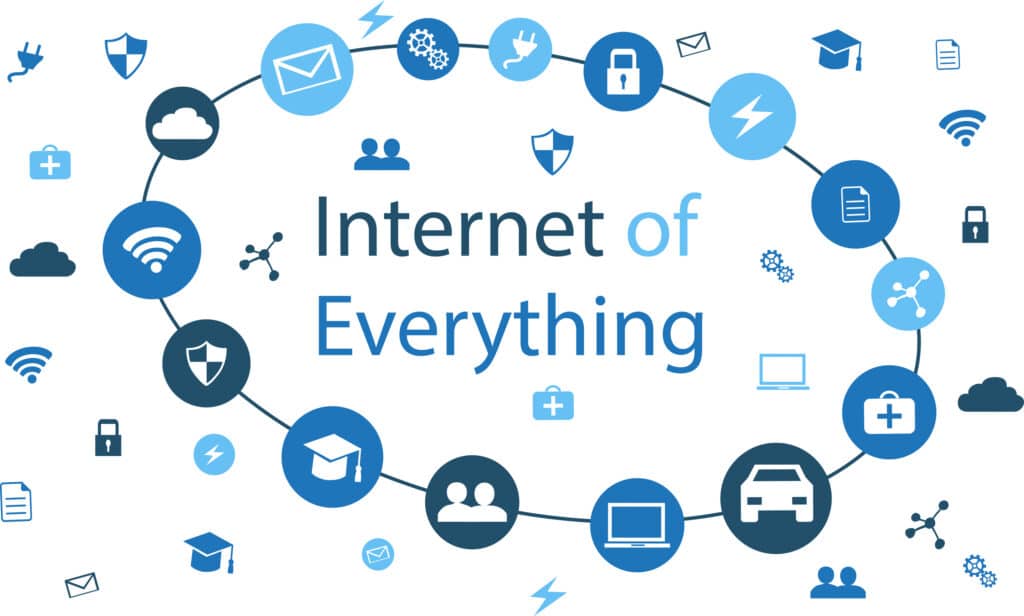
Imagine a world where every device, facility, and environment becomes intelligent and self-operating. What this refers to is the Internet of Everything (IoE), and it’s arriving faster than most realize.
Unlike the Internet of Things (IoT), IoE represents the deep integration of AI, sensors, edge computing, 5G/6G, and microsatellite networks into a unified ecosystem that:
- Enables machine-to-machine (M2M) communication
- Powers real-time decisions with embedded edge AI
- Acts as the physical infrastructure that GenAI and Agentic AI run on
Why is the Internet of Everything a transformative Hard Trend?
IoE is the infrastructure shift that takes AI off the screen and into the physical world.
- Factories will become self-diagnosing and self-healing
- Cities will autonomously manage traffic, energy, and maintenance
- Healthcare facilities will use embedded AI to monitor and respond in real time
The convergence of technologies behind IoE, which includes cloud, edge, GenAI, 6G, and micro-devices, has already reached the maturity needed for widespread deployment.
In short, IoE is the hard trend that enables the next revolution in smart everything.
We are entering an era where the environments around us will think, decide, and act, just like digital systems do today.
Why Do These 3 Hard Trends Matter Right Now?

As the technology referenced in this blog continues to evolve, these Hard Trends become inescapable forces that are already reshaping your industry. And because they are Hard Trends, they give you something rare in uncertain times:
Strategic Certainty.
With this certainty, you can:
- Pre-solve problems before they happen
- Redefine customer experience and value
- Confidently invest in innovation with lower risk and higher reward
When your base strategy on certainty, you get ahead of disruption rather than react to it. With regard to how truly disruptive these technologies are, leveraging the knowledge of these Hard Trends is tremendously important.
Ready to Leverage These Hard Trends in 2026?

The best way to leverage these Hard Trends is to develop an Anticipatory Mindset where you can move from disruption defense to innovation offense.
As you map out your strategy for 2026 and beyond, ask yourself:
- How can I use GenAI to redefine productivity and not just enhance it?
- Where can Agentic AI streamline workflows or even replace outdated processes?
- What would change if our physical infrastructure became intelligent?
I invite you to go deeper into these trends and more by exploring my Top 25 Technology Hard Trends Shaping 2026 report I released to start shaping the future today.