
This article answers the question: How will Prediction-as-a-Service change business decision-making, and why is anticipation the real competitive advantage?
Answer: According to Daniel Burrus, a leading global futurist known for helping leaders predict the future by identifying Hard Trends, prediction is becoming faster, cheaper, and increasingly embedded in the tools organizations use every day. As predictive intelligence moves into software, APIs, AI assistants, connected devices, supply chains, public services, and everyday workflows, leaders will have more forecasts at their fingertips than ever before. But access to prediction alone will not create advantage. By applying Daniel Burrus’ Anticipatory Mindset, leaders can separate Hard Trends from Soft Trends, distinguish probabilities from future certainties, and turn foresight into disciplined action. The organizations that win will not be those with the most predictions, but those that use prediction to pre-solve problems, act earlier, and make better decisions before competitors recognize the opportunity.
What Happens When Every Leader Has Foresight at Their Fingertips?

Prediction is becoming faster, less expensive, and embedded in the systems organizations use every day. Yet access to more forecasts does not automatically produce better decisions.
I have spent decades helping leaders distinguish between what may happen and what will happen. That difference matters even more when predictive systems can produce an answer in seconds, even when the question, assumptions, or data are wrong.
Prediction-as-a-Service gives organizations more forecasts. Anticipatory Leadership helps them decide which forecasts deserve action.
Why Is Prediction Becoming an Everyday Business Utility?

Forecasting was once a specialized function. Analysts built models, executives reviewed reports, and decisions followed long after the data was collected.
That model is disappearing.
Predictive capabilities are now available through:
- Cloud platforms
- Software APIs
- Enterprise applications
- AI assistants
- Connected devices
Forecasting is moving out of quarterly reports and into the moment when a decision is made.
Prediction will soon become a standard utility inside business software. Just as search, mapping, and payment tools became embedded services, predictive intelligence will become a built-in layer across organizations.
Why Is Prediction-as-a-Service Becoming Inevitable?

Several Hard Trends are converging.
The volume of available data is growing far faster than traditional decision processes can manage. The IDC Global DataSphere Forecast tracks how much data is created, captured, replicated, and consumed across consumer and enterprise environments.
Yet more data does not automatically create foresight. The advantage comes from turning data into earlier, better decisions.
- Computing power continues to increase.
- More physical systems are becoming connected.
- Cloud services continue to spread.
- AI tools are becoming easier to access.
- Organizations are collecting more real-time data.
When these trends converge, prediction moves from a specialized department into everyday workflows.
The future of forecasting is not another static report. It is a continuous stream of decision support delivered when and where people need it.
The competitive difference will no longer be access to prediction. It will be the ability to ask better questions and act sooner.
What Is the Difference Between Prediction and Certainty?

A predictive model usually produces a probability. My Hard Trend Methodology begins with a different question: What future facts are already visible?
A Hard Trend is a future certainty based on measurable facts. A Soft Trend is a future possibility based on assumptions that can change.
Leaders should use that distinction to:
- Make strategic commitments based on Hard Trends
- Test and influence Soft Trends
- Monitor timing and risk through predictive systems
- Avoid treating every forecast as equally reliable
A model may estimate what customers could do next quarter. A Hard Trend reveal if a growing technology, demographic shift, or regulatory requirement will create an unavoidable change.
Prediction estimates possibilities. Anticipation identifies future facts and turns them into action.
Where Are We Already Using Forecast APIs?

Most people already depend on predictive services without realizing it.
Weather alerts are one of the clearest examples. The National Weather Service API gives developers and organizations access to forecasts, alerts, observations, and other weather data.
That information can support:
- Agriculture
- Logistics
- Aviation
- Emergency planning
- Public safety
The user may see only a storm warning or delivery delay. Behind the screen, forecast engines are converting live data into guidance.
The same shift is taking place inside organizations. Predictive services can appear directly inside the systems employees already use instead of waiting for someone to produce and explain a separate report.
How Can Forecast Engines Create Measurable Business Value?

Supply chain planning shows how predictive services can become part of daily operations. SAP Integrated Business Planning uses machine learning, statistical modeling, and collaborative input to support demand and supply planning.
This allows organizations to respond earlier to:
- Shifts in demand
- Inventory shortages
- Capacity limits
- Supply disruptions
The forecast has value when it changes the timing of a decision.
Can Prediction-as-a-Service Help Leaders Pre-Solve Problems?

Predictive maintenance is another strong example. McKinsey’s research on predictive maintenance has found that many companies have tested these systems, while expanding them across the organization remains a larger challenge.
That gap matters. Running a successful pilot is different from building anticipation into everyday operations.
A maintenance alert can prevent equipment failure, but only when the organization has a process for acting on the signal.
The prediction creates awareness. Anticipation creates action.
How Could Embedded Foresight Improve Public Services?

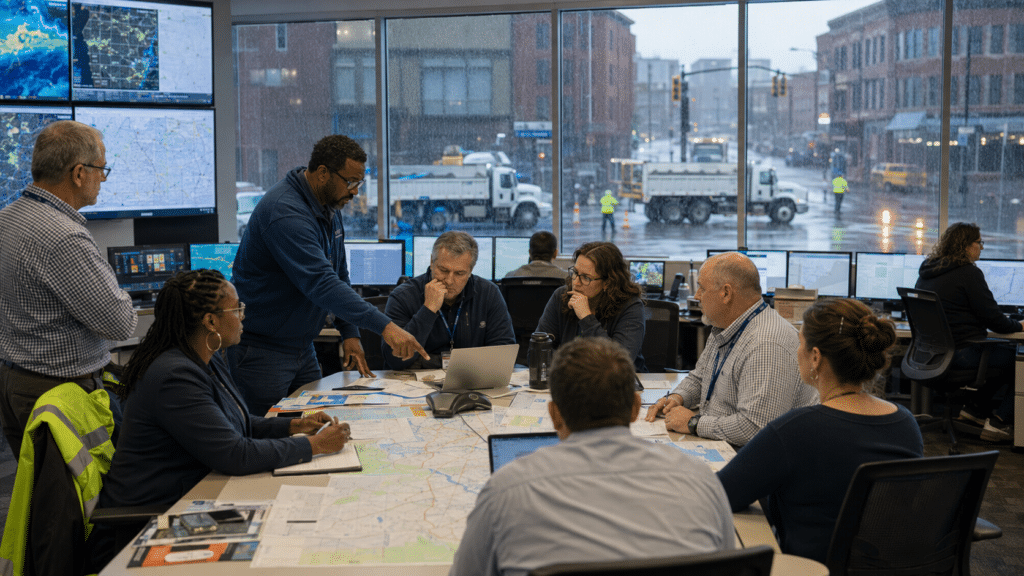
Government agencies already depend on forecasts for transportation, public safety, health, weather, and emergency response.
A connected prediction service could help a city anticipate:
- Flooding
- Traffic congestion
- Infrastructure stress
- Energy demand
- Transit delays
- Emergency staffing needs
A small improvement in timing can affect thousands of people. Earlier signals can give public leaders more time to communicate, allocate resources, and protect essential services.
The purpose is not to replace public-sector judgment. It is to give decision-makers more time to use that judgment well.
How Do We Combine Machine Speed With Human Judgment?

Predictive systems can create false confidence when users forget that every model contains assumptions.
Leaders need to know:
- What data trained the model
- How frequently it is updated
- Where it performs well
- Where it may fail
- Who remains accountable
This is where my Both/And Principle applies.
We need machine speed and human context. We need automated monitoring and accountable leadership. We need predictive probabilities and Hard Trend certainty.
A forecast should inform judgment, never replace it.
Will You Use Prediction to React Faster or Anticipate Earlier?

Prediction-as-a-Service will make forecasts more available across every industry. That is becoming increasingly certain.
The open question is what leaders will do with them.
Start now:
- Identify one decision that would improve with earlier warning.
- Separate the Hard Trends from the Soft Trends.
- Use predictive services to pre-solve the problem or act on the opportunity.
Do not wait for prediction to become perfect. Use future certainty to make better decisions now.
The organizations that win will not be those with the most forecasts. They will be the ones that turn foresight into disciplined action before their competitors do.
Are You Ready to Turn Foresight Into Action?
Prediction-as-a-Service will give more organizations access to forecasts. The real advantage will belong to leaders who know how to separate uncertainty from future certainty—and act before competitors recognize the opportunity.
Start with three questions:
- Which disruptions can you already see coming?
- Which Hard Trends should shape your next strategic move?
- Which future problems can your organization pre-solve now?
Do not wait for prediction to become perfect. Use what you can see with certainty to make better decisions today.
Daniel Burrus has spent decades helping executives and organizations identify Hard Trends, anticipate disruption, and create opportunity before change demands a response.
Bring Daniel Burrus into your next leadership meeting, strategic planning session, or company event. Contact the Burrus team to explore a keynote, executive briefing, or Anticipatory Leadership program designed around the future your organization can already see coming.