Strategic foresight is quickly becoming one of the most powerful tools in leadership, helping organizations to turn uncertainty into opportunity and disruption into advantage. As markets evolve faster than ever before, C-suite leaders are increasingly using foresight, data, and AI-driven insights to stay ahead of change rather than react to it.
We analyzed 27,672 opinions from C-suite leaders in the US about strategic foresight using AI-driven audience profiling, based on 12 months of online discussions ending April 8th, 2026. The findings highlight key priorities, approaches, and challenges, offering insight into how strategic foresight is shaping decision making , guiding investments, and driving long-term competitive advantages in an increasingly complex business environment.
Index
- 42% of C-suite leaders say their organization is fully proactive and that using strategic foresight is central to how they navigate uncertainty and change
- Strategic foresight is a key input to most planning processes for 29% of C-suite leaders
- 61% of C-suite leaders say that strategic foresight plays a key role in budget planning and resource allocation decisions
- 100% of C-suite leaders say that advanced analytics and AI are central to how their organizations conduct strategic foresight
- 88% of C-suite leaders sometimes use AI tools to support soft trend identification in some strategic foresight activities
- 82% of C-suite leaders say that AI regularly helps their organizations to distinguish hard trends from soft trends in strategic foresight work
- 60% of C-suite leaders’ organizations distinguish between soft and hard trends for strategic foresight planning
- 68% of C-suite leaders’ strategic foresight plans are continuously monitored and updated in real time
- 100% of C-suite leaders are moderately confident in their organization’s ability to anticipate and respond to major industry disruptions using strategic foresight but some gaps remain
- 53% of C-suite leaders use strategic foresight to identify and respond to shifts in consumer behavior
- 60% of C-suite leaders use strategic foresight to shape their organization’s approach to customer experience
- 47% of C-suite leaders believe that risk identification and mitigation through strategic foresight has a transformative impact on their organizations
- 75% of C-suite leaders say that identifying and entering emerging markets is the biggest advantage of using strategic foresight to gain a competitive advantage over the next several years
- A lack of leadership buy-in or organizational commitment is only a minor challenge for 92% of C-suite leaders when trying to implement strategic foresight effectively
- 28% of C-suite leaders in the US are based in Los Angeles
- The Move From Reactive to Anticipatory Decision-Making
- About the Data
Which Best Describes C-Suite Leaders Organization’s Overall Approach to Managing Uncertainty and Change?
42% of C-suite leaders say their organization is fully proactive and that using strategic foresight is central to how they navigate uncertainty and change
Approaches to uncertainty and change are mostly proactive: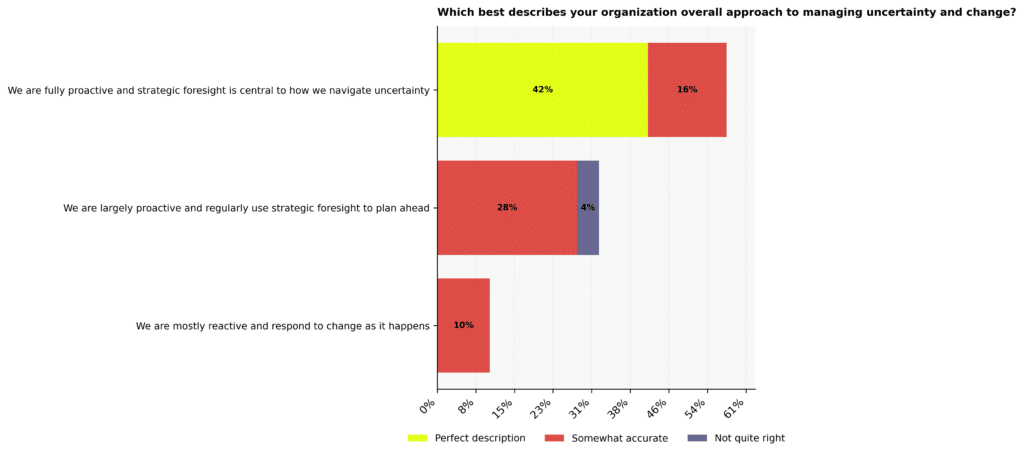
A report from the International Monetary Fund highlights how strategic foresight has been successfully implemented to navigate future uncertainties in different types of organizations, ranging from SMEs to government departments. This aligns with our audience’s opinions, who use it in varying degrees to manage uncertainty and change.
42% of C-suite leaders say the perfect description of their organization’s approach to this kind of upheaval is fully proactive, and that strategic foresight is central to how they navigate uncertainty, while 16% say this description is somewhat accurate. Another 28% say that it’s somewhat accurate that their organization is largely proactive and regularly uses strategic foresight to plan ahead, while only 4% say this isn’t quite the right fit for them.
However, 28% of C-suite leaders say their organization is mostly reactive and responds to change as it happens, indicating that, while strategic foresight is widely recognized and adopted to some degree, a significant proportion of organizations still operate in a more responsive rather than fully anticipatory mode.
Daniel Burrus, named one of the 2026 World’s Top 30 Futurist Professionals, comments: Too many leaders still treat uncertainty as something to react to, when in reality it’s something you can anticipate. The organizations that outperform in times of disruption are not the ones with the best reaction time, but the ones that have learned to separate certainty from uncertainty and use strategic foresight to act on that distinction. What stands out in this data is that while many C-suite leaders are becoming more proactive, a meaningful percentage still remain reactive. That is the real competitive divide. Strategic foresight is not about predicting the future; it is about identifying the hard trends that will happen and using them to pre-solve problems, capitalize on disruption, and shape your advantage before others even see it coming.
How Integrated Is Strategic Foresight With C-Suite Leaders’ Overall Corporate Strategy Development Process?
Strategic foresight is a key input to most planning processes for 29% of C-suite leaders
Strategic foresight is largely crucial to corporate strategy development processes: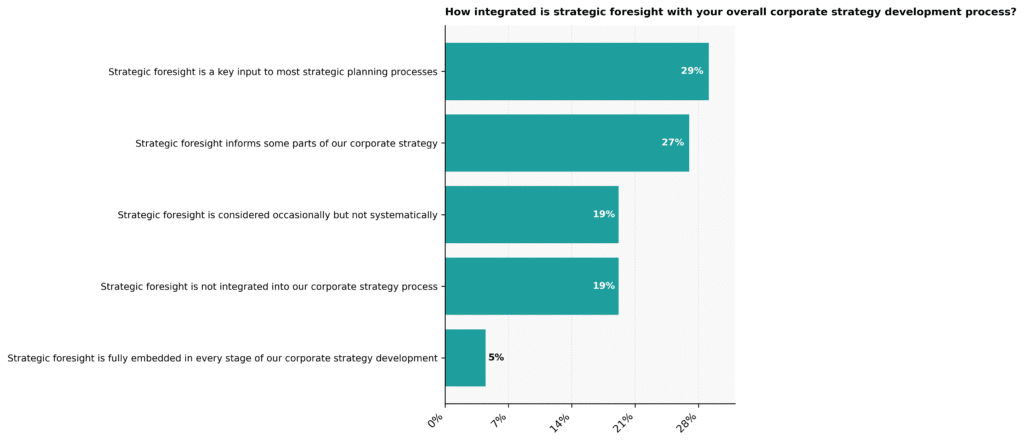
In 2021, the NIM reported that as many as 90% of organizations were already using strategic foresight in their business strategy. For our audience, it’s also generally well integrated into their organization’s overall corporate strategy development process.
While only 5% of C-suite leaders say it’s fully embedded in every stage of their corporate strategy development, another 29% say it’s a key input to most strategic planning processes, 27% say it informs some part of corporate strategy, and 19% that it’s considered occasionally but not systematically.
19% lag behind, saying that strategic foresight is not integrated into their organization’s corporate strategy process, bucking the trend and likely putting them at a distinct disadvantage compared to those who are embedding foresight more consistently to anticipate change and plan ahead.
Daniel Burrus comment: Strategic foresight delivers its greatest value when it moves from the margins to the center of strategy. If it is only informing part of the planning process or being considered occasionally, leaders are leaving opportunity on the table. The future does not operate in silos, and neither should strategy. The organizations gaining the greatest advantage are the ones embedding foresight into every stage of strategic development, using it not just to respond to change, but to identify certainty, anticipate disruption, and make smarter decisions before competitors do.
How Do C-Suite Leaders Describe the Role That Strategic Foresight Plays in Their Organization’s Budget Planning Process?
61% of C-suite leaders say that strategic foresight plays a key role in budget planning and resource allocation decisions
Strategic foresight and budget decision-making go hand in hand: 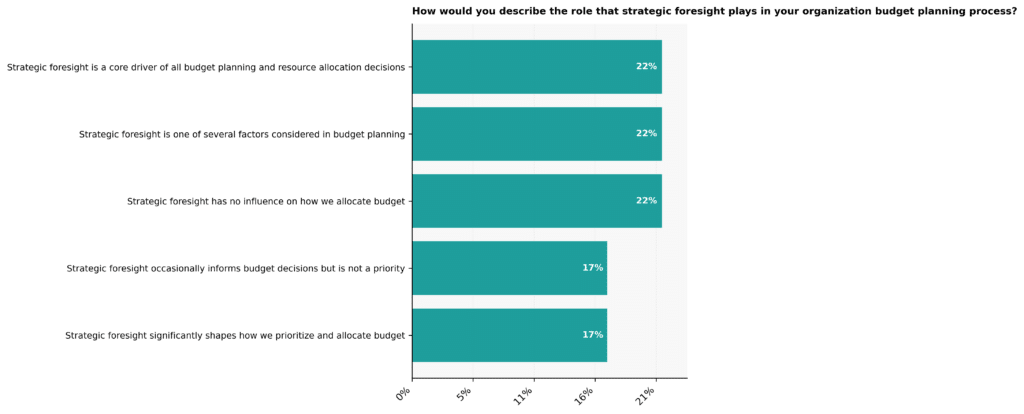
Strategic foresight largely plays an integral role in C-suite leaders’ organizational budget planning process, with 22% agreeing it’s a core driver of all budget planning and resource allocation decisions, another 22% saying it’s one of several factors considered in budget planning, and 17% saying it significantly shapes how they prioritize and allocate budget, showing it is increasingly embedded in core decision-making.
Yet, some organizations use strategic foresight only occasionally to inform budget decisions, and it’s not a priority. 22% say it has no influence on how they allocate their budgets, proving that, while foresight is deeply embedded among many leaders, adoption and integration remain inconsistent.
Daniel Burrus comments: Budgeting is one of the clearest indicators of whether an organization is serious about strategic foresight or merely talking about it. It is easy to say the future matters; it is much harder to fund for it. When foresight influences budget planning and resource allocation, leaders are doing more than reacting to current pressures, they are investing in the opportunities and disruptions they can see coming. That is how you move from short-term expense management to long-term strategic advantage.
To What Extent Do C-Suite Leaders’ Organizations Use Data and Analytics to Support Strategic Foresight Decision-Making?
100% of C-suite leaders say that advanced analytics and AI are central to how their organizations conduct strategic foresight
Opinions are unanimous about the use of data and analytics: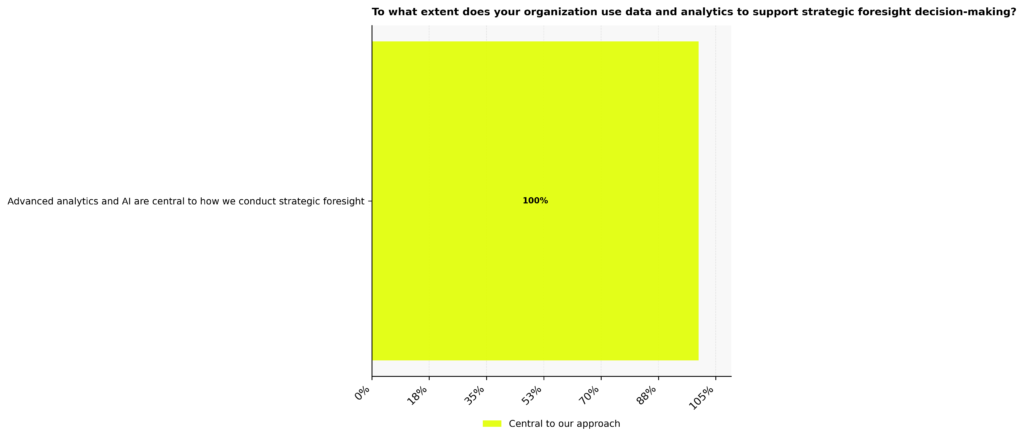
Studies show that AI is primarily valued for its ability to save time and handle repetitive, labor-intensive tasks. This closely mirrors the finding that 100% of C-suite leaders in our audience say advanced analytics and AI are central to how their organizations conduct strategic foresight.
These unanimous opinions point to a clear convergence between operational efficiency and strategic decision-making, where AI is streamlining day-to-day processes and serving as a foundational enabler of forward-looking, data-driven insights at the highest levels of leadership.
Daniel Burrus, recognized as a 2026 Top AI Conference Speaker, comments: Strategic foresight without data is speculation. Strategic foresight powered by analytics and AI becomes a leadership advantage. What is especially significant here is the unanimity. When 100% of C-suite leaders say advanced analytics and AI are central to foresight, it confirms that the future of strategy is no longer based on instinct alone. The most effective leaders are combining human judgment with machine intelligence to identify patterns earlier, reduce uncertainty faster, and make better decisions with greater confidence.
How Often Do C-Suite Leaders’ Organizations Use AI Tools to Identify Soft Trends?
88% of C-suite leaders sometimes use AI tools to support soft trend identification in some strategic foresight activities
AI is used by everyone to some degree: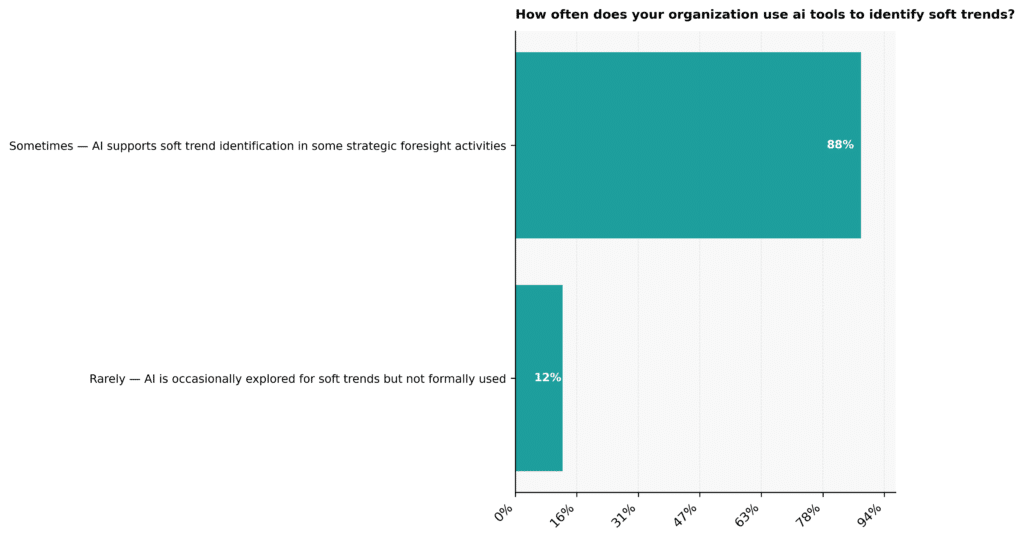
With 88% of C-suite leaders saying that their organizations sometimes use AI to support soft trend identification in strategic foresight activities,and a further 12% doing so only rarely, it’s clear that AI is still being used more informally than as a fully embedded capability.
Yet, its potential is significant. AI-powered clustering can uncover new micro-segments and surface evolving trends and consumer preferences that traditional methods often miss, while enabling automated data analysis, pattern recognition, predictive modeling, and dynamic scenario generation to enhance accuracy and depth of insight.
Daniel Burrus comment: This data shows that leaders clearly recognize AI’s value in spotting Soft Trends, but for most, it has not yet become a deeply embedded capability. That matters, because Soft Trends are often the earliest indicators of disruption, innovation, and shifting customer expectations. AI gives organizations the ability to scan wider, learn faster, and uncover signals that traditional analysis can easily miss. The companies that move from informal use to disciplined integration will be the ones best positioned to turn emerging change into strategic opportunity.
How Effectively Do C-Suite Leaders’ Organizations Use AI to Separate Hard Trends From Soft Trends?
82% of C-suite leaders say that AI regularly helps their organizations to distinguish hard trends from soft trends in strategic foresight work
All leaders are utilizing AI for trend separation: 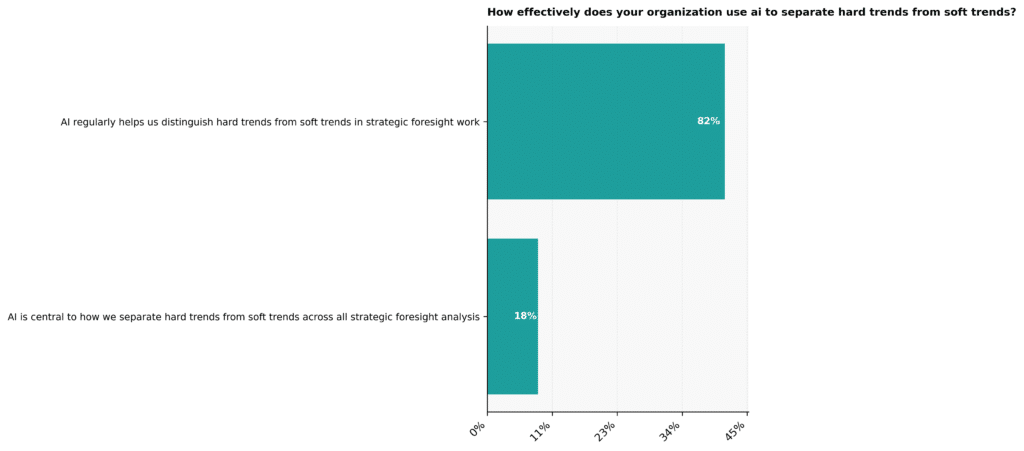
It’s clear AI is playing an increasingly important role in how organizations distinguish between hard and soft trends within strategic foresight.
82% of C-suite leaders say that AI regularly helps their organizations differentiate between the two, while a further 18% say it’s central to how they separate hard trends from soft trends across all foresight analysis work. This widespread reliance reflects AI’s strength in processing large volumes of data, identifying patterns, and filtering signals based on reliability and consistency over time.
Daniel Burrus comment: This finding is especially important because separating Hard Trends from Soft Trends is foundational to Anticipatory Leadership. AI can dramatically strengthen that capability by processing signals at scale, identifying patterns humans may miss, and helping leaders focus on what is certain versus what is still changeable. That matters because the future is not something to be guessed at broadly. It is something to be understood in layers of certainty, and then acted on strategically.
How Well Do C-Suite Leaders’ Organizations Distinguish Between Soft Trends and Hard Trends?
60% of C-suite leaders’ organizations distinguish between soft and hard trends for strategic foresight planning
Distinguishing between soft and hard trends is done differently: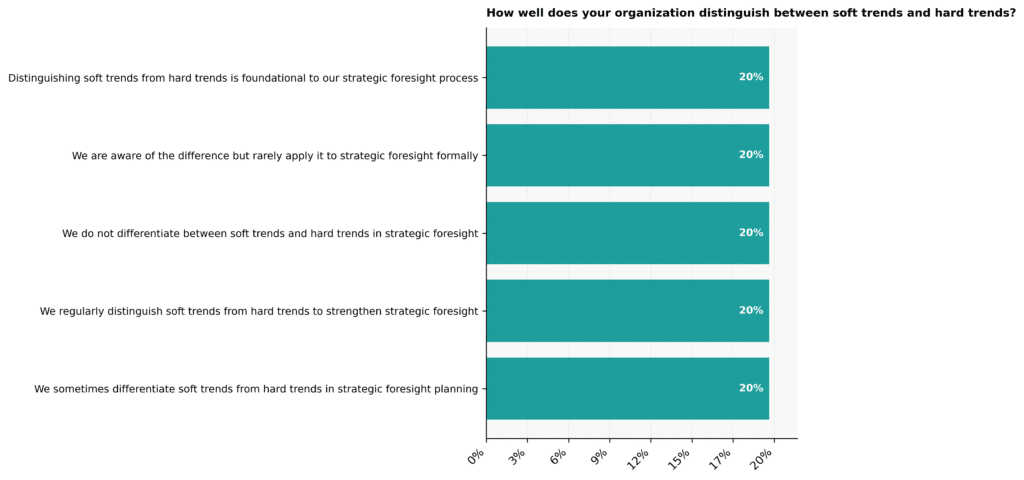
When it comes to how well organizations distinguish between soft and hard trends, C-suite leaders’ opinions are evenly split across five groups, at 20% each.One group sees this distinction as foundational to strategic foresight, another applies it regularly, and a third so only occasionally. The remaining groups either rarely apply the distinction despite understanding it or do not differentiate between the two at all.
This divide highlights a broader gap in foresight maturity. Organizations that get strategic foresight right excel in both process and mindset as they equip teams to assess uncertainty across time horizons and identify opportunities using data and advanced tools. Those who fail to distinguish between trend types are more likely to fall behind, lacking the structure and forward-looking perspective needed to fully capitalize on foresight.
Daniel Burrus comment: These findings reveal a clear maturity gap. Organizations that consistently distinguish between Hard Trends and Soft Trends are far better positioned to anticipate disruption, allocate resources wisely, and uncover opportunity before others do. Those that fail to make that distinction are often left treating all uncertainty the same, which weakens decision-making and limits strategic agility. Strategic foresight is not just about seeing change coming. It is about knowing which future developments are certain, which are flexible, and what to do about both.
How Frequently Do C-Suite Leaders’ Organizations Revisit and Update Their Long-Range Strategic Foresight Plans in Response to Emerging Trends?
68% of C-suite leaders’ strategic foresight plans are continuously monitored and updated in real time
Real-time monitoring is the primary route: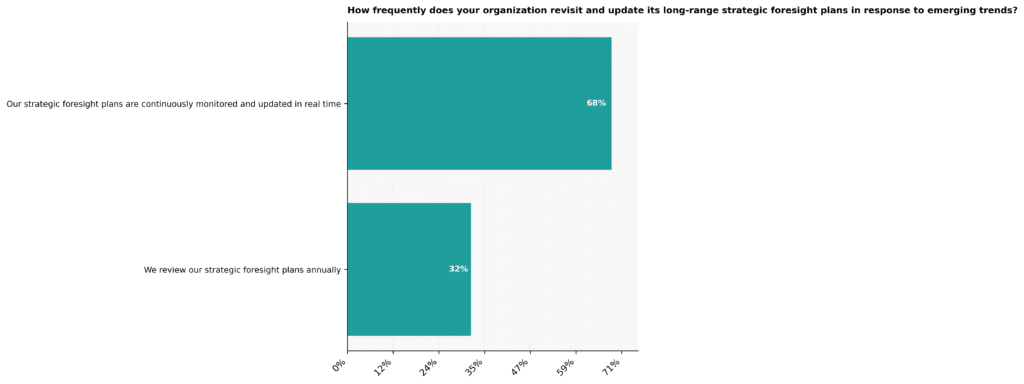
Whereas VUCA (Volatile, Uncertain, Complex, and Ambiguous) environments were previously the norm, the current operating environment is BANI (Brittle, Anxious, Non-linear, and Incomprehensible). Because of this, traditional annual planning cycles may struggle to keep up with AI, geopolitical shifts, and changing consumer breakthroughs. This is likely why only 32% of C-suite leaders say their organizations review their strategic foresight plans every year.
In contrast, 68% continuously monitor and update their plans in real time, enabling them to respond to events and breakthroughs as they occur. This creates a stronger competitive edge and provides more business resilience, too.
Daniel Burrus comment: This finding reflects a major shift in what effective strategy now requires. In today’s environment, the future is moving too fast for static planning cycles. Strategic foresight must be dynamic, continuously informed by emerging trends, market signals, and technological change. The leaders who revisit and refine their long-range plans in real time are not simply staying current, they are building the agility and clarity needed to shape outcomes instead of being surprised by them.
How Confident Are C-Suite Leaders in Their Organization’s Ability to Anticipate and Respond to Major Industry Disruptions Using Strategic Foresight?
100% of C-suite leaders are moderately confident in their organization’s ability to anticipate and respond to major industry disruptions using strategic foresight, but some gaps remain
Opinions are the same regarding confidence in ability:
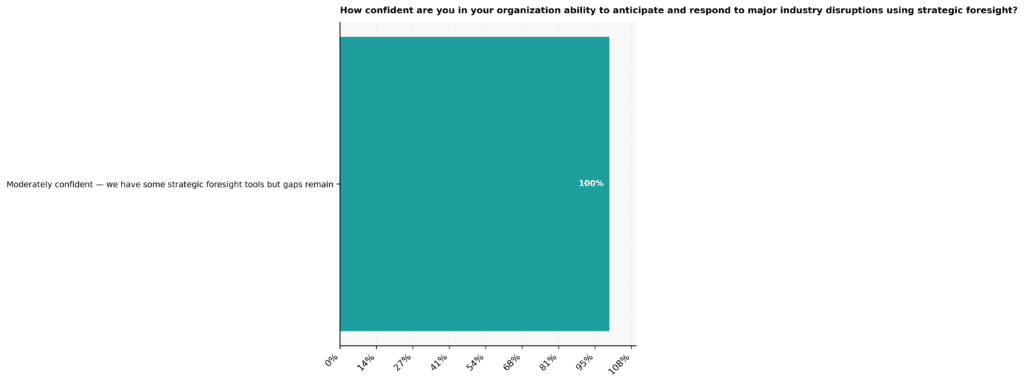
100% of C-suite leaders in our audience report being moderately confident in their organization’s ability to anticipate and respond to major industry disruptions using strategic foresight, indicating a widespread belief in its value. However, this confidence does not necessarily reflect full capability.
Research shows that while strategic foresight is evolving and improving, most organizations are still not fully equipped to execute it effectively. This suggests a gap between perception and practice, where leaders recognize the importance of foresight but may lack the tools, integration, or real-time capabilities needed to fully integrate it.
Daniel Burrus comment: Confidence is important, but confidence without capability can create blind spots. What stands out in this data is that leaders clearly believe in the value of strategic foresight, yet moderate confidence also suggests many organizations know they still have room to grow. Anticipating disruption requires more than awareness. It requires the ability to identify hard trends, track accelerating change in real time, and turn insight into action. The organizations that close that gap between belief and execution will be the ones best positioned to lead through uncertainty.
How Do C-Suite Leaders Describe Their Organization’s Ability to Use Strategic Foresight to Identify and Respond to Shifts in Consumer Behavior?
53% of C-suite leaders use strategic foresight to identify and respond to shifts in consumer behavior
The ability to respond to changing behavior differs: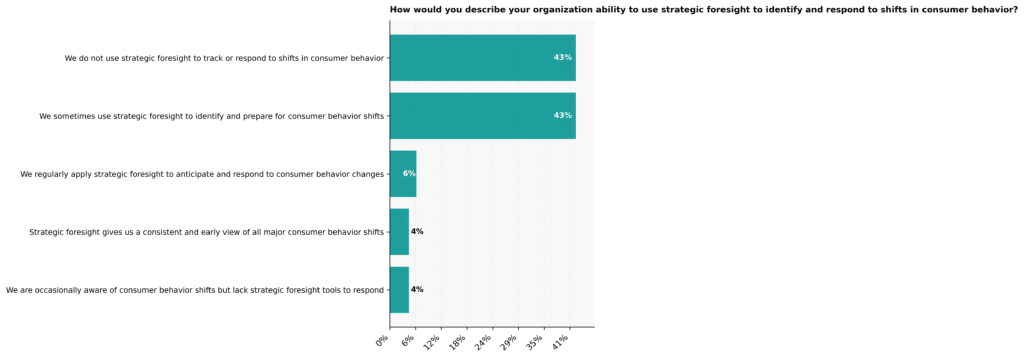
Consumer behavior changes regularly, with a 2025 State of the Consumer report from McKinsey revealing that in just one year, customers became more digital and convenience-driven, spending behavior became more selective, sentiment no longer matched, and price sensitivity increased, amongst numerous other observations.
The ability to predict these shifts in behavior is crucial to long-term success, but not all C-suite leaders are using strategic foresight to monitor these important developments. A substantial 43% say they don’t use strategic foresight to track or respond to shifts in consumer behavior, while 4% use it only occasionally.
These leaders are missing out on valuable data that could cost their organizations considerable profits in the long-term. Fortunately, slightly more than half are using strategic foresight to identify and respond to shifts in consumer behavior, with 43% doing so sometimes, 6% regularly, and 4% consistently.
Daniel Burrus Comments: Customer behavior is one of the earliest places disruption becomes visible. When leaders use strategic foresight to identify shifts in how customers think, buy, and engage, they gain the ability to move ahead of demand rather than react to it after the market has already changed. What is striking here is that nearly half of organizations are still not using foresight in this area. That creates a major vulnerability, because in times of rapid change, the organizations that understand evolving customer expectations first are the ones that shape the market, protect relevance, and capture growth.
How Do C-Suite Leaders Describe the Role of Strategic Foresight in Shaping Their Organization’s Approach to Customer Experience?
60% of C-suite leaders use strategic foresight to shape their organization’s approach to customer experience
CX is a core focus for C-suite leaders: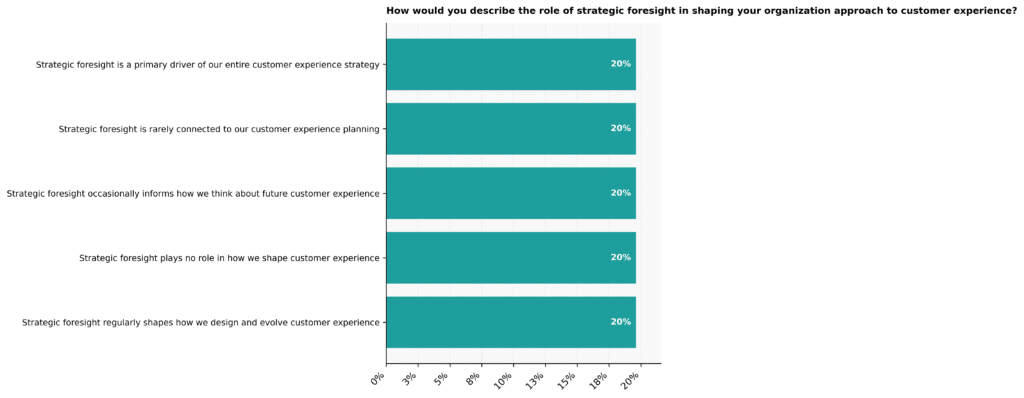
Having insight into trends and adapting customer experiences (CX) accordingly is essential for organizational success, and a significant portion of our audience recognizes this. 60% of C-suite leaders say they are using strategic foresight to shape their organization’s approach to customer experience, with a three-way split between those who say it is a primary driver of their organization’s entire CX strategy, those agreeing it regularly shapes how they design and evolve CX, and the leaders who describe it as occasionally informing how they think about future CX.
The remaining 40%is split evenly between those who say strategic foresight plays no role in shaping CX and those who say it is rarely connected to CX planning. This highlights a major gap in how consistently organizations embed forward-looking insights into customer experience strategy, with many still relying on reactive, short-term approaches rather than proactive,foresight-led design.
Daniel Burrus comment: Customer experience should never be designed only for where customers are today. It should be shaped by where their expectations are going tomorrow. Strategic foresight gives leaders the ability to anticipate those shifts and build experiences that stay relevant, differentiated, and valuable as markets evolve. What this data shows is that while many organizations are beginning to connect foresight to CX, too many are still treating customer experience as a reactive function rather than a strategic opportunity to lead change.
Which Area Do C-Suite Leaders Believe Strategic Foresight Has the Greatest Potential to Impact Within Their Organization?
47% of C-suite leaders believe that risk identification and mitigation through strategic foresight has a transformative impact on their organizations
Strategic foresight has major impacts across organizations: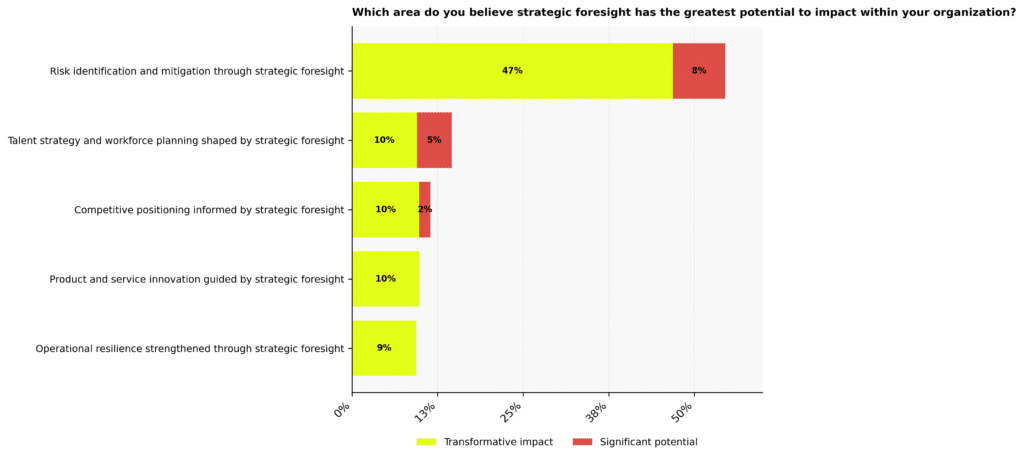
There are differing opinions on the areas in which C-suite leaders believe strategic foresight has the greatest potential to impact within their organization, with risk identification and mitigation coming out on top. 43% believe it can have a transformative effect, and 8% say it has significant potential.
Thereafter, opinions are largely divided into 10% who say that operational resilience is strengthened through strategic foresight, another 10% who highlight product and service innovation as the area with the most potential, as well as competitive positioning, talent strategy and workforce planning (both 10%). However, the latter two also have 5% and 2% who feel this area has significant potential.
These opinions highlight a broad but fragmented view of strategic foresight’s value, suggesting that while risk management is the clearest priority, its perceived impact across other business functions is more distributed and less consistent.
Daniel Burrus comment: Risk identification rising to the top is not surprising, because one of the greatest values of strategic foresight is helping leaders see disruption early enough to turn vulnerability into preparedness. But strategic foresight should not be viewed only as a defensive tool. Its real power is broader. It helps organizations mitigate risk, yes, but also uncover innovation, strengthen resilience, sharpen competitive positioning, and better align talent and strategy with the future. The leaders who gain the most value from foresight are the ones who use it not just to protect the business, but to transform it.
What Is the Biggest Opportunity C-Suite Leaders See for Leveraging Strategic Foresight to Gain Competitive Advantage Over the Next Several Years?
75% of C-suite leaders say that identifying and entering emerging markets is the biggest advantage of using strategic foresight to gain a competitive advantage over the next several years
Two main opportunities are cited:
McKinsey predicted that by 2025, annual consumption in emerging markets would reach $30 trillion, making it the biggest growth opportunity in capitalism’s history. Understandably, then, 73% of C-suite leaders say that the ability to identify and enter emerging markets through strategic foresight is a transformative advantage that will impact them over the next several years.
Another 4% feel the same about the ability to build a more agile and resilient supply chain using strategic foresight, while 21% agree this is a promising opportunity. This reinforces the important role that supply chains play in enabling organizations to capture growth, manage volatility, and respond effectively to shifting global demand.
Daniel Burrus Comments: Emerging markets represent one of the clearest examples of why strategic foresight matters. Growth rarely appears first in the obvious places. It appears where demographic shifts, economic development, technology adoption, and changing customer needs begin to converge. Leaders who use strategic foresight to identify those patterns early are far better positioned to enter new markets with confidence, allocate resources more intelligently, and establish advantage before competitors fully recognize the opportunity.
What Is the Primary Barrier C-Suite Leaders’ Organizations Face When Trying to Implement Strategic Foresight Effectively?
A lack of leadership buy-in or organizational commitment is only a minor challenge for 92% of C-suite leaders when trying to implement strategic foresight effectively
There are minimal barriers to entry: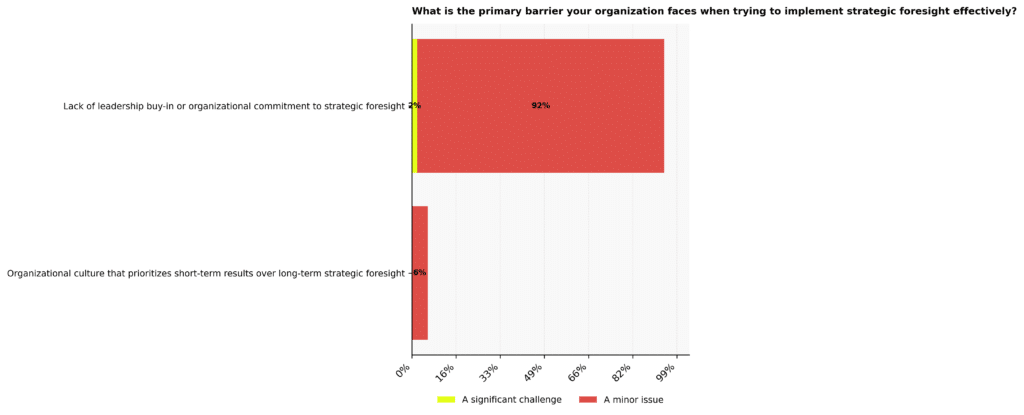
Based on our audience’s opinions, there are very few barriers to implementing strategic foresight effectively. 92% agree that a lack of leadership buy-in or organizational commitment to strategic foresight is only a minor issue, and a meager 2% say this is a significant challenge.
6% also say that having an organizational culture that prioritizes short-term results over long-term strategic foresight is a minor issue, highlighting just how easy it is for most organizations to adopt and integrate foresight into their existing strategic processes.
Daniel Burrus comment: This is encouraging, because it suggests the conversation around strategic foresight has already gained meaningful traction at the leadership level. When buy-in is no longer the primary obstacle, the real challenge shifts from persuasion to execution. The question is no longer whether leaders believe foresight matters. It is whether they are embedding it deeply enough into culture, decision-making, and daily operations to produce measurable advantage.
Which City Are The C-Suite Leaders in Our Audience Based In?
28% of C-suite leaders in the US are based in Los Angeles
LA is home to the largest numbers: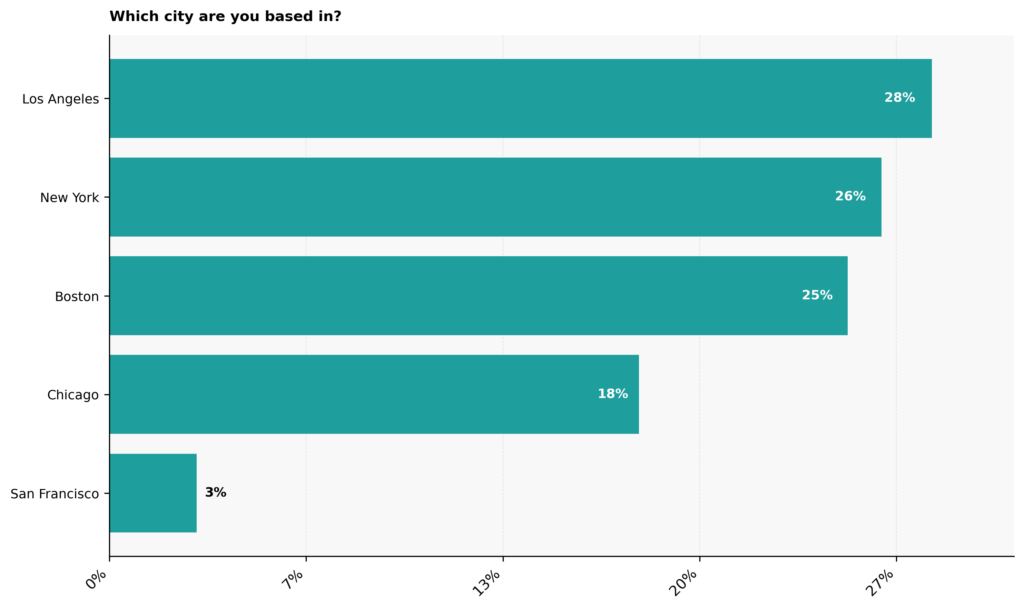
U.S. C-suite leaders are relatively evenly distributed across regions (Los Angeles 28%, New York 26%, Boston 25%, and Chicago 18%), with only small percent differences. However, the tech capital of the world lags significantly, with just 3% of leaders based here. Placing it well behind the other major hubs and suggesting a notable geographic variation in where strategic leadership is concentrated versus where it may be expected.
Daniel Burrus comment: Where leadership is concentrated matters, because geography often shapes how organizations perceive disruption, opportunity, and innovation. What is interesting here is not just that Los Angeles leads, but that the distribution is relatively close across several major business hubs. That suggests strategic foresight is not confined to one dominant center of influence. It is becoming a broader leadership priority across diverse markets. At the same time, the surprisingly low concentration in Silicon Valley is a reminder that strategic leadership and technology leadership do not always reside in the same place.
The Move From Reactive to Anticipatory Decision-Making
Overall, the findings show that strategic foresight is widely recognized as a critical component of leadership, particularly in areas such as budgeting, risk management, and long-term planning. However, levels of integration and maturity vary significantly across US organizations, with some fully embedding foresight into core decision-making, while others apply it more selectively or not at all.
The growing influence of AI and advanced analytics is accelerating adoption, but differences in execution highlight an ongoing divide between awareness and full operational integration. As organizations continue to navigate uncertainty, the ability to move from reactive planning to truly foresight-led strategy will increasingly define their competitive advantage.
Daniel Burrus comment: These findings reflect an important shift in modern leadership. Strategic foresight is gaining recognition across budgeting, risk, planning, and customer strategy, but recognition alone is not enough. The real differentiator is execution. Organizations that embed foresight into the core of decision-making, supported by AI, analytics, and a disciplined understanding of Hard Trends and Soft Trends, will be far better positioned to transform uncertainty into opportunity. Those that remain reactive will continue to be defined by change rather than helping define it.
About The Data
Sourced using Artios from an independent sample of 27,672 opinions of C-suite leaders in the US across X, Quora, Reddit, Bluesky, TikTok, and Threads. Responses are collected within a 95% confidence interval and 5% margin of error. Results are derived from what people describe online, from opinions expressed, and not from actual questions answered by people in the sample.
Best AI Speakers Statistics: US 2026 << >> Futurist Speakers Statistics: USA 2026