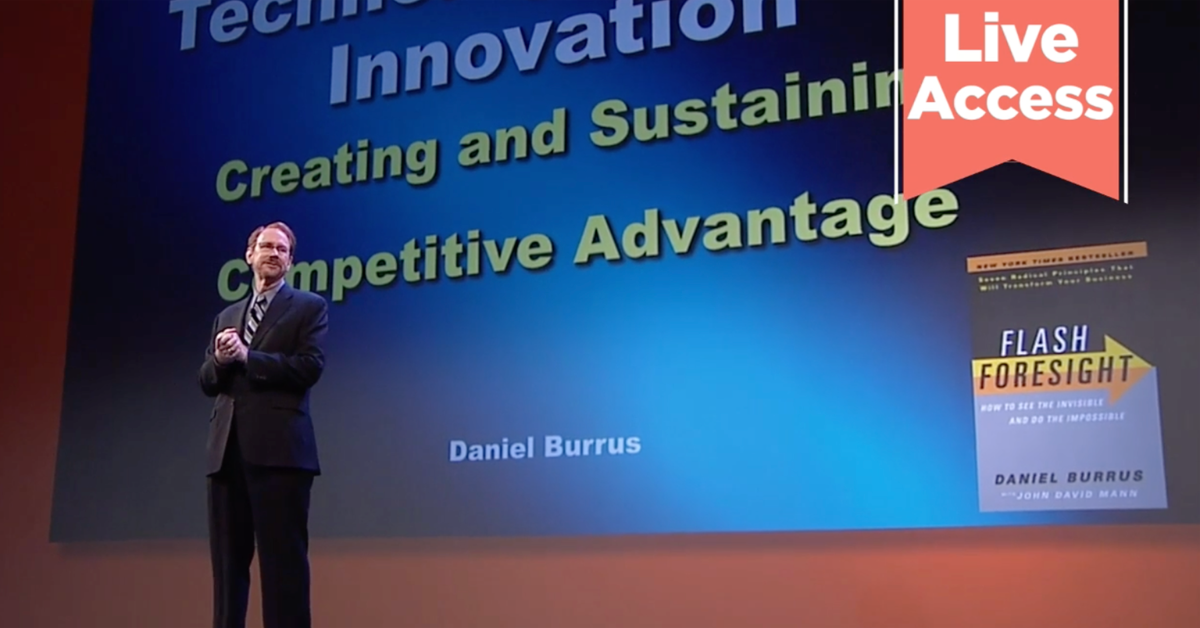
Futurist speakers have become a go-to choice for business events where leaders want more than motivation. They are invited to challenge established thinking, surface emerging trends, and help audiences make sense of what lies ahead. From technology and innovation to leadership and long-term strategy, the best futurist speakers are expected to turn big ideas into perspectives that feel relevant, timely, and worth acting on.
To find out what 164,925 opinions of business leaders who have booked futurist speakers for their events in the US were, we utilized AI-driven audience profiling to synthesize insights from online discussions for a full year to a high statistical confidence level. This approach allows us to examine shared decision patterns at scale, revealing what consistently shapes credibility, value, and impact when organizations invest in future-focused voices.
Index
- 52% of business leaders who have booked futurist speakers for their events say that Cory Doctorow is their top choice
- 50% of business leaders who have booked futurist speakers say that visionary keynote specialists are their top recommendation for business events
- 28% of business leaders who have booked futurist speakers for their events agree that a strong audience connection is an absolutely essential motivator for working with the same speaker again
- 100% of business leaders who have booked futurist speakers for their events say that they assess if a speaker has met their expectations by the engagement level
- 50% of business leaders who have booked futurist speakers for their events value actionable insights as an absolutely essential quality in a speaker
- The range of speaker options from a current provider is extremely important for 28% of business leaders who have booked futurist speakers for their events
- 70% of business leaders who have booked futurist speakers for their events say that speed of response is the top priority they’d like to see their current provider improve on
- Unique insights are a major influence when choosing a final futurist speaker for 36% of business leaders who have booked speakers for their events
- 55% of business leaders who have booked futurist speakers for their events say that audience engagement is a strong factor that influences their search process
- 53% of business leaders who have booked futurist speakers for their events say that industry presence is their top method for validating a speaker’s credibility
- 70% of business leaders who have booked futurist speakers for their events say they use audience suitability and message adaptability to evaluate a speaker’s suitability for their theme
- When reviewing speaker content, innovation levels are absolutely essential for 29% of business leaders who have booked futurist speakers for their events
- When making a final decision on speaker selection, innovation quality is an important factor for 90% of business leaders who have booked futurist speakers for their events
- 76% of business leaders who have booked futurist speakers for their events are based in San Francisco
- 47% of business leaders who have booked futurist speakers for their events work in the healthcare industry
- Measuring the Value of Futurist Presentations
- About the Data
Which Futurist Speakers Have You Hired?
52% of business leaders who have booked futurist speakers for their events say that Cory Doctorow is their top choice
Most bookings cluster around one familiar name, with others attracting more selective interest:

Cory Doctorow stands out among the speakers whom business leaders have booked for their events, with 52% naming him as a top choice and a further 12% saying they would consider him, suggesting his focus on technology, power, and digital rights resonates strongly with decision-makers. At the same time, 6% say he is not their preference, and 8% would not hire him, pointing to clearly defined views rather than universal appeal.
Kevin Kelly appears more selectively, with 5% calling him a top choice, 2% saying they would consider him, 2% noting he is not their preference, and 6% saying they would not hire him, reflecting interest in his long-range thinking on technology, systems, and optimism about progress. Michio Kaku is named a top choice by 3%, with less than 1% saying they would consider him and less than 1% saying they would not hire him, indicating appeal rooted in big-picture science storytelling.
Ray Kurzweil registers at 2% as a top choice, with less than 1% saying they would consider him, reflecting niche demand for his work on AI, exponential growth, and long-term futures. Peter Diamandis stands apart, with no opinions expressed, suggesting limited visibility in this audience rather than active sentiment.
Daniel Burrus Comments: Well-known names on social media tend to surface repeatedly in on-line discussions where the survey results were drawn from because they’re visible, not necessarily because they’re the most effective for a specific business presentation.
In my experience delivering more than 3,500 keynotes across global industries, the most successful engagements occur when organizations prioritize relevance and impact over recognition. A futurist speaker’s real value lies in their ability to understand the business realities of the audience and translate future forces into strategic advantage. On-line popularity may open the door, but impact determines whether a speaker is invited back.
Who Are The Best Futurist Speakers For Business Events?
50% of business leaders who have booked futurist speakers say that visionary keynote specialists are their top recommendation for business events
The strongest recommendations favor speakers who can frame what comes next:
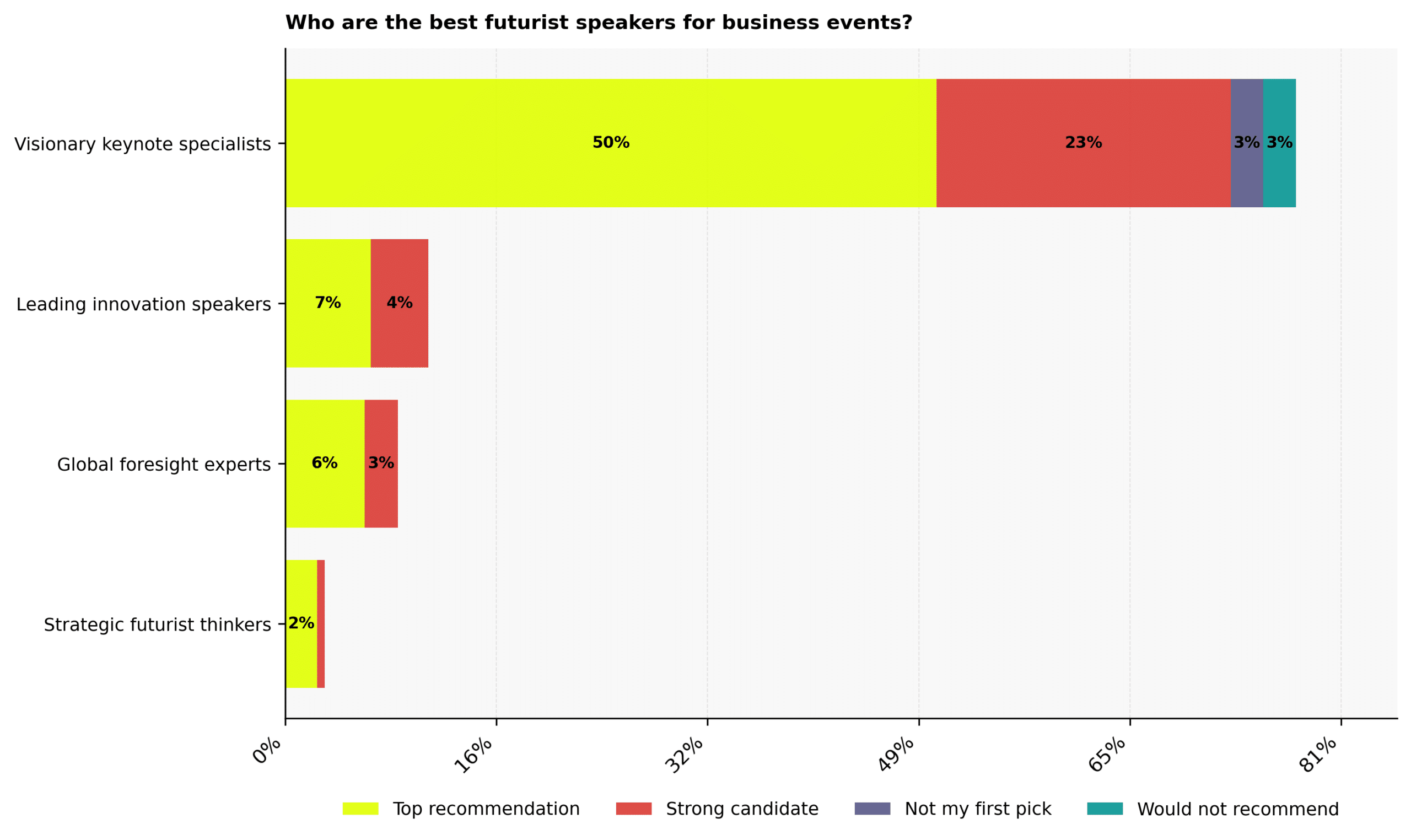
The best futurist speakers for business events are most often defined by their ability to articulate vision. Visionary keynote specialists lead strongly, with 50% of business leaders who have booked futurist speakers for their events in our audience naming them as a top recommendation, and 23% as strong candidates. This reflects the value business audiences place on speakers who can frame long-term direction and help leaders navigate uncertainty.
This is an approach central to visionary leadership research, which emphasizes the importance of leaders providing clear strategic direction in uncertain times. At the same time, 3% say they are not their first pick, and 3% would not recommend them, showing that vision alone does not suit every event context.
Leading innovation speakers follow at a distance, with 7% naming them as a top recommendation and 4% as strong candidates, suggesting appeal where applied innovation is the focus. Global foresight experts register at 6% top recommendation and 3% strong candidate, reflecting interest in macro trends and global context. Strategic futurist thinkers appear more selectively, with 2% naming them as a top recommendation and less than 1% as strong candidates, indicating niche demand for deep strategic framing rather than broad keynote delivery.
Daniel Burrus Comments: Business audiences consistently gravitate toward speakers who can articulate a compelling vision based on the technological, demographic, and geopolitical forces that are shaping the future. But vision alone isn’t enough. What leaders ultimately need is clarity they can act on. The most effective futurist speakers don’t just describe what’s coming; they explain what leaders should do to turn disruption into opportunity. My work focuses on anticipatory leadership, helping executives identify certainties about the future and using them to reduce risk and accelerate innovation. Based on my experiences delivering 100 keynote speeches every year for several decades, the best futurist speakers are those who connect vision directly to actionable decision-making.
What Drives You To Work With The Same Futurist Speaker Again?
28% of business leaders who have booked futurist speakers for their events agree that a strong audience connection is an absolutely essential motivator for working with the same speaker again
Lasting appeal comes from a combination of delivery and depth:

What drives business leaders who have booked futurist speakers for their events to work with the same speaker again is a combination of connection and substance. Strong audience connection is absolutely essential for 28%, highlighting how speakers who tailor their message and engage listeners directly leave a lasting impression. This reflects guidance on effective speaking from Harvard’s Continuing Education Division that stresses making presentations audience-focused, ensuring people feel understood rather than spoken at.
Fresh insights play an even broader role overall, with 47% describing them as a strong factor and a further 25% saying they somewhat matter. This suggests that while connection builds trust, it is the ability to consistently offer new, relevant thinking that ultimately brings audiences back.
Daniel Burrus Comments: Every year, I have a large number of repeat speaking clients. Strong audience connection is essential; but connection is a byproduct of powerful stories that are highly relevant and engaging. Audiences engage when they feel a speaker understands their industry, their pressures, and their decisions. That’s why I tailor every keynote using real-world scenarios from the specific industry in the room, whether it be healthcare, manufacturing, technology, sales, or financial services. When leaders see their own challenges reflected back to them with insightful solutions, engagement becomes natural rather than performative. In my experience, repeat bookings happen when audiences leave saying, “We can use this immediately.
How Do You Usually Assess If A Futurist Speaker Met Your Event Expectations?
100% of business leaders who have booked futurist speakers for their events say that they assess if a speaker has met their expectations by the engagement level
Success is evaluated in one clear and consistent way:
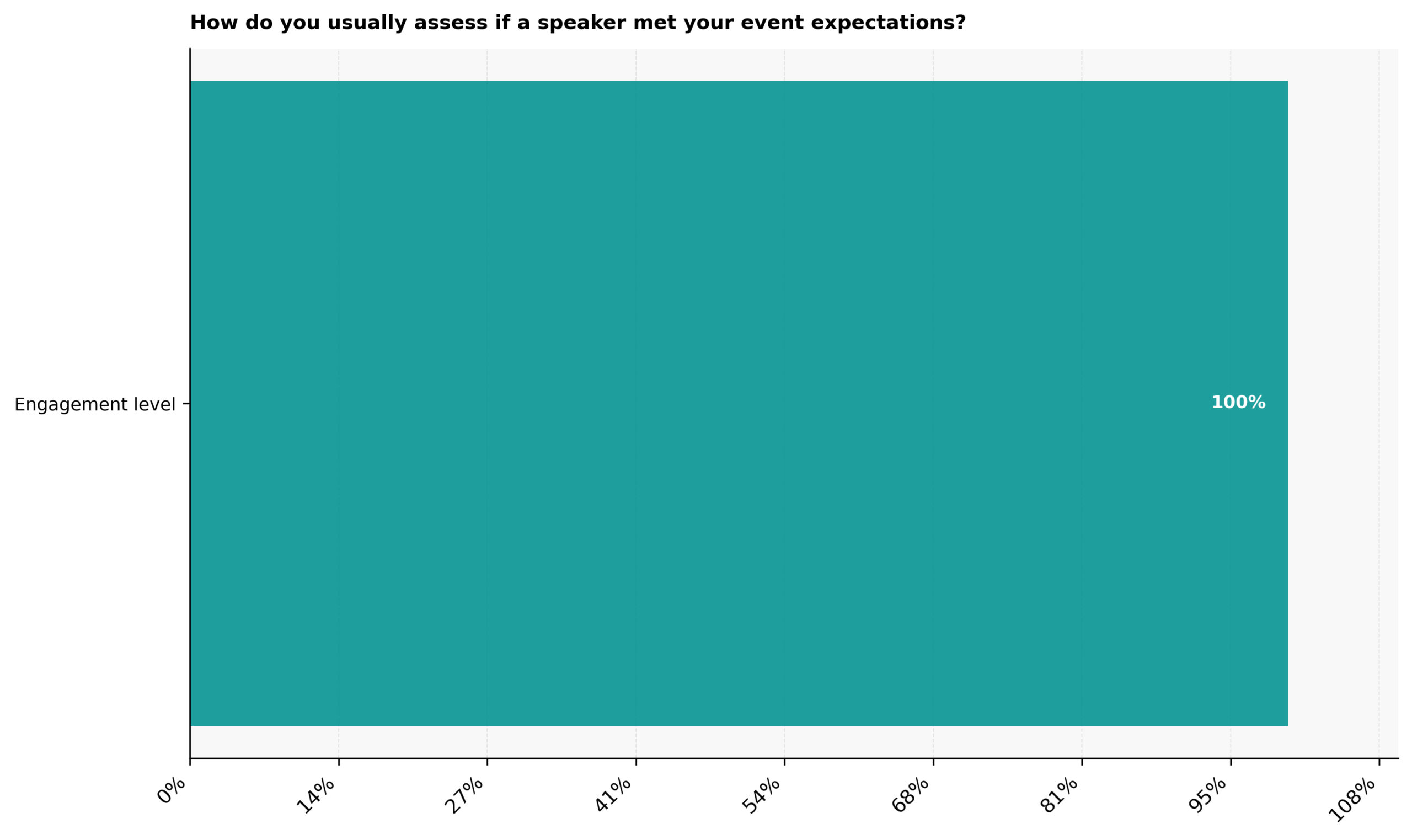
Assessment on whether a futurist speaker met event expectations is unanimous. Engagement level is used by 100% of business leaders who have booked futurist speakers for their events as the measure, showing clear agreement on what success looks like.
This focus aligns with well-established learning research, including Ebbinghaus’ Forgetting Curve, which shows that learners forget approximately 50% of new information within one hour, about 70% within 24 hours, and up to 90% within a week. In that context, engagement becomes critical, as attention, interaction, and emotional connection help ideas last beyond the event itself. When engagement is high, expectations are met because the message is more likely to be remembered and acted on.
Engagement that leads to action is the benchmark that matters most.
Daniel Burrus Comments: Engagement is the right metric, but engagement should be defined carefully. Applause is easy to earn; behavioral change is not. In my experience, the true test of success is whether leaders leave with a new way of seeing risk, opportunity, and a personal commitment to act on those insights. When a keynote reshapes how people think, including how people feel, expectations have been exceeded.
Which Qualities Do You Value Most In A Futurist Speaker During Delivery?
50% of business leaders who have booked futurist speakers for their events value actionable insights as an absolutely essential quality in a speaker
Delivery is judged most by what audiences can take away and use:

The qualities valued most in a futurist speaker during delivery place clear emphasis on usefulness. Actionable insights are absolutely essential for 50% of business leaders who have booked futurist speakers for their events, with a further 18% rating them as quite important, pointing to a strong expectation that ideas should translate into real decisions and next steps.
That focus makes sense when viewed alongside business insights from McKinsey, which show that companies guided by strong insights can achieve EBITDA (earnings before interest, taxes, depreciation, and amortization) increases of up to 25%.
Clear storytelling follows, with 12% calling it absolutely essential and 4% quite important, highlighting how structure helps complex ideas land. An interactive approach is absolutely essential for 13%, reinforcing the value of involvement during delivery. Inspirational tone appears less influential, with 3% saying it is not a top priority, suggesting energy alone is not enough without practical substance.
Daniel Burrus Comments: Actionable insight consistently outranks inspiration, and for good reason. Executives are under pressure to make decisions quickly in uncertain environments. That’s why I focus on anticipatory thinking strategies and tools leaders can immediately apply; these are tools that help them spot disruption early and turn uncertainty into advantage. A great futurist speaker doesn’t overwhelm an audience with trends; they simplify complexity and make the future visible and actionable.
What Area Of Your Experience With Your Current Futurist Speaker Provider Stands Out Most?
The range of speaker options from a current provider is extremely important for 28% of business leaders who have booked futurist speakers for their events
Provider experience is judged largely by how much choice is available:

The area of experience that stands out most with a current futurist speaker provider centers on choice and flexibility. A wide range of speaker options is rated extremely important by 28% of business leaders, and somewhat important by 45%, showing clear value placed on being able to match the right voice to the right event.
At the same time, 15% say this range is not very important, and 12% say it is not important at all, suggesting that breadth matters most when events have specific or varied requirements. Understanding of event needs registers more narrowly, with less than 1% rating it as somewhat important, indicating that expectations around fit are often assumed rather than explicitly prioritized.
Daniel Burrus Comments: Based on delivering over 3,500 keynote speeches over the decades, I would disagree that only 1% of meeting planners say understanding audience needs is important. Every meeting planner I’ve worked with wants remarks that are highly relevant to the audience and the overall goals of the meeting. Organizations want speakers who can speak to different industries, leadership levels, and strategic objectives. Having worked across healthcare, manufacturing, technology, finance, retail, and government, I’ve seen firsthand how future forces manifest differently in each sector. Customization isn’t a bonus, it’s essential. The strongest providers understand that fit drives outcomes, not just applause.
What Aspect Of Your Current Provider Would You Most Like To Improve?
70% of business leaders who have booked futurist speakers for their events say that speed of response is the top priority they’d like to see their current provider improve on.
The need for improvement is pointed sharply in one primary direction:
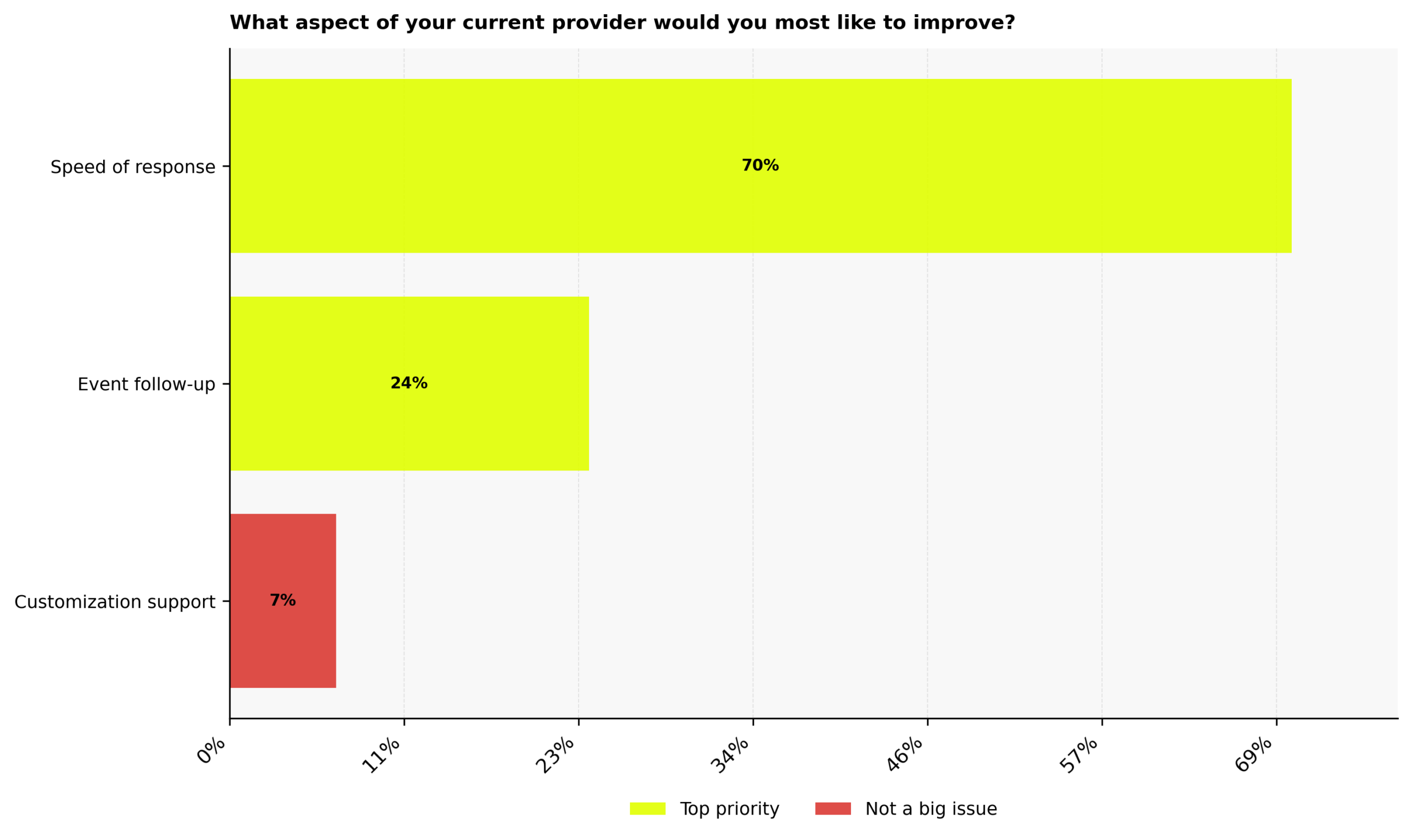
Given that 46% of customers expect companies to respond in less than four hours, it’s not surprising that the aspect business leaders who have booked futurist speakers for their events in our audience would most like to improve in their service provider is speed of response, with 70% naming this as their top priority. When timelines are tight and decisions need to move quickly, slow communication becomes an immediate friction point.
Event follow-up ranks next, with 24% citing it as a top priority, pointing to expectations that extend beyond the event itself. Follow-up often shapes how value is carried forward, through recap materials, next-step recommendations, or continuity planning for future engagements. Customization support appears less pressing, with 7% saying it is not a big issue, suggesting that once a suitable speaker is secured, responsiveness and continuity matter more than additional tailoring.
Daniel Burrus Comments: Speed of response is more than a service issue, it’s a signal. When timelines are tight, responsiveness reflects professionalism and respect for the client’s priorities. In my experience, proactive communication builds trust before the final decision to book a speaker. Clear alignment early on ensures the message delivered on stage is precisely what leaders need. Responsiveness sets the tone for the entire engagement.
How Do You Usually Begin Sourcing Potential Futurist Speakers For Your Events?
Discovery starts in spaces designed for broad professional exposure:
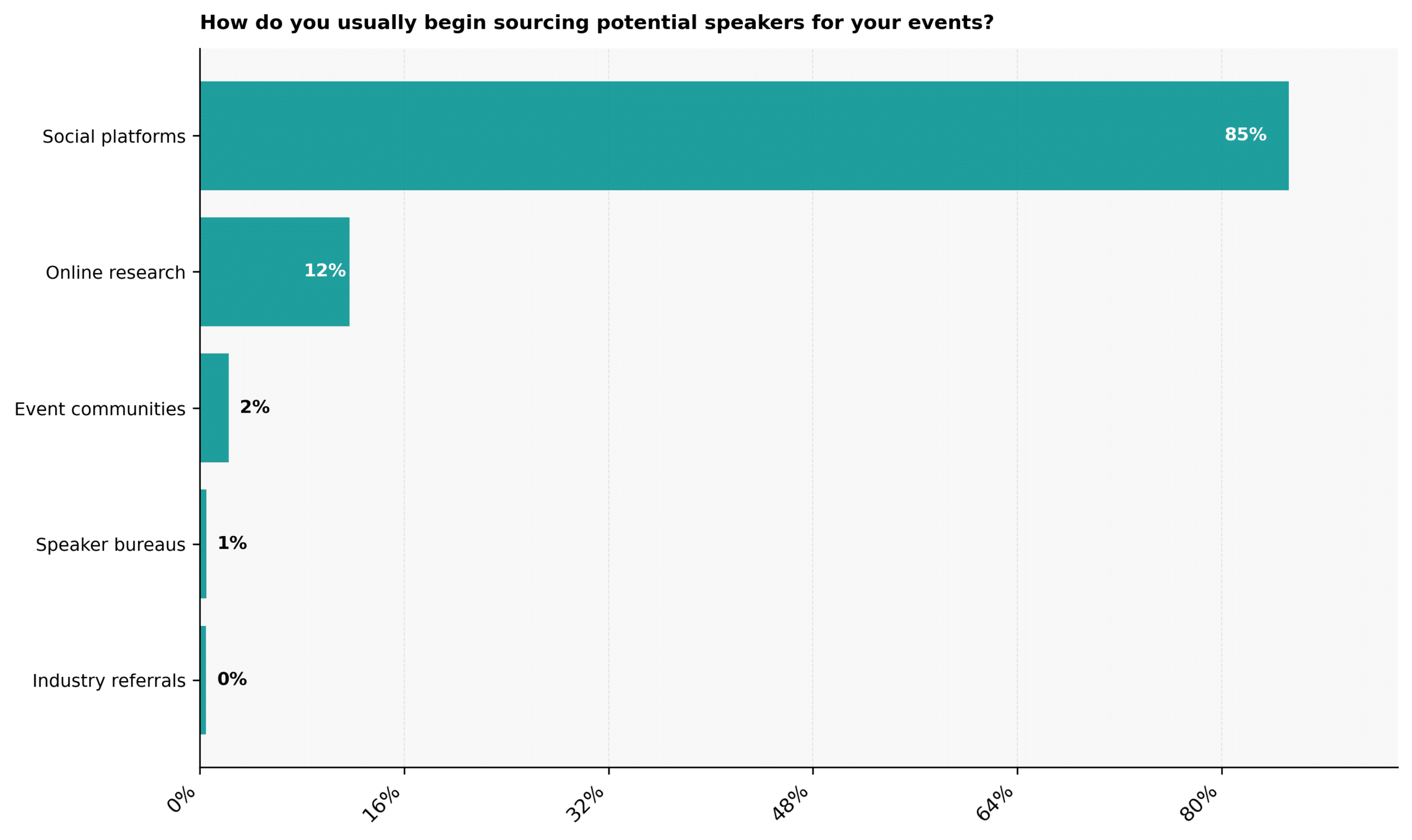
85% of business leaders usually begin sourcing potential futurist speakers for their events on social media platforms, which mirrors broader B2B discovery behavior. 2025 data on social media platforms used by marketers worldwide shows that, while B2C professionals tend to favor Facebook and Instagram, B2B marketers focus more heavily on LinkedIn, given its emphasis on connecting people and companies in a professional, corporate setting.
Online research follows at 12%, suggesting a secondary step once initial options surface. Event communities account for 2%, while speaker bureaus sit at 1%, indicating more limited use for early discovery. Industry referrals register at 0%, showing that sourcing now starts publicly rather than through private networks.
Daniel Burrus Comments: The shift toward social and digital discovery reflects how credibility is now built in public view. Most planners who contact my office know I have 1.2 million followers on LinkedIn and several million blog readers. Planners and leaders want to see how futurist speakers think consistently, not just how they perform on stage. That’s why ongoing thought leadership matters. Articles, interviews, and insights shared over time allow decision-makers to evaluate depth, clarity, and relevance before making contact. Visibility combined with substance is what earns serious consideration. Based on my experience, I would disagree that only 1% use a speakers bureau, that number should be much higher.
What Influences Your Confidence When Choosing A Final Futurist Speaker?
Unique insights are a major influence when choosing a final futurist speaker for 36% of business leaders who have booked speakers for their events
Final decisions hinge on a small set of trust signals:
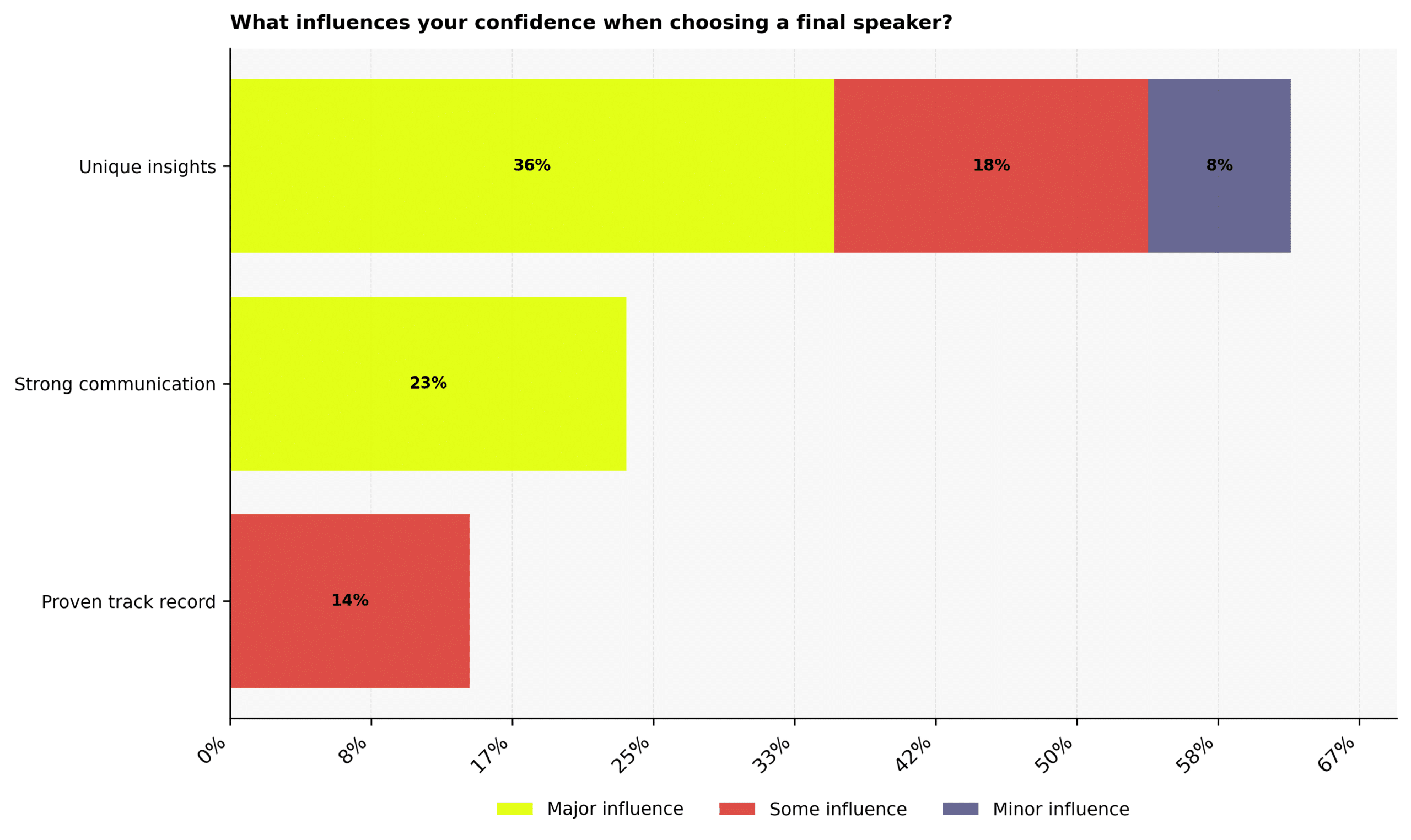
Confidence in a final futurist speaker is shaped first by the strength of their thinking. Unique insights are a major influence for 36% of business leaders who have booked futurist speakers for their events, with 18% seeing them as having some influence and 8% as a minor one, suggesting decision-makers look for perspectives that challenge familiar narratives rather than repeat well-worn trends.
Strong communication follows, rated as a major influence by 23%, underlining the need for complex ideas to be delivered clearly. Proven track record plays a supporting role, with 14% citing it as some influence, indicating that past experience reassures but rarely seals the decision on its own.
Daniel Burrus Comments: Confidence comes from a proven track record of accurate forecasts combined with original research and originality in presentation style. Leaders are weary of recycled narratives and trend overload. Unique insights signal that a speaker is not simply saying what other futurists and industry experts are saying but actively studying the forces that are shaping the future. My approach centers on identifying Hard Trends, which are future certainties that cannot be changed, and leveraging them strategically. When insights feel both new and inevitable, confidence follows.
What Is The Main Factor That Influences Your Futurist Speaker Search Process?
55% of business leaders who have booked futurist speakers for their events say that audience engagement is a strong factor that influences their search process
Early decisions tend to favor how ideas are delivered before what they contain:

The main factor influencing the futurist speaker search process tilts slightly toward how speakers engage an audience. Audience engagement style is a strong factor for 55% of business leaders, putting delivery front and center early in the search. This points to a practical view of speaker selection, where keeping attention and holding interest comes first. Research into audience engagement techniques supports this idea, showing that engagement shapes focus and retention before ideas can really land.
Fresh industry insights follow closely, with 45% citing them as a strong factor. This shows that while content quality remains essential, it tends to matter most once a speaker has already passed the initial test of keeping an audience tuned in.
Daniel Burrus Comments: Early in the search process, engagement style often takes precedence and is very important, but content quality combined with the motivation to take action ultimately determines value. Audiences need to stay engaged long enough to absorb the message, but it’s the substance of that message that drives results. The most effective futurist speakers balance clarity, relevance, and strategic depth. Engagement opens the door; actionable insights justify the investment.
What Is Your Preferred Method For Validating A Futurist Speakers Credibility?
53% of business leaders who have booked futurist speakers for their events say that industry presence is their top method for validating a speaker’s credibility
Visible signals tend to outweigh secondhand validation:
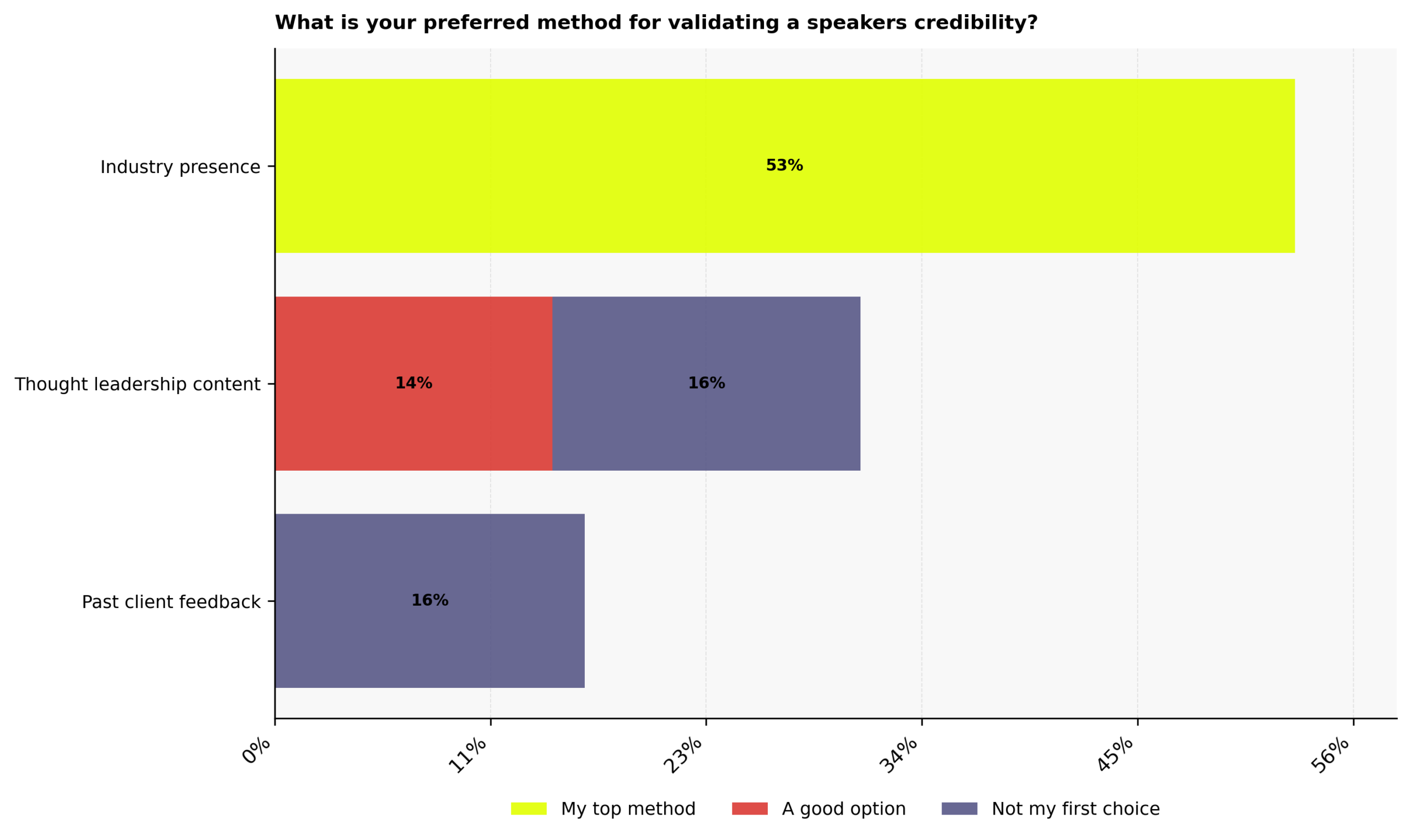
When it comes to validating a futurist speaker’s credibility, industry presence stands out as the preferred method for 53% of business leaders, emphasizing the importance of a speaker’s established reputation and visibility in the field.
Thought leadership content follows, with 14% viewing it as a good option and 16% saying it’s not their first choice, suggesting that while content can demonstrate expertise, it’s not always enough on its own. Past client feedback also rates low as a first choice, with 16% saying it’s not their preferred method, indicating that direct, public credibility often carries more weight than testimonials.
Daniel Burrus Comments: Industry presence matters because it reflects consistency and trust earned over time. Credibility in this field doesn’t come from bold claims, it comes from being right early and helping organizations act before competitors do. Advising leading global organizations across decades has reinforced one lesson: accuracy builds reputation. The most credible futurist speakers are those whose forecasts and strategies stand the test of time.
How Do You Evaluate A Futurist Speaker’s Ability To Fit Your Event Theme?
70% of business leaders who have booked futurist speakers for their events say they use audience suitability and message adaptability to evaluate a speaker’s suitability for their theme
Three considerations carry almost equal weight in decision-making:
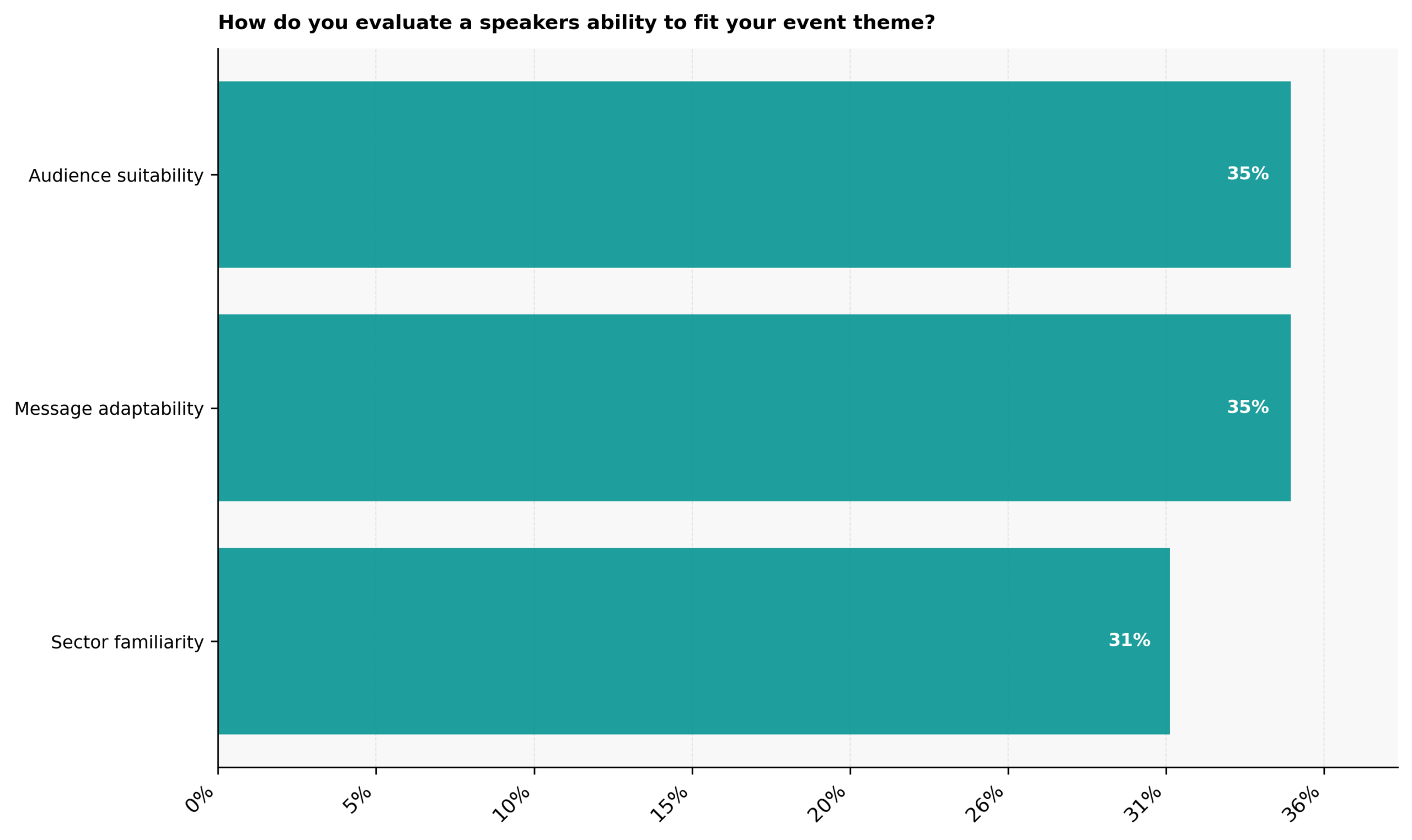
How business leaders who have booked futurist speakers for their events evaluate a speaker’s ability to fit an event theme reinforces a common thread in the data of how well they engage with the people in the room.
Audience suitability and message adaptability are equally weighted at 35% each, showing that fit is judged by whether ideas resonate and can be shaped to match the tone and goals of the event. Sector familiarity follows closely at 31%, pointing to the value of contextual understanding without requiring deep specialization.
Daniel Burrus Comments: Fit is about understanding industry pressures, constraints, and opportunities. Adaptability is critical. A futurist speaker must be able to shape insights to the audience’s context without diluting their strategic value. That’s why I work closely with leadership teams to align the message with their goals, challenges, and timing. When the future feels personally relevant, it becomes actionable.
What Matters Most To You When Reviewing Futurist Speaker Content?
When reviewing speaker content, innovation levels are absolutely essential for 29% of business leaders who have booked futurist speakers for their events
The biggest factor is whether ideas hold up beyond the stage:

What matters most when reviewing futurist speaker content centers on whether ideas genuinely add value. Innovation level leads, with 29% of business leaders rating it as absolutely essential, pointing to a clear desire for thinking that introduces new angles rather than recycled trends. Quality of keynotes follows closely, with 26% calling it absolutely essential and another 26% saying it is very important, showing that depth, structure, and relevance matter as much as originality.
Clarity of message, cited as absolutely essential by 7%, plays a distinct role by ensuring complex ideas can be understood and repeated beyond the stage. Real-world applicability, also at 7% absolutely essential, speaks to whether ideas can survive contact with day-to-day business realities. Strategic value, again at 7% absolutely essential, highlights the need for content that informs direction and decision-making, not just conversation.
Together, these priorities echo broader thinking on keynote value, where strong content reshapes perspective, connects ideas to business direction, and helps audiences translate innovation into decisions rather than inspiration alone.
Daniel Burrus Comments: Innovation only matters if it is highly relevant to the audience. Leaders want ideas that are not just novel, but durable. The most valuable content reframes how people see the future, offering perspectives that remain relevant way beyond a single news cycle. My focus on anticipatory thinking ensures that insights are grounded in certainty, not speculation. Strong content doesn’t just inform—it reshapes perspective.
What Criteria Guide Your Final Futurist Speaker Selection Decision?
When making a final decision on speaker selection, innovation quality is an important factor for 90% of business leaders who have booked futurist speakers for their events
The final choice is guided by a single dominant priority:
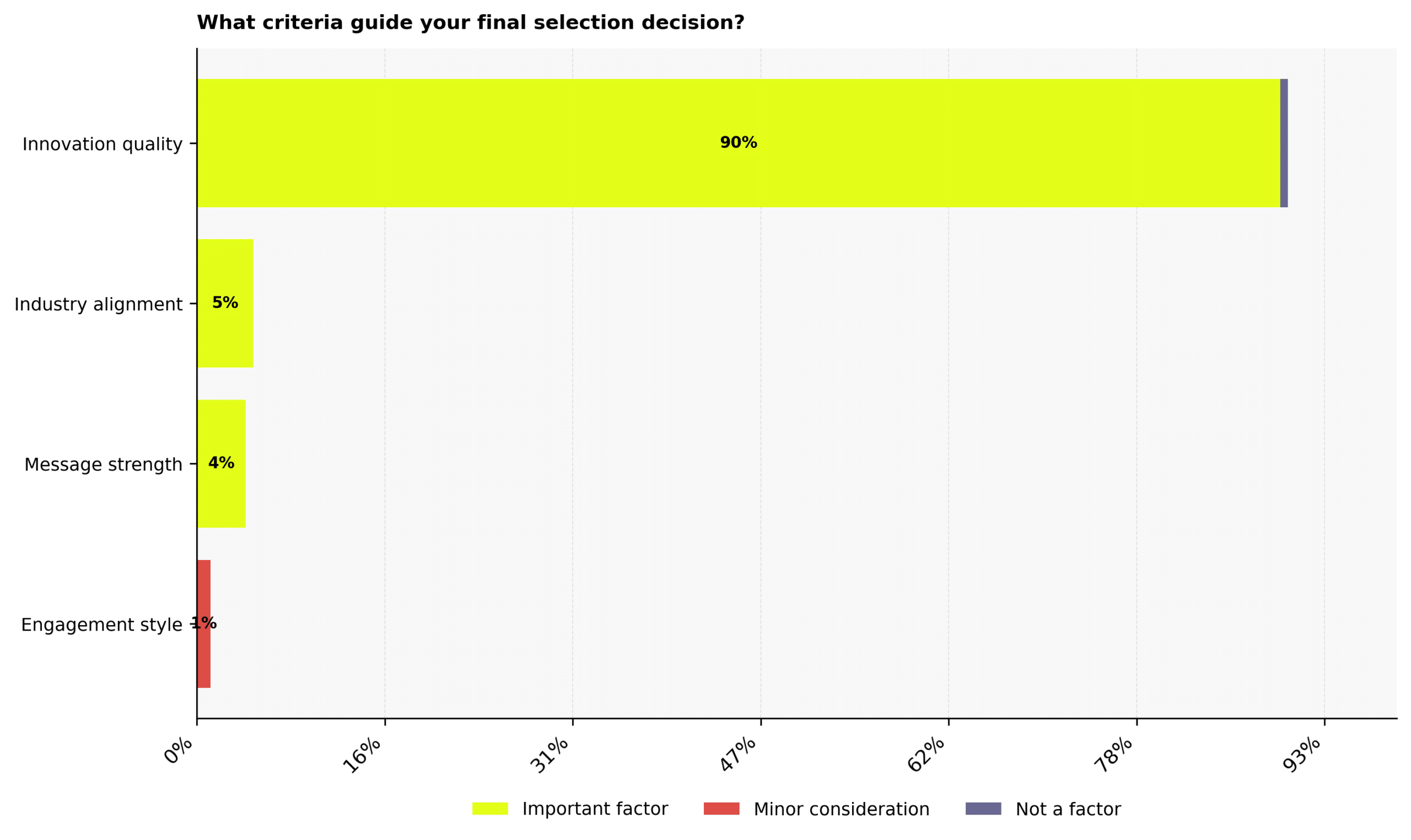
The criteria guiding business leaders’ final futurist speaker selection decision place overwhelming weight on innovation quality. For 90%, this is an important factor, while less than 1% see it as a minor consideration, and less than 1% say it is not a factor at all. This underpins a pattern seen in the previous graph where innovation shapes how content is assessed, showing it carries through to the final choice.
Industry alignment, cited as important by 5%, plays a narrower role, helping confirm relevance rather than driving the choice. Message strength follows at 4%, suggesting clarity supports confidence but rarely overrides substance. Engagement style appears only as a minor consideration for 1%, indicating that delivery influences earlier stages, while innovation ultimately determines the final call.
Daniel Burrus Comments: At the final decision stage, innovation quality coupled with actionable trends rises above all else because leaders are making a strategic investment. The best futurist speakers help organizations move from reacting to anticipating using the certainty of Hard Trends based on future facts to shape the future. That requires insight, clarity, and a proven ability to translate future forces into practical strategy. Ultimately, leaders choose futurists who help them win now and in the future, not just understand what’s coming.
Which City Are You Based In?
76% of business leaders who have booked futurist speakers for their events are based in San Francisco
Location is heavily concentrated rather than evenly distributed:
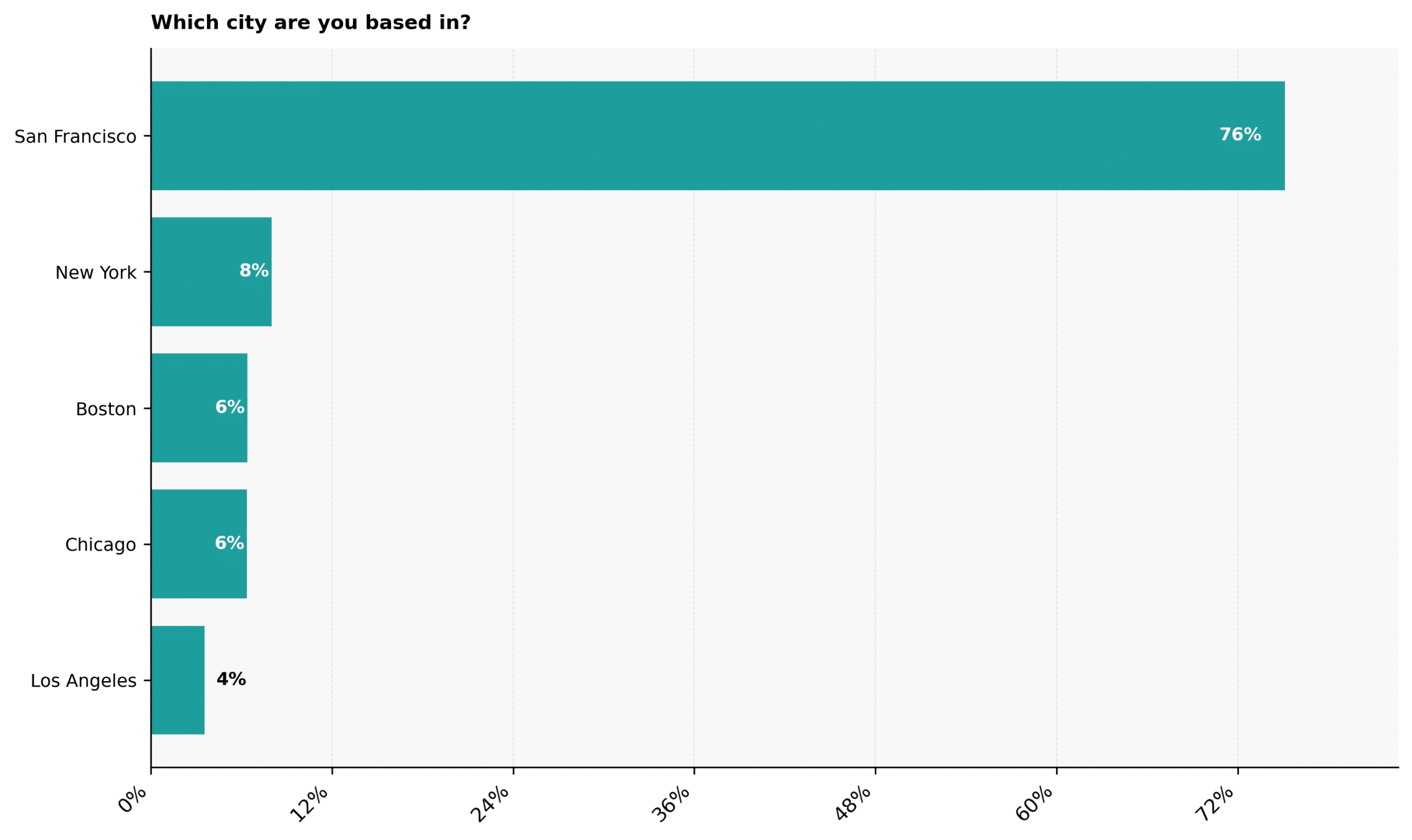
At 76%, San Francisco dominates the cities in which business leaders who have booked futurist speakers for their events in our audience are based, pointing to its continued role as a center for technology-driven thinking and future-focused dialogue. New York follows at 8%, reflecting its position as a hub for business, media, and large-scale events.
Boston and Chicago each account for 6%, suggesting steady representation from cities with strong academic and commercial foundations. Los Angeles rounds out the list at 4%, indicating a smaller but notable presence tied to creative and innovation-led industries.
Daniel Burrus Comments: Based on many decades of keynote speaking, I would disagree with the low percentage from New York, Boston, Chicago and Los Angeles. In addition, many national associations who book speakers are based in Washington DC and that city was not on the list.
Which Industry Are You In?
47% of business leaders who have booked futurist speakers for their events work in the healthcare industry
Industry representation clusters around a small number of key sectors:
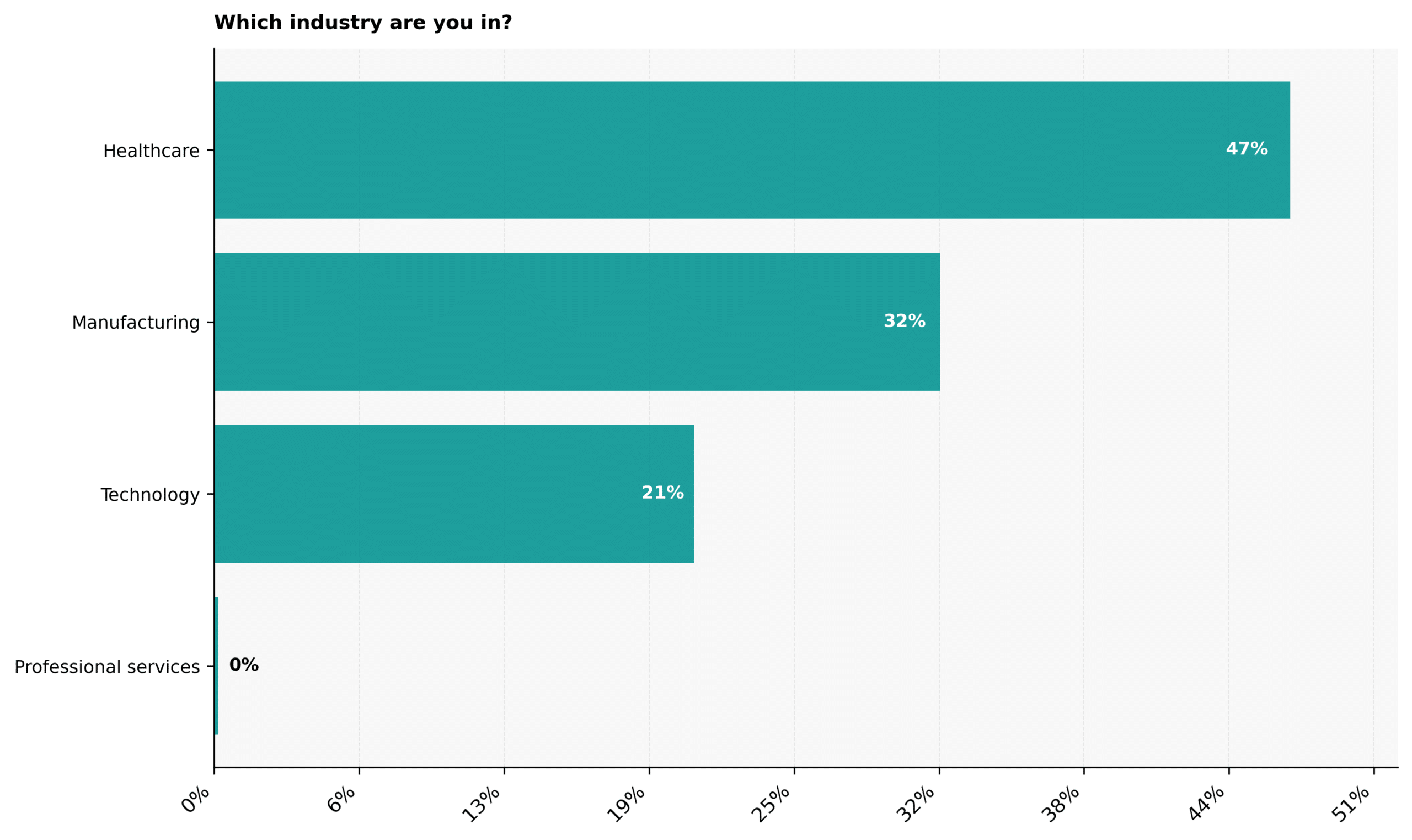
The industry mix of business leaders who have booked futurist speakers for their events in our audience is led by healthcare, at 47%. With 76% of our audience based in San Francisco, that emphasis makes sense, as the county employs over 95,000 health care workers, accounting for around 12% of the local workforce.
Manufacturing follows at 32%, highlighting ongoing interest in how future trends will shape production and operations. Technology accounts for 21%, showing solid representation without dominating the mix. Professional services sit at 0%, suggesting this audience is more focused on sectors experiencing large-scale change than advisory or consultancy-led environments.
Daniel Burrus Comments: I would have to disagree with this statistic. Healthcare is big, but with the rapid growth of AI, technology is as big if not bigger, and retail was not even mentioned.
Measuring the Value of Futurist Presentations
Overall, the findings highlight how business leaders who have booked futurist speakers for their events approach selection with a clear sense of purpose. From innovation and credibility to audience connection and long-term value, the data shows what consistently matters when choosing voices to challenge thinking and shape future-facing conversations.
About the Data
Sourced using Artios from an independent sample of 164,925 opinions of Business Leaders that have booked futurist speakers for their events in the US across X, Quora, Reddit, Bluesky, TikTok, and Threads. Responses are collected within a 95% confidence interval and 5% margin of error. Results are derived from what people describe online, from opinions expressed, and not actual questions answered by people in the sample.