Generative AI has moved from experimentation into the harder work of implementation. Now, the question is no longer whether companies should engage with it, but whether they can turn rapid advances into clear business value. A strategic approach to harnessing AI is becoming essential as businesses weigh opportunity against complexity and try to move with enough speed to stay competitive without losing direction.
To find out what 1,905,237 opinions of C-suite leaders in the US were about generative AI, we utilized AI-driven audience profiling to synthesize insights from online discussions over 12 months, ending on June 29th, 2026, to a high statistical confidence level. Examined at scale, these perspectives offer a sharp view of how senior executives are thinking about GenAI as it moves from a headline technology into a serious business priority.
Index
- Methodology and data
- 4% of C-suite leaders’ organizations have reached full AI maturity, 58% are progressing well, and 21% have made some progress; a further 1% are fully mature in the pilot or exploratory phase, and 5% are making progress, 1% have made progress fully integrating AI into their core operations, but 9% have not yet started doing so
- For 34% of C-suite leaders, the biggest reason for adopting GenAI is for innovation or new products, cost reduction is the motivator for 23%, and 14% are driven by a desire to improve the customer experience, followed by 2% who are adopting GenAI for productivity gains, and1% to give themselves a competitive advantage
- 38% of C-suite leaders agree that GenAI delivers the most value in data analysis and insights, but 26% don’t think this is where the value lies, 9% find it most valuable in code generation but 9% don’t agree, 7% find it has significant value in customer support automation and 4% feel it has less to no value here, while 3% agree it delivers significant value in content creation compared to 4% who don’t see the value
- For 11% of C-suite leaders, the IT or engineering department absolutely leads GenAI use, and 43% agree this department likely leads its use; however, 30% say this department is unlikely to be the leader in GenAI use, and 15% say they do not lead at all in this regard
- 8% of C-suite leaders’ boards discuss GenAI strategy at every meeting, 24% discuss it quarterly, 19% annually, 24% rarely, and 23% never have board discussions about the topic
- 48% of C-suite leaders don’t only follow AI governance industry guidelines, indicating they have far more policies in place, 9% have a policy in development, and 25% are leaning towards creating one, 8% are not opting to outsource governance, 2% are leaning towards having a formal policy in place, and 2% have no formal policy yet
- 6% of C-suite leaders absolutely use a hybrid build and buy approach to vendors, and 31% lean this way, while it’s not the main choice for 15%, and 20% are not using it; the remaining 29% are undecided as to what approach they want to take
- 6% of C-suite leaders dedicated between 5 and 30% of their 2026 budget to AI and consider this a major portion, 39% feel this is a considerable share, and 4% agree that is a small part, while 12% say that the less than 5% they dedicate to GenAI is a significant share, and 5% a small part, and those who have set aside more than 30% of their budget say this is significant, but it’s considered a small part for 13%, and almost nothing for 2%
- For 54% of C-suite leaders, a GenAI enterprise rollout is not going to happen anytime soon, and 43% have no plans for it, but 2% are planning on a full rollout soon, and 2% have already rolled out across their business and will be reaching enterprise-wide status in 2 to 3 years
- Talent or skills gaps are a GenAI adoption barrier for 39% C-suite leaders, and only 2% don’t see them as such, 29% are hindered by a lack of clear ROI, 23% by data quality or readiness, and 6% find security or compliance risks to be a significant barrier to adoption
- AI governance or ethics is a major skills gap concern for 14% C-suite leaders, and of some concern for 41%, 16% are somewhat worried about change management, and 15% have major concerns about data science and ML expertise; however, 15% have no concerns about any of these skills gaps
- More executive buy-in would accelerate GenAI adoption for 30% of C-suite leaders, clearer buy-in would speed it up for 28%, and better internet would help a lot for 14% and have some impact for 4%, while proven ROI examples would be an accelerator for 3%, help 10% a lot, and have some impact for 4%
- 82% of C-suite leaders have not assessed their workforce’s readiness for AI, 5% are not prepared, 5% are minimally prepared, and 4% are somewhat prepared, while just 5% have workforces that are very AI-ready
- 6% of C-suite leaders strongly support the use of employee GenAI tool use on a case-by-case basis, 21% somewhat support this, and 34% have some reservations, and 14% don’t support this tool use at all, 6% would support it with some guidelines, but 11% are less comfortable about doing so, and just 2% are fully encouraging it company-wide, while 4% are less enthusiastic
- 55% of C-suite leaders are somewhat unsure about their AI strategy, 42% are neutral about how confident they are, and 1% is very confident, but a further 1% are only somewhat confident, and 1% are not confident at all
- 54% of C-suite leaders measure GenAI ROI in cost savings, 28% in productivity and time saved, 13% in revenue growth, and 5% don’t formally measure GenAI ROI at all
- For 50% of C-suite leaders, it’s too early to tell if GenAI has changed their customer experience, and 46% have seen no major change; however, 3% have seen a significant improvement in CX
- 46% of C-suite leaders have reduced hiring due to GenAI; yet 36% have increased hiring, 14% have observed no change, and 4% agree that it’s too early to tell
- GenAI is giving 37% of C-suite leaders a slight advantage over their competitors, 20% are gaining a strong competitive advantage, and 28% are not noticing any impact, while 8% are unsure, and 7% are falling behind their competitors
- Data privacy or security is a top GenAI concern for 47% C-suite leaders and a real worry for 17%, regulatory compliance is tops for 24%, 7% cite it as a real worry, and 3% as some concern, and fewer than 1% are worried about misinformation or hallucinations
- 80% of C-suite leaders are most inspired by the use of GenAI in retail or e-commerce, 10% of its use in technology, 7% are inspired by how it’s used in healthcare, and 4% are inspired by GenAI in manufacturing
- 38% of C-suite leaders see GenAI as playing a niche role or being used for specialized purposes only in the next 5 years, 23% think it will be core to every function, 19% think it will be replaced by next-gen tech, and 18% think it will play a major role, but not one that’s central, and 1% are uncertain about its long-term value
- The future of GenAI in business
Methodology and data
Sourced using Artios from an independent sample of 1,905,237 opinions of C-suite leaders in the US across X, Quora, Reddit, Bluesky, TikTok, and Threads. Responses are collected within a 95% confidence interval and 5% margin of error. Results are derived from what people describe online and from opinions expressed, not from actual questions answered by people in the sample.
What is the current GenAI maturity level of C-suite leaders’ organizations?
4% of C-suite leaders’ organizations have reached full AI maturity, 58% are progressing well, and 21% have made some progress; a further 1% are fully mature in the pilot or exploratory phase, and 5% are making progress, 1% have made progress fully integrating AI into their core operations, but 9% have not yet started doing so
The AI race is underway, but few organizations are fully ready:
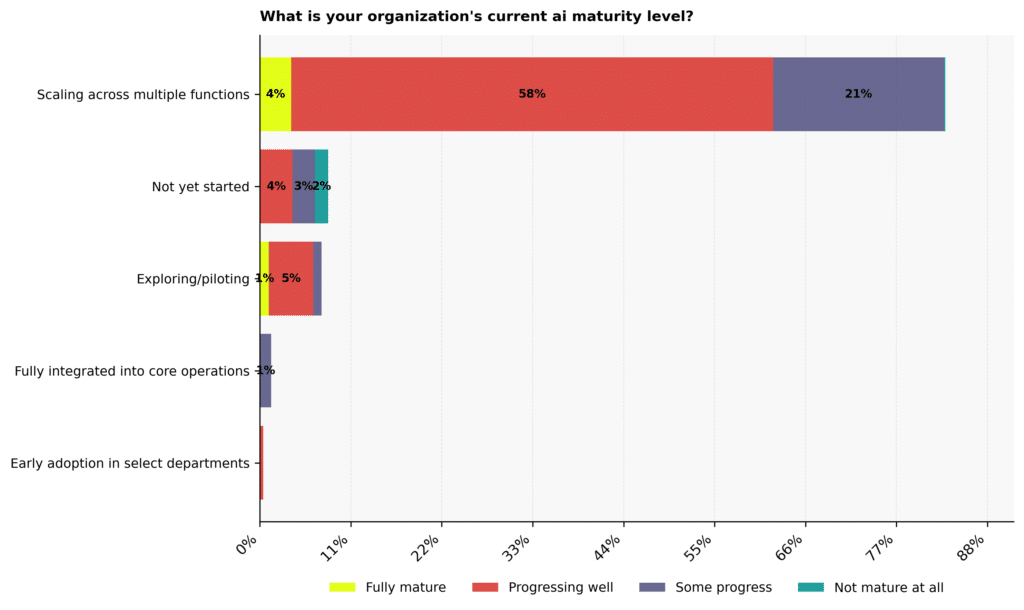
AI maturity is concentrated in organizations that are already scaling across multiple functions. 4% of C-suite leaders consider their organizations fully mature, 58% are progressing well, and 21% have made some progress. Most have moved beyond isolated experiments and are working out how to expand AI across teams, systems, and business processes.
Gartner found that 45% of high-maturity organizations keep AI initiatives in production for at least three years, compared with 20% of low-maturity organizations. This shows that maturity depends on more than launching projects. Organizations also need the governance, technical foundations, and business case to keep useful AI systems running.
AI adoption is still in its early stages
On the lower end of the scale, 4% of our audience are progressing well with plans but haven’t started rollout. A further 3% have made some planning progress but have not yet put AI into use. These organizations may be building internal support, choosing tools, or deciding where AI can deliver enough value to justify investment. The 2% with no plans are not mature at all and remain at the starting line.
Exploring and piloting is a smaller part of the picture. Here, 1% are fully mature within the testing phase, which may mean they have a disciplined approach to choosing, running, and assessing pilots. Another 5% are progressing well as they test use cases and learn what can scale.
Only 1% have made some progress toward fully integrating AI into core operations. Very few organizations have reached the point where AI is embedded deeply enough to influence everyday work across the business.
Less than 1% are progressing well with early adoption in select departments. Their AI use may be producing results in a few teams, but it has not yet spread far enough to become an organization-wide capability.
Daniel Burrus, Futurist and Strategic Advisor comments: Most organizations are measuring AI maturity by how much AI they have deployed. That is the wrong benchmark. Real maturity is measured by how well an organization can anticipate where AI is going, identify the business processes that will inevitably be transformed, and act on those opportunities before competitors do. The rapid advancement of AI is a Hard Trend, it will continue regardless of whether an organization is ready. What remains a Soft Trend is how quickly any individual company responds. The leaders will be those that move beyond pilots and isolated productivity gains and begin re-designing workflows, products, services, and customer experiences around capabilities that are becoming increasingly predictable. AI maturity is not simply a technology journey; it is an anticipatory leadership capability.
What is the top reason C-suite leaders adopt GenAI?
For 34% of C-suite leaders, the biggest reason for adopting GenAI is for innovation or new products, cost reduction is the motivator for 23%, and 14% are driven by a desire to improve the customer experience, followed by 2% who are adopting GenAI for productivity gains, and1% to give themselves a competitive advantage
GenAI adoption starts with what it can create:
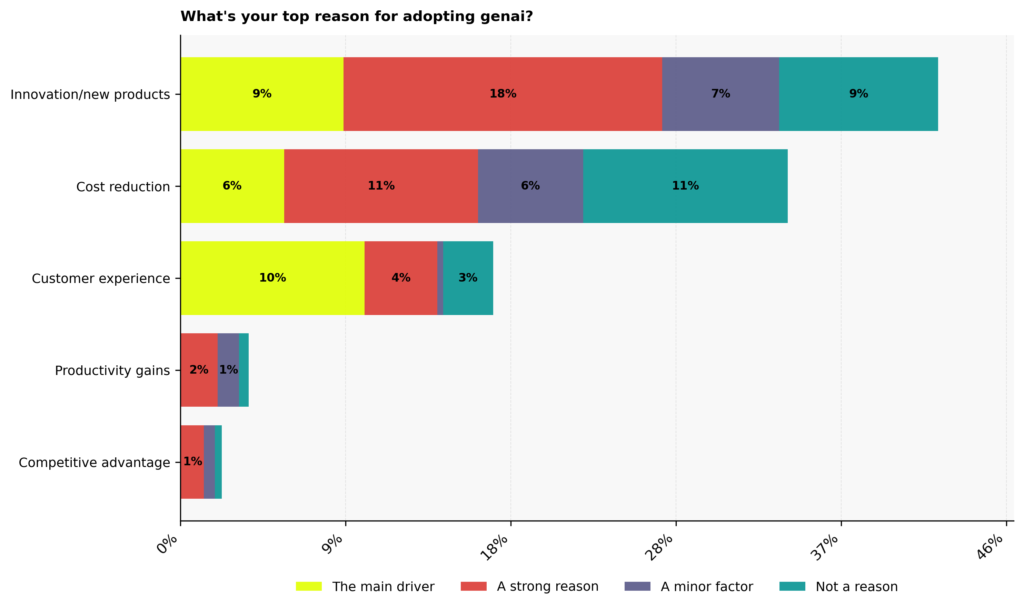
The reasons C-suite leaders adopt GenAI stretch across growth, efficiency, customer experience, and everyday performance. Innovation and new products lead the overall picture. They’re the main driver for 9% of our audience, a strong reason for 18%, a minor factor for 7%, and not a reason for 9%. McKinsey’s 2025 State of AI global survey backs this up, with 64% saying AI is enabling innovation. GenAI can help companies explore new ideas, speed up product development, test concepts, and create value in ways that would have taken more time or resources before.
Cost reduction is the main driver for 6%, a strong reason for 11%, a minor factor for 6%, and isn’t a reason for 11%. Savings may come from faster research, drafting, analysis, and routine knowledge work, but the return depends on how well the technology is implemented.
Customer experience is the main driver for 10%, a strong reason for 4%, and a minor factor for less than 1%, though it isn’t a reason for 3%. Leaders may be using GenAI to improve personalization, speed up support, and make information easier for customers to access.
Productivity gains are a strong reason for 2%, a minor factor for 1%, and not a reason for less than 1%. Competitive advantage is a strong reason for 1%, a minor factor for less than 1%, and not a reason for less than 1%. These may be seen less as standalone goals and more as outcomes that follow from stronger products, faster work, and better customer experiences.
Which GenAI use case delivers the most value for C-suite leaders?
38% of C-suite leaders agree that GenAI delivers the most value in data analysis and insights, but 26% don’t think this is where the value lies, 9% find it most valuable in code generation but 9% don’t agree, 7% find it has significant value in customer support automation and 4% feel it has less to no value here, while 3% agree it delivers significant value in content creation compared to 4% who don’t see the value
Complexity is where GenAI earns its keep:
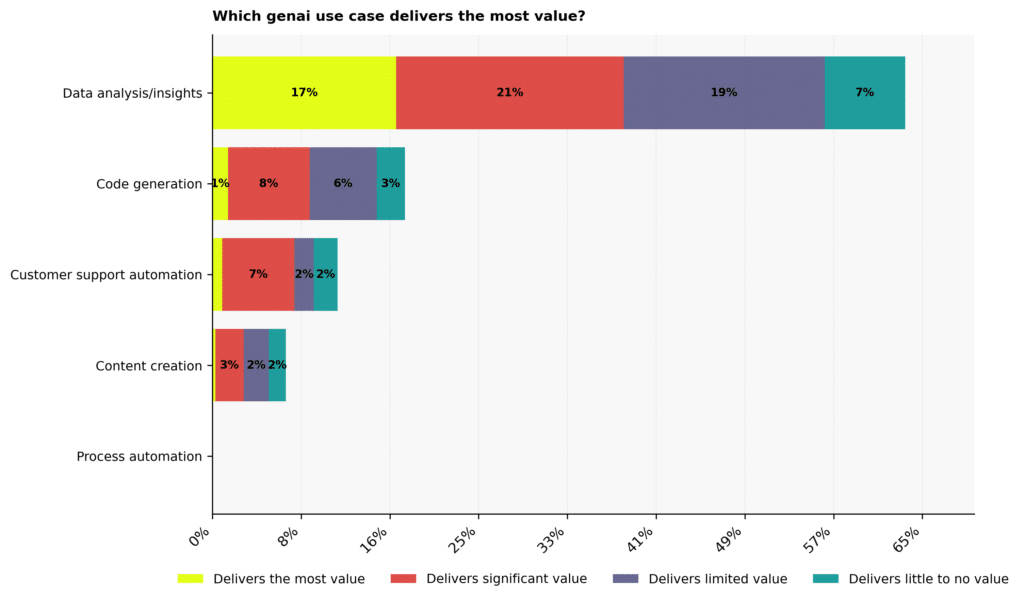
C-suite leaders are finding the greatest GenAI value in use cases that turn complex information into clearer decisions. Data analysis and insights lead by a wide margin. They deliver the most value for 17% of our audience, significant value for 21%, limited value for 19%, and little to no value for 7%.
A recent paper on the impact of generative AI on data analytics makes the point that GenAI can improve the full analytics process, from preparing and cleaning data to identifying patterns, generating insights, and explaining complex findings in accessible language. This helps leaders get more from large or scattered datasets and makes advanced analysis easier to use in decision-making.
GenAI tools are making a small but significant difference
Code generation delivers the most value for 1%, significant value for 8%, limited value for 6%, and little to no value for 3%. It can speed up development and reduce repetitive coding work, but its value depends on having the technical oversight to review and apply the output properly.
Customer support automation delivers the most value for less than 1%, significant value for 7%, limited value for 2%, and little to no value for 2%. Its strongest benefit may come from handling routine queries quickly while allowing employees to focus on more complex customer needs.
Content creation delivers significant value for 3%, limited value for 2%, and little to no value for 2%. Leaders may value its speed, but quality control and differentiation still require human input.
Process automation received no opinions. This doesn’t mean GenAI isn’t being used to handle repetitive workflows, move information between systems, or speed up routine approvals. It simply didn’t come up in the online conversations analyzed.
Daniel Burrus, Futurist and Strategic Advisor comments: The strongest value of GenAI in data analysis is not simply that it can process more information faster. Its real value is that it can help leaders see patterns, relationships, and emerging opportunities that would otherwise remain hidden. The strategic advantage comes when organizations use those insights to anticipate change and make better decisions before the need becomes obvious. Data by itself does not create value. Insight does, and actionable foresight creates even more. The companies that gain the most from GenAI will be those that connect analysis directly to decision making, innovation, and execution.
Which department leads GenAI use today at C-suite leaders’ organizations?
For 11% of C-suite leaders, the IT or engineering department absolutely leads GenAI use, and 43% agree this department likely leads its use; however, 30% say this department is unlikely to be the leader in GenAI use, and 15% say they do not lead at all in this regard
GenAI ownership is still up for grabs:
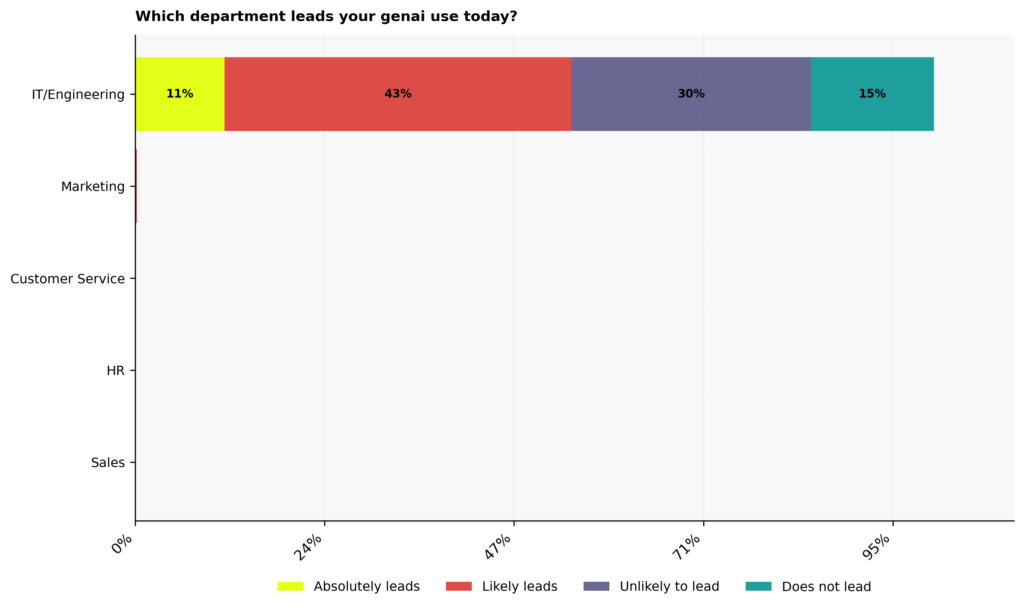
The department leading GenAI use is far less settled among our audience than the technology’s rapid growth might imply. IT and engineering are the only functions that come through clearly, but even there, the picture is mixed. They absolutely lead at 11% of C-suite leaders’ organizations and likely lead at 43%. At the same time, 30% say they’re unlikely to lead, while 15% say they don’t lead at all.
The split shows that GenAI ownership is still shifting between technical teams and the parts of the business that use the technology day to day. IT and engineering may control infrastructure, security, integration, and governance, but that doesn’t always mean they’re directing how GenAI is applied across the organization. The fact that no one mentioned marketing, customer service, HR, finance, or other business functions also shows that currently, responsibility for GenAI remains concentrated rather than being owned across the wider business.
Daniel Burrus, Futurist and Strategic Advisor comments: GenAI should not belong to a single department. IT and engineering have an essential role in security, integration, infrastructure, and governance, but the business value of AI is created when every function understands how to apply it to its own opportunities and challenges. The strongest organizations will treat GenAI as an enterprise capability, with technical teams enabling it and business leaders shaping how it is used. When ownership is too concentrated, adoption slows and valuable use cases are missed. The goal should be shared responsibility, clear governance, and leadership alignment around where AI can create the greatest strategic impact.
How often do boards discuss GenAI strategy at C-suite leaders’ organizations?
8% of C-suite leaders’ boards discuss GenAI strategy at every meeting, 24% discuss it quarterly, 19% annually, 24% rarely, and 23% never have board discussions about the topic
GenAI strategy still lacks a regular place at the table:
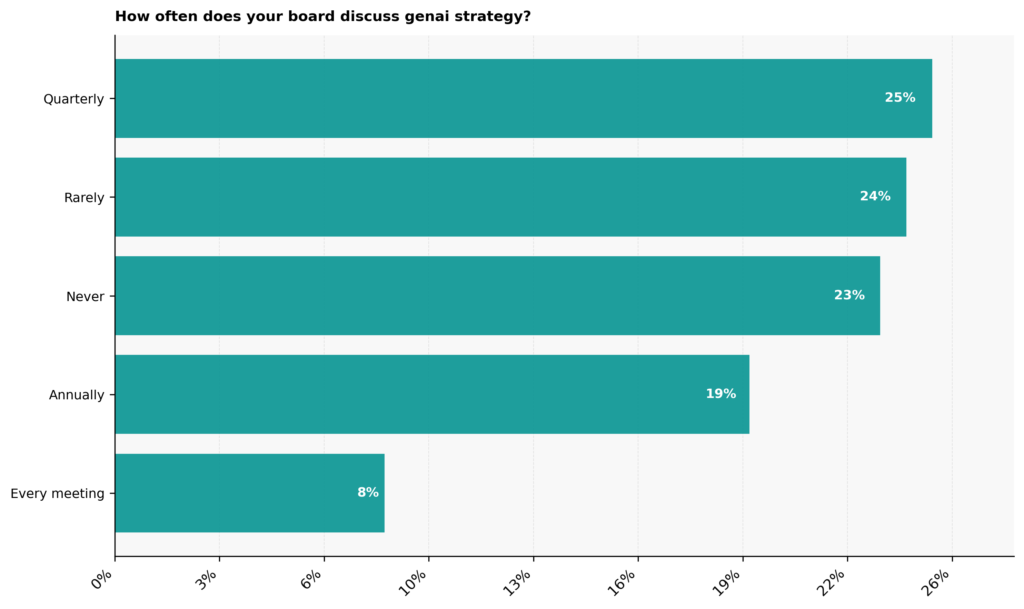
Given the view of GenAI as a way to balance short-term operational gains with long-term transformation, the regularity with which boards discuss GenAI strategy varies strikingly across C-suite leaders’ organizations.
For 25% of our audience, GenAI strategy discussions occur quarterly. This gives boards recurring opportunities to review immediate results while keeping the wider strategic direction in view.
Another 24% rarely discuss GenAI strategy, while 23% never do. These boards are missing regular opportunities to connect early use cases with the longer work of building resilience, digital maturity, and sustained growth. GenAI may still be adopted in isolated areas, but the broader transformation can lose direction without consistent board attention.
A further 19% discuss GenAI strategy annually. A yearly review may help set broad priorities, but it leaves long gaps between discussions while capabilities, risks, and competitive use continue to develop.
Only 8% discuss GenAI strategy at every meeting. This creates the strongest chance to keep short-term performance and long-term transformation aligned as the technology evolves.
Daniel Burrus, Futurist and Strategic Advisor comments: When boards discuss GenAI only occasionally, they risk treating a strategic transformation as a technology update. AI is advancing too quickly for annual or infrequent review to be enough. Boards need to examine not only current projects, but also the predictable changes AI is creating in customer expectations, workforce capabilities, competition, and business models. The most important question is not simply what AI is doing today. It is what AI will make possible next, and whether the organization is preparing for that future before competitors are. Regular board level discussion turns AI from a reactive issue into a strategic priority.
What is C-suite leaders’ approach to GenAI governance?
48% of C-suite leaders don’t only follow AI governance industry guidelines, indicating they have far more policies in place, 9% have a policy in development, and 25% are leaning towards creating one, 8% are not opting to outsource governance, 2% are leaning towards having a formal policy in place, and 2% have no formal policy yet
The AI rulebook is a work in progress:
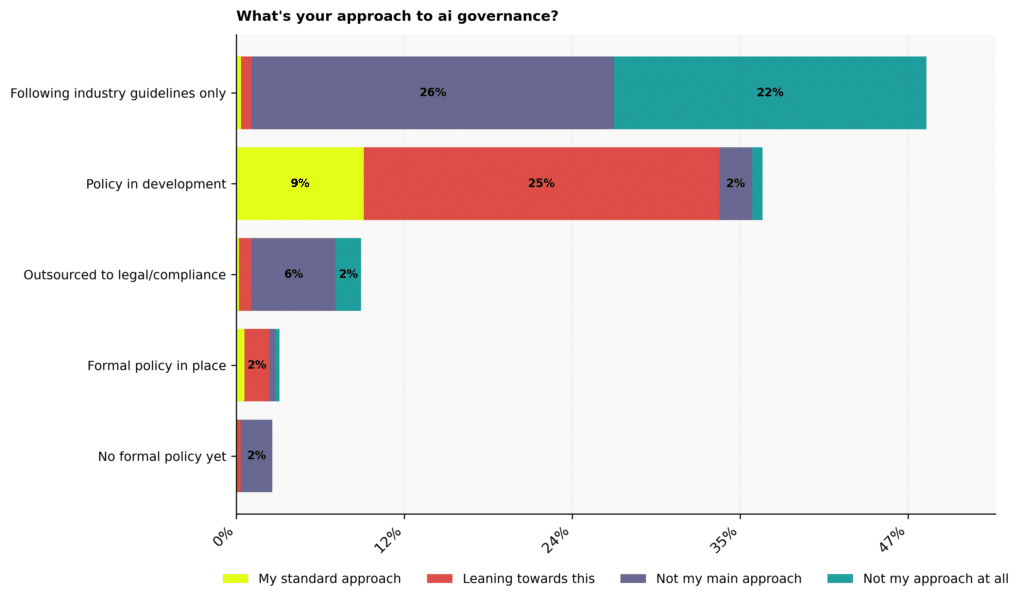
AI governance is developing against a fragmented regulatory backdrop. The US still has no comprehensive federal AI legislation, while state legislation is creating a growing set of obligations. This uneven regulatory landscape helps explain why many leaders are still developing policies rather than treating governance as settled.
Only following industry guidelines receives very little support. Less than 1% of C-suite leaders treat it as the standard approach, and even fewer are leaning toward it. Another 26% don’t see it as the main approach, while it’s not the approach at all for 22%. Industry guidance can provide a starting point, but it cannot account for every organization’s legal obligations, data risks, AI systems, and business activities.
Policy in development is the clearest direction. It’s the standard approach for 9%, while 25% are leaning toward it. Another 2% don’t see it as the main approach, and it’s not the approach at all for less than 1%. These organizations may be developing rules as they learn where AI is being used, what risks need tighter controls, and who should own key decisions.
Policies not a priority
Less than 1% see outsourcing governance to legal or compliance as the standard approach, and even fewer are leaning toward it. Another 6% don’t see it as the main approach, while it’s not the approach at all for 2%. Legal and compliance teams remain important, but effective governance also needs input from technology, security, operations, and business leaders.
A formal policy is the standard approach for less than 1%, while 2% are leaning toward it. It’s not the approach at all for less than 1%. The small share with a settled policy shows how few organizations have completed the move from principles to clear, organization-wide rules.
Less than 1% are leaning toward having no formal policy yet, while 2% don’t see this as the main approach. Leaving AI use without clear rules is becoming harder to defend as adoption spreads and regulatory expectations continue to develop.
Daniel Burrus, Futurist and Strategic Advisor Comments: AI governance should not be treated as a compliance exercise that begins after adoption. It needs to be designed into the strategy from the start. The organizations that wait for regulation to tell them what to do will always be reacting. Strong governance creates the confidence to move faster because leaders know where the boundaries are, who is accountable, how data is protected, and how decisions are reviewed. The goal is not to slow innovation. The goal is to create a trusted framework that allows innovation to scale responsibly. Governance becomes a strategic advantage when it gives the organization clarity before uncertainty turns into risk.
Which vendor approach are C-suite leaders using?
6% of C-suite leaders absolutely use a hybrid build and buy approach to vendors, and 31% lean this way, while it’s not the main choice for 15%, and 20% are not using it; the remaining 29% are undecided as to what approach they want to take
Leaders are moving towards a mix-and-match model:
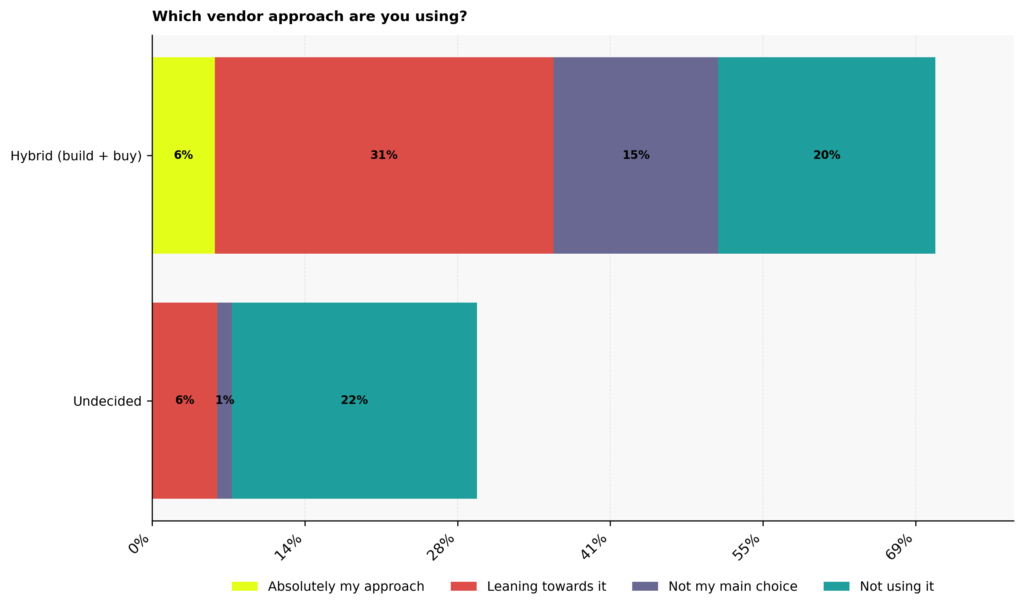
C-suite leaders are taking different routes to vendor selection, but flexibility is the clearest preference. A hybrid build-and-buy model is absolutely the approach for 6%, while 31% are leaning toward it. Another 15% don’t see it as their main choice, and 20% aren’t using it.
A build-and-buy model can give organizations faster access to established platforms while still allowing them to develop the parts that need greater control, customization, or protection. External vendors may be useful for general capabilities, while internal teams can focus on company-specific data, workflows, and competitive priorities.
Another 6% are leaning toward being undecided, which may mean they are still comparing vendors, assessing costs, or deciding which capabilities should stay in-house. A further 1% are looking at other choices, possibly favoring a fully internal build or a single external provider instead.
The remaining 22% are not using vendors at all, likely building their own systems, relying on tools already included in existing software, or holding back until the market becomes easier to assess.
Daniel Burrus, Futurist and Strategic Advisor Comments: The build versus buy decision should not be treated as a simple technology choice. It is a strategic decision about where the organization needs speed, where it needs control, and where it can create meaningful differentiation. Buying can accelerate access to powerful capabilities, while building can protect proprietary knowledge, workflows, and competitive advantage. For many organizations, the strongest approach will be a thoughtful combination of both. The key is to avoid investing heavily in capabilities that are becoming commoditized while identifying the areas where custom AI can create unique business value.
What percentage of C-suite leaders’ 2026 budget goes to GenAI?
6% of C-suite leaders dedicated between 5 and 30% of their 2026 budget to AI and consider this a major portion, 39% feel this is a considerable share, and 4% agree that is a small part, while 12% say that the less than 5% they dedicate to GenAI is a significant share, and 5% a small part, and those who have set aside more than 30% of their budget say this is significant, but it’s considered a small part for 13%, and almost nothing for 2%
Budgeting is split across the board:
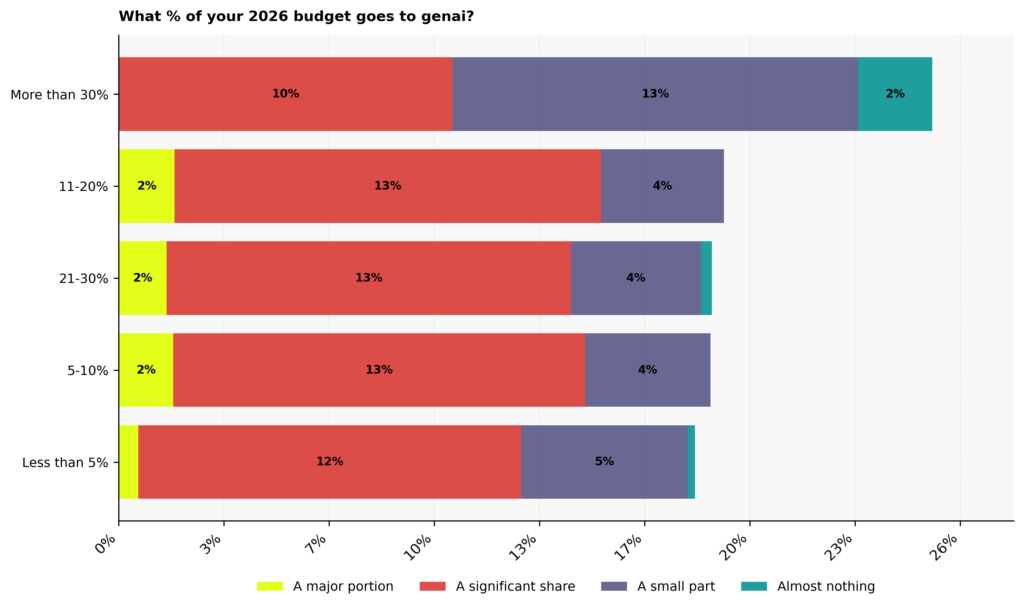
In 2025, US companies spent $37 billion on generative AI, and this figure looks set to keep on increasing. For our audience, opinions on how much of their 2026 budget is dedicated to this technology differ, with very clear patterns emerging between those spending between 5% and 30%.
2% each see between 5 and 10%, 11 and 20%, and 21 and 30% as a major portion of their budget being dedicated to this tech, and 13% each think that it’s a significant share of their overall budget to dedicate this way. Conversely, 4% each consider these figures as a small part overall. This is likely due to the potential GenAI has and how much investing in it could improve their business.
Those who are planning to spend less than 5% of their 2026 budget number 12% who think this is a significant share and 5% who consider this spend a small part, pointing to differences of opinion even at the lowest level. In contrast, there are those who have dedicated more than 30% of their budget, revealing they are investing a significant share in GenAI, while 13% say this is just a small part of their budget, and 2% who feel it’s almost nothing. This indicates that this portion of C-suite leaders are putting a lot of store in GenAI in their business.
Daniel Burrus, Futurist and Strategic Advisor Comments: The percentage of budget allocated to GenAI matters less than the discipline behind the investment. Companies can spend aggressively and still fall behind if the money is going toward disconnected experiments instead of strategic priorities. The strongest leaders will fund AI based on where it can create measurable advantage, accelerate innovation, improve decision making, and transform important business processes. The real question is not how much an organization is spending on GenAI. It is whether that spending is aligned with a clear vision of where the technology is heading and where the business can create the greatest future value.
What is C-suite leaders’ timeline for enterprise-wide rollout?
For 54% of C-suite leaders, a GenAI enterprise rollout is not going to happen anytime soon, and 43% have no plans for it, but 2% are planning on a full rollout soon, and 2% have already rolled out across their business and will be reaching enterprise-wide status in 2 to 3 years
The enterprise-wide leap is still on hold:
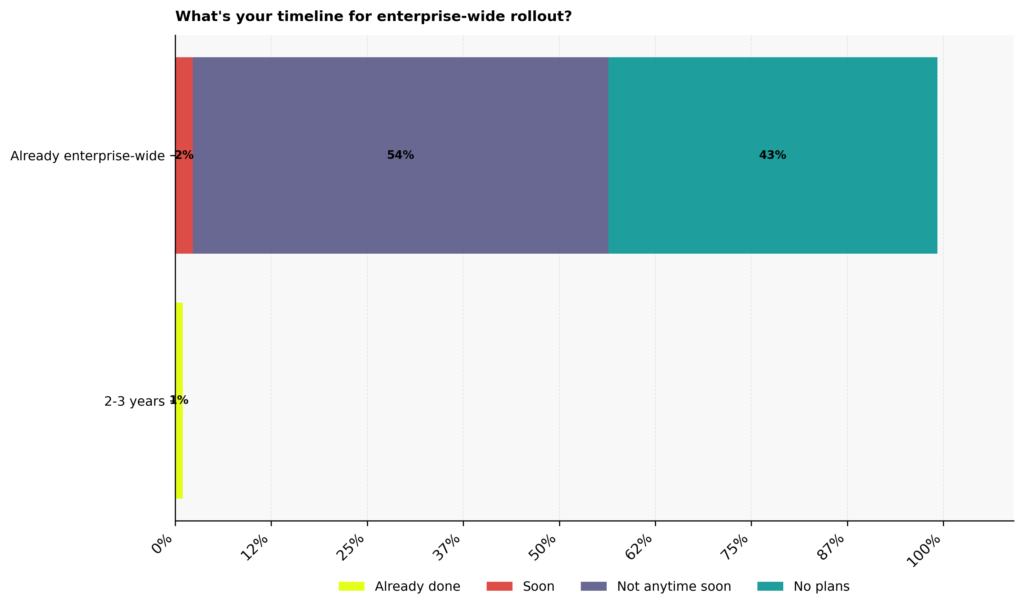
C-suite leaders are taking a cautious approach to enterprise-wide AI rollout. Only 2% expect to reach this stage soon, while 54% don’t see it happening anytime soon, and 43% have no plans for a full rollout.
Rolling AI out across an entire organization takes more than adding a few tools. Leaders need systems that can work together, clear rules for use, reliable data, and employees who know where AI fits into their work. Many may prefer to expand gradually rather than commit to a company-wide rollout before those foundations are in place.
A two-to-three-year rollout was planned by 1% and has already been completed. The small share shows how unusual it still is for organizations to move from limited use to full enterprise deployment within a set timeframe.
Daniel Burrus, Futurist and Strategic Advisor Comments: Enterprise wide AI adoption should not be rushed, but it should be anticipated. The organizations that wait until every uncertainty disappears will wait too long. Leaders need to identify which changes are becoming inevitable, strengthen the data, governance, and workforce capabilities required to support them, and then scale with purpose. A phased rollout can be smart, but only when each phase is connected to a larger strategic direction. The competitive risk is not moving cautiously. It is moving cautiously without a clear destination.
What is the biggest barrier to GenAI adoption for C-suite leaders?
Talent or skills gaps are a GenAI adoption barrier for 39% C-suite leaders, and only 2% don’t see them as such, 29% are hindered by a lack of clear ROI, 23% by data quality or readiness, and 6% find security or compliance risks to be a significant barrier to adoption
The hard part begins after the green light:
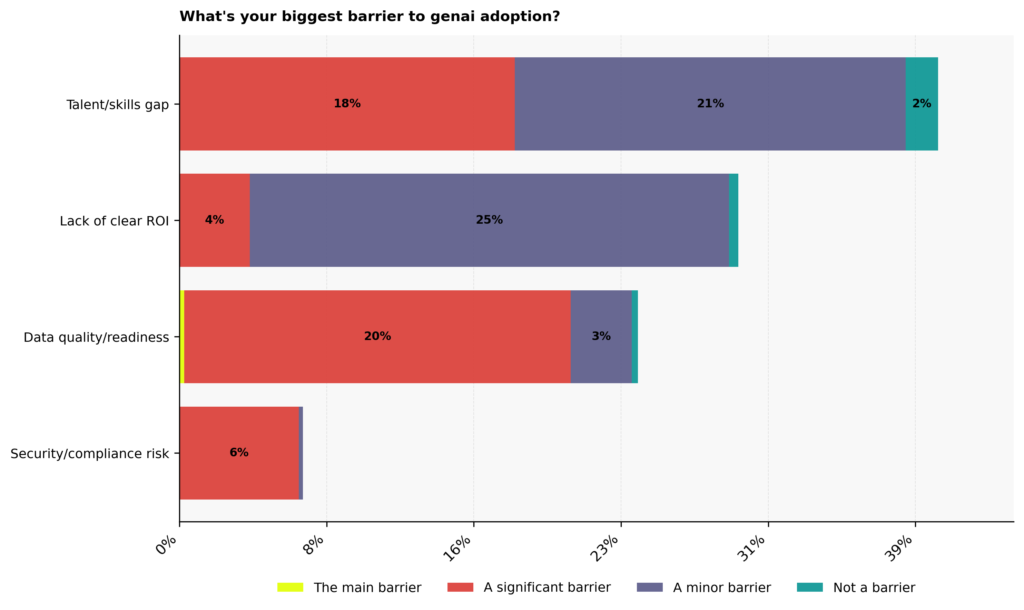
The biggest barriers to GenAI adoption for C-suite leaders sit less in the technology itself and more in whether organizations have the people, data, and commercial clarity to use it well. Talent and skills gaps lead the picture. They’re a significant barrier for 18% of our audience, a minor barrier for 21%, and not a barrier for 2%.
A global study of 1,010 C-suite executives, reported on by the World Economic Forum, found that 94% of leaders face shortages in AI-critical skills, with around one-third seeing gaps of 40% to 60% in critical roles. GenAI adoption depends on people who can choose the right use cases, manage implementation, review outputs, and connect the technology to business goals.
Lack of clear ROI is a significant barrier for 4% and a minor barrier for 25%, while less than 1% don’t see it as a barrier. Leaders may understand the potential, but investment becomes harder to defend when gains are difficult to measure or take time to appear.
Data quality and readiness are the main barrier for less than 1%, a significant barrier for 20%, a minor barrier for 3%, and not a barrier for less than 1%. GenAI can only work with the information available to it, so inconsistent, incomplete, or poorly governed data can limit the reliability of the output.
Security and compliance risk are a significant barrier for 6% and a minor barrier for less than 1%. These concerns are concentrated, but serious, because sensitive data, regulatory exposure, and unclear accountability can slow adoption quickly.
Daniel Burrus, Futurist and Strategic Advisor Comments: The biggest barrier to GenAI adoption is not the technology itself. It is organizational readiness. Skills, data, ROI, security, and compliance are all connected, and weakness in any one of them can slow progress across the entire business. Leaders should focus first on building the capabilities that make adoption repeatable and scalable. That means developing people who understand how to apply AI strategically, improving the quality and accessibility of data, and defining clear measures of value. The organizations that remove these barriers systematically will move faster because they are building confidence and capability at the same time.
What skill gap concerns C-suite leaders most?
AI governance or ethics is a major skills gap concern for 14% of C-suite leaders, and of some concern for 41%, 16% are somewhat worried about change management, and 15% have major concerns about data science and ML expertise; however, 15% have no concerns about any of these skills gaps
Knowing the technology is only the beginning:
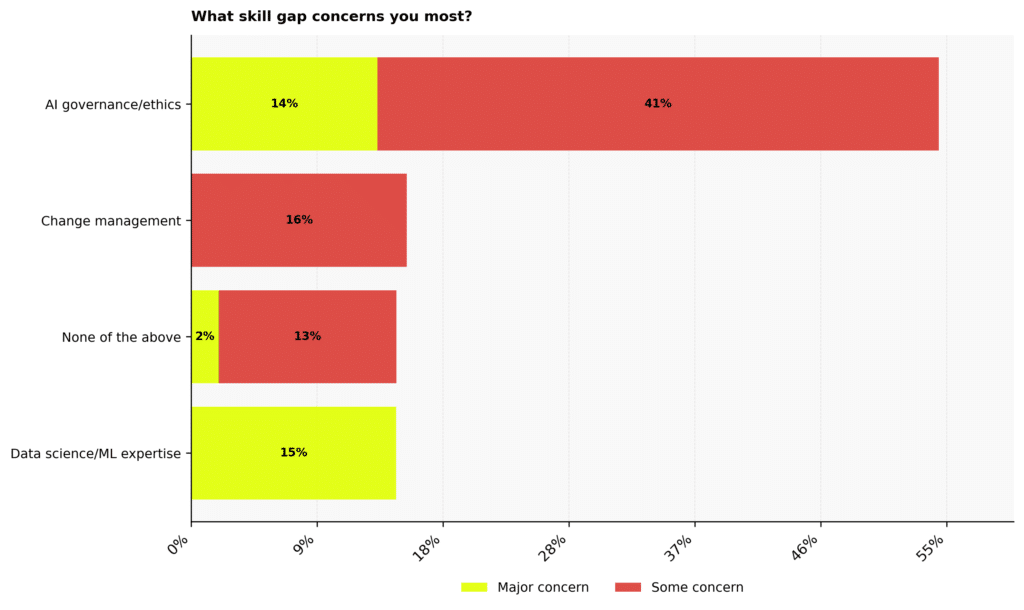
The skill gaps that concern C-suite leaders must sit at the point where GenAI moves from experimentation into responsible business use. AI governance and ethics are a major concern for 14% of C-suite leaders, and some concern for 41%. A 2025 study into AI ethics and governance in the job market found that more than 100,000 professionals with this expertise are now sought each year. The demand points to the need for people who can set guardrails, interpret regulations, manage risk, and make responsible AI use practical across the business.
Change management is of some concern for 16%. GenAI adoption can alter workflows, responsibilities, and expectations, so leaders need people who can help teams understand what is changing and how new ways of working should be introduced.
Data science and machine learning expertise are a major concern for 15%. These skills are needed when organizations want to build, adapt, test, or monitor AI systems rather than rely only on off-the-shelf tools. The gap can also make it harder to judge whether outputs are reliable and fit for business use.
Another 2% have major concerns outside the listed skill gaps, while 13% have some other concern. These may include areas such as AI literacy, cybersecurity, legal expertise, leadership capability, or the ability to connect GenAI investment with day-to-day business use.
Daniel Burrus, Futurist and Strategic Advisor Comments: The most important AI skill gap is not simply technical expertise. It is the ability to apply AI responsibly, strategically, and with enough foresight to understand the consequences of its use. Governance and ethics matter because trust will determine how far and how fast organizations can scale AI. At the same time, leaders cannot overlook change management. Employees need to understand not only how to use these tools, but how their roles, decisions, and responsibilities will evolve. The organizations that build technical capability, governance discipline, and human adaptability together will be far better prepared to turn AI into lasting business value.
What would accelerate GenAI adoption most for C-suite leaders?
More executive buy-in would accelerate GenAI adoption for 30% of C-suite leaders, clearer buy-in would speed it up for 28%, and better internet would help a lot for 14% and have some impact for 4%, while proven ROI examples would be an accelerator for 3%, help 10% a lot, and have some impact for 4%
GenAI adoption needs a clearer runway:
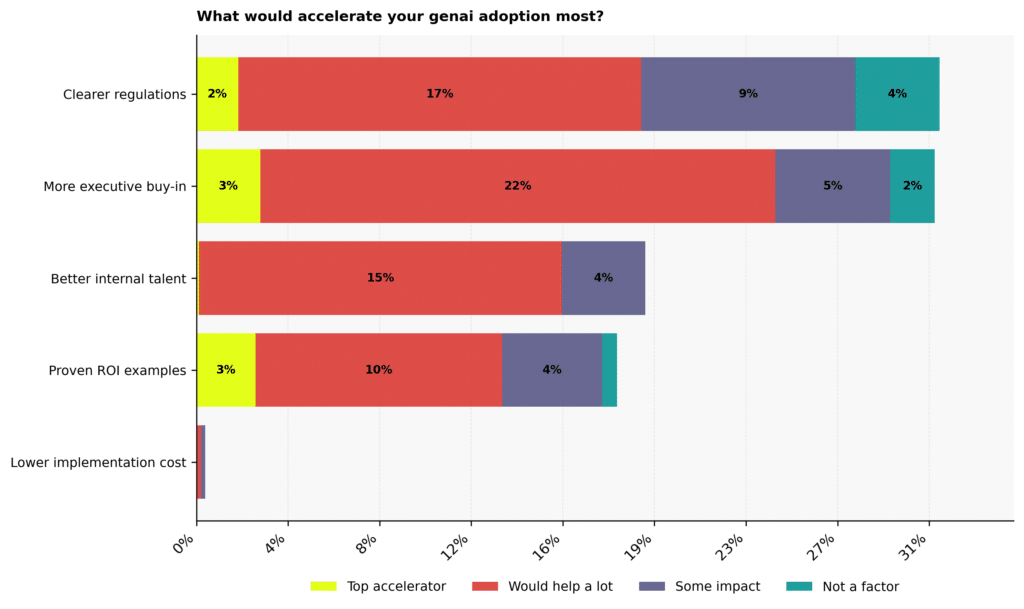
Accelerating GenAI adoption most effectively comes down to removing uncertainty and making implementation easier to support across the business. Clearer regulations are the top accelerator for 2% of C-suite leaders, would help a lot for 17%, have some impact for 9%, and aren’t a factor for 4%. More certainty around compliance, accountability, data use, and acceptable risk would give organizations firmer ground for investment.
Executive backing carries even wider support. It’s the top accelerator for 3%, would help a lot for 22%, has some impact for 5%, and isn’t a factor for 2%. Senior sponsorship can connect GenAI projects with budget, authority, and broader business priorities. Better internal talent would help a lot for 15% and have some impact for 4%. People who can identify valuable applications, manage implementation, assess outputs, and guide employees can turn scattered experimentation into more consistent adoption.
ROI and evidence encourage AI adoption
Proven ROI examples would also strengthen the case. They’re the top accelerator for 3%, would help a lot for 10%, have some impact for 4%, and aren’t a factor for less than 1%. Clear evidence makes investment easier to defend and gives leaders a practical model to follow.
Price barely enters the conversation, with lower implementation costs helping a lot for less than 1% and having some impact for less than 1%. Access to GenAI is already relatively affordable compared with the wider investment needed to use it well.
Daniel Burrus, Futurist and Strategic Advisor Comments: Executive support accelerates AI adoption because transformation requires more than access to technology. It requires a clear strategic direction, visible leadership commitment, and agreement on where AI can create the greatest value. When executives hesitate, individual teams may experiment, but the organization rarely moves with purpose. Leaders should identify the most predictable opportunities, connect them to measurable business outcomes, and give teams the authority to act. Clear leadership reduces uncertainty, strengthens accountability, and turns scattered AI activity into coordinated progress.
How prepared is the workforce for GenAI at C-suite leaders’ organizations?
82% of C-suite leaders have not assessed their workforce’s readiness for AI, 5% are not prepared, 5% are minimally prepared, and 4% are somewhat prepared, while just 5% have workforces that are very AI-ready
Workforce readiness is a major blind spot:
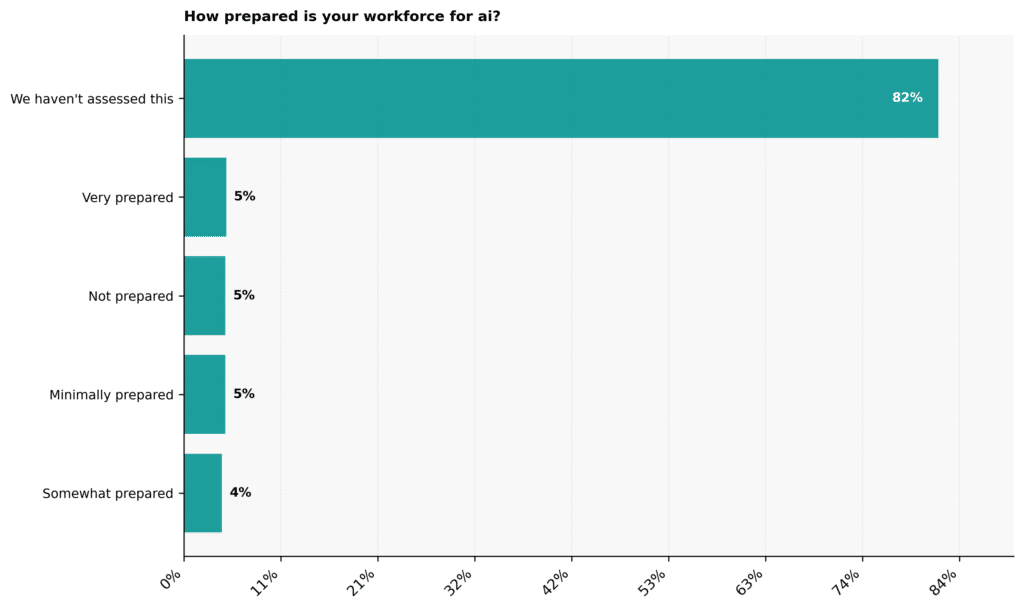
Workforce preparedness for AI remains largely unknown across C-suite leaders’ organizations. A striking 82% haven’t assessed how ready their employees are. Without that insight, leaders may not know which roles will change, where useful AI skills already exist, or which teams need training and support.
Research referenced by the U.S. Chamber of Commerce shows why this assessment is becoming urgent. It found that 80% of American jobs are likely to have at least 10% of their tasks altered by AI, while almost 20% could have at least half of their tasks altered.
Workforces at another 5% of C-suite leaders in our audience’s organizations aren’t prepared, 5% are minimally prepared, and 4% are somewhat prepared. Even where readiness has been assessed, most organizations still have work to do before employees can use AI confidently and consistently. Some may need basic training, while others may need more practical experience applying AI in their roles.
Only 5% consider their workforce very prepared. These organizations may already understand how AI will affect roles, have practical training in place, and be helping employees apply the technology in their day-to-day work. This gives them a stronger foundation for introducing AI across the business while helping employees adapt as their responsibilities change.
Daniel Burrus, Futurist and Strategic Advisor Comments: The fact that so many organizations have not assessed workforce readiness is a major strategic risk. AI adoption will not succeed simply because employees are given access to new tools. Leaders need to understand which tasks will change, which capabilities will become more valuable, and where people need training to work effectively with AI. The organizations that assess readiness early can prepare their workforce before disruption forces the issue. That creates a significant advantage because they can build confidence, develop new skills, and redesign roles with intention rather than reacting after change is already underway.
What is the C-suite leaders’ stance on employee GenAI tool use?
6% of C-suite leaders strongly support the use of employee GenAI tool use on a case-by-case basis, 21% somewhat support this, and 34% have some reservations, and 14% don’t support this tool use at all, 6% would support it with some guidelines, but 11% are less comfortable about doing so, and just 2% are fully encouraging it company-wide, while 4% are less enthusiastic
Employee GenAI use is already ahead of the rulebook:
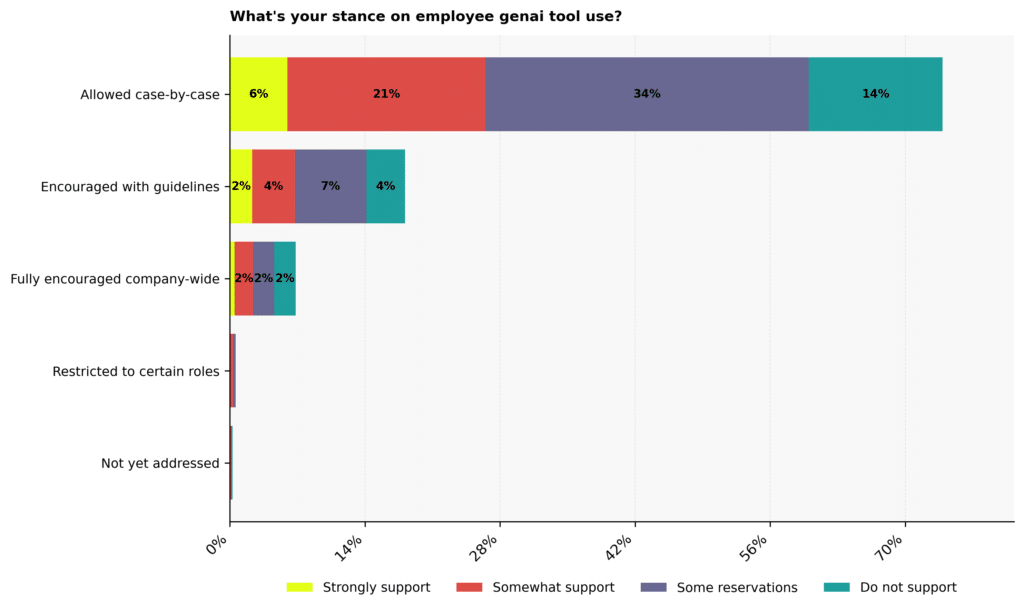
C-suite leaders’ stance on employee GenAI use is cautious. With a Conference Board survey finding that 56% of workers already use generative AI on the job and nearly 1 in 10 use it daily, leaders are no longer deciding whether these tools belong at work, but how employees should use them.
Case-by-case use has strong support from 6% of C-suite leaders in our audience and some support from 21%. Another 34% have some reservations, while 14% don’t support it. This approach lets organizations judge the task, information involved, and level of oversight before approving use, though employees may face different rules across teams.
Encouraging GenAI use with guidelines has strong support from 2% and some support from 4%. Another 7% have reservations, while 4% don’t support it. Clear guidance can set boundaries around sensitive information, checking outputs, and human review.
Opinions on tool use are somewhat divided
Company-wide encouragement has strong support from less than 1% and some support from 2%. Another 2% have reservations, and 2% don’t support it. Broad approval may feel premature while organizations are still deciding which tools are reliable and where they add real value.
Restricting GenAI to certain roles has some support from less than 1%, which may reduce risk in sensitive work but limit useful applications elsewhere. Less than 1% have reservations about their organization not yet addressing employee GenAI use. With employees already using the technology, delaying a clear position can leave privacy, accuracy, and acceptable use to individual judgment.
Daniel Burrus, Futurist and Strategic Advisor Comments: Employee use of GenAI is moving faster than many organizations’ policies, which means leaders need to replace uncertainty with clear guidance. Restricting access without a strategy can drive use underground, while unrestricted access can create unnecessary risk. The better approach is to define where GenAI adds value, establish clear rules for data, accuracy, privacy, and human oversight, and train employees to use the tools responsibly. When people understand both the opportunities and the boundaries, organizations can encourage innovation without sacrificing trust or control.
How confident are C-suite leaders in their GenAI strategy?
55% of C-suite leaders are somewhat unsure about their AI strategy, 42% are neutral about how confident they are, and 1% is very confident, but a further 1% are only somewhat confident, and 1% are not confident at all
AI strategy is still in wait-and-see mode:
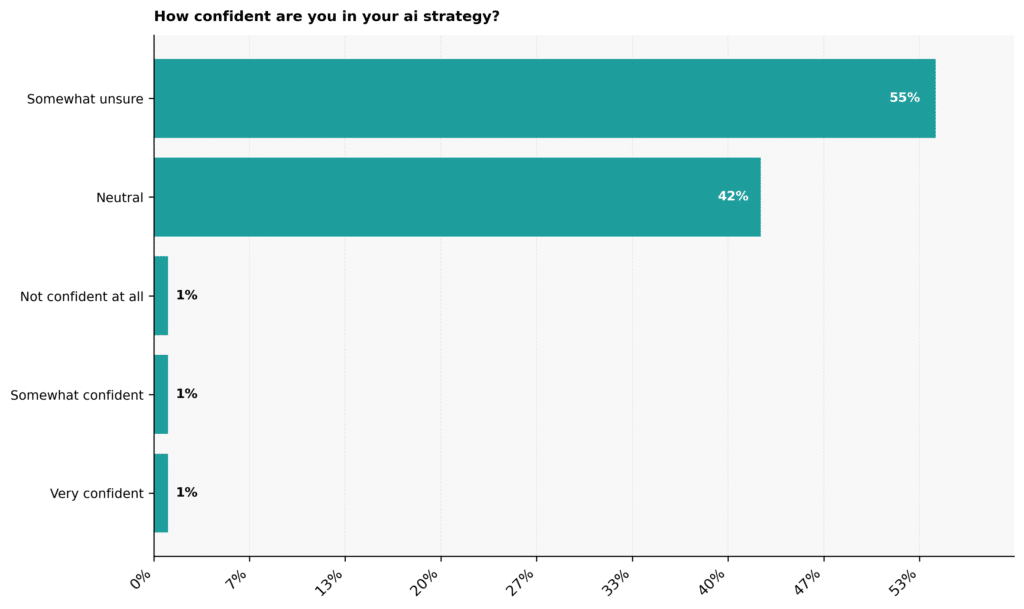
C-suite leaders have yet to reach a clear level of confidence in their AI strategy. More than half are somewhat unsure at 55%, while 42% are neutral. Most leaders are still working out whether their strategy gives them enough direction on where to invest, which uses to prioritize, and how success should be judged.
Somewhat unsure leaders may already have AI projects underway, but still lack a firm view of how those projects fit together. Neutral leaders may be waiting for stronger results, clearer ownership, or a better sense of where AI can add the most value. In either case, the strategy can remain broad while individual teams move ahead at different speeds.
Only 1% are not confident at all, 1% are somewhat confident, and 1% are very confident. These tiny figures show how few leaders have reached either a strongly positive or a strongly negative position. Most are still somewhere in the middle, with interest in AI but no settled view on whether the current strategy is ready to guide the business.
Daniel Burrus, Futurist and Strategic Advisor Comments: Low confidence in AI strategy is often a sign that organizations are reacting to rapid change instead of anticipating it. Leaders do not need perfect certainty about every new tool or model, but they do need clarity about which developments are predictable, which business capabilities will be transformed, and where the organization should act first. A strong AI strategy connects those predictable shifts to measurable priorities, clear ownership, and disciplined execution. Confidence grows when leaders stop chasing every new development and start building around the changes they can already see coming.
How do C-suite leaders measure GenAI ROI today?
54% of C-suite leaders measure GenAI ROI in cost savings, 28% in productivity and time saved, 13% in revenue growth, and 5% don’t formally measure GenAI ROI at all
GenAI ROI starts with the gains leaders can count:
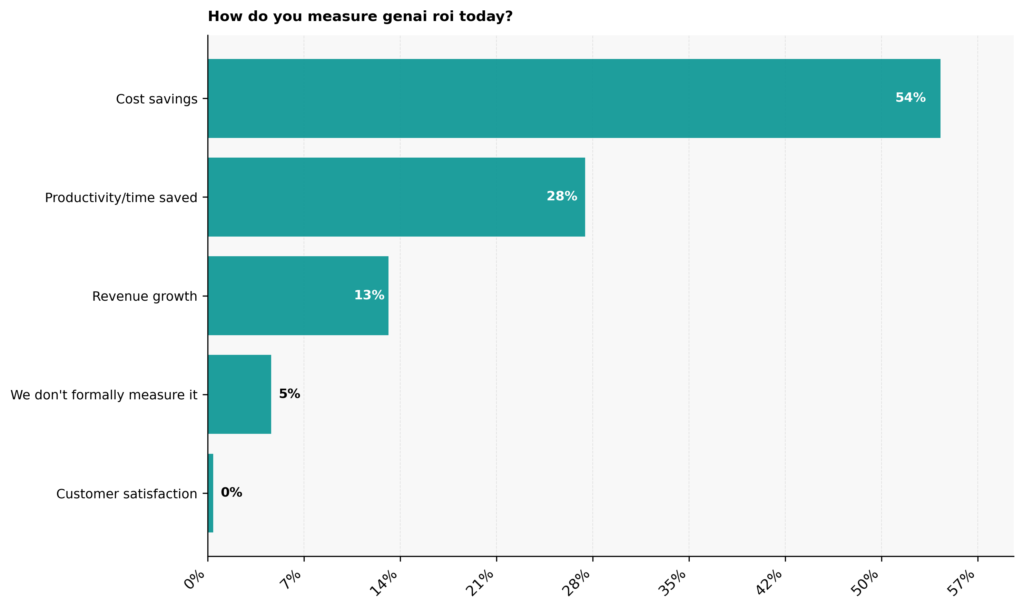
C-suite leaders measure GenAI ROI mainly through financial and operational gains that can be tracked directly. IBM found that the average ROI on enterprise-wide AI initiatives is just 5.9%, well below the typical 10% cost of capital, while best-in-class organizations achieve 13%. The gap shows why choosing clear measures and tracking results closely can make such a difference.
Cost savings are the leading measure for 54% of C-suite leaders. Savings can come from reducing manual work, limiting outside spend, improving processes, or making better use of existing technology. These gains are often easier to connect to a particular GenAI project than broader business outcomes.
Productivity and time saved come next at 28%. Faster research, drafting, analysis, and administration can show value quickly, even when the financial return is harder to calculate straight away. Time savings can also free employees to focus on work that needs judgment, creativity, or closer customer attention.
Revenue growth is the main measure for 13%. GenAI may support new products, stronger sales work, or faster responses to opportunities, but revenue gains usually take longer to emerge and can be harder to attribute to one investment.
Another 5% don’t formally measure GenAI ROI. Without clear tracking, it becomes difficult to compare projects, identify what is working, or decide where further investment should go.
Customer satisfaction sits at 0%. This doesn’t mean it isn’t being used to measure GenAI ROI, but that customer satisfaction may be harder to isolate because many factors beyond GenAI influence the overall customer experience.
Daniel Burrus, Futurist and Strategic Advisor Comments: Cost savings and productivity are important, but they capture only part of GenAI’s value. The larger opportunity is to measure how AI improves decision making, accelerates innovation, strengthens customer value, and creates new sources of revenue. Leaders should ask not only what AI helps them spend less on, but what it enables them to do that was not practical before. The organizations that measure both efficiency and strategic growth will have a much clearer view of whether GenAI is simply reducing costs or actually creating competitive advantage.
How has GenAI changed customer experience for C-suite leaders?
For 50% of C-suite leaders, it’s too early to tell if GenAI has changed their customer experience, and 46% have seen no major change; however, 3% have seen a significant improvement in CX
Most customer experience gains are still below the surface:
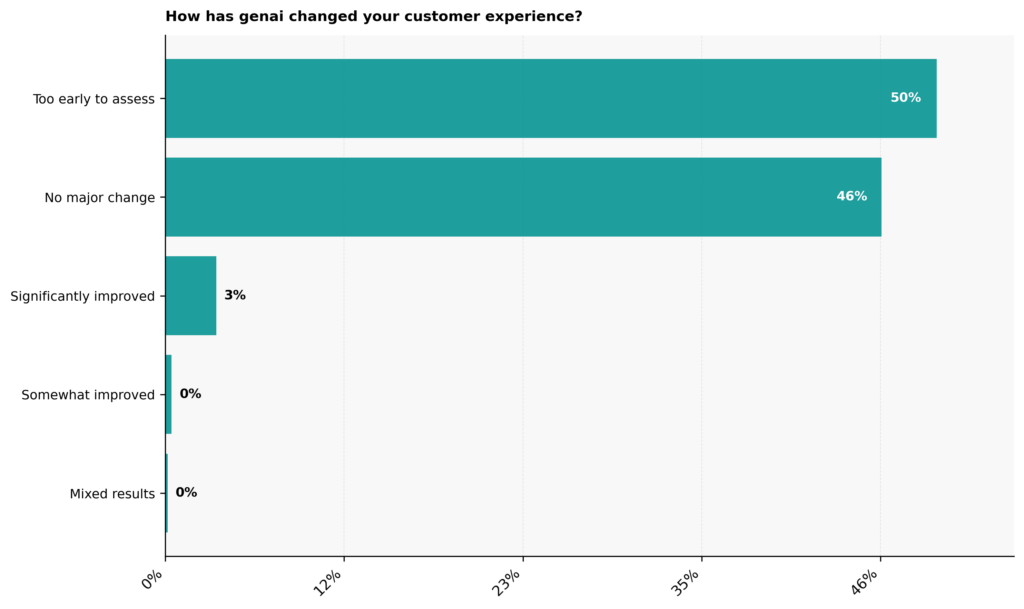
GenAI has yet to produce a clear customer experience (CX) shift across most C-suite leaders’ organizations. Most leaders are still waiting for enough evidence to judge whether the technology is improving how customers interact with the business.
The 50% who consider it too early to assess may still be testing GenAI in limited areas such as support, personalization, search, or self-service. Customer experience changes can also take time to show up clearly, especially when early tools are working behind the scenes rather than changing the customer journey directly.
The 46% seeing no major change may have introduced GenAI without yet altering the speed, quality, or consistency of customer interactions. Early use may be helping employees internally, while customers experience much the same service as before. This likely also explains why there were no opinions showing mixed results or customer experience improving somewhat.
Only 3% have seen customer experience improve significantly. These organizations may already be using GenAI in areas where faster answers, easier access to information, or more relevant support are immediately visible to customers.
Daniel Burrus, Futurist and Strategic Advisor Comments: The limited impact on customer experience suggests that many organizations are still using GenAI behind the scenes rather than redesigning the customer journey around what the technology now makes possible. The bigger opportunity is not simply faster service. It is using AI to make interactions more relevant, more personalized, more predictive, and easier for customers. Leaders should look beyond automating existing touchpoints and ask how GenAI can remove friction, anticipate customer needs, and create experiences that were not practical before. That is where AI begins to move from an internal efficiency tool to a true source of customer value.
How has GenAI impacted headcount plans for C-suite leaders?
46% of C-suite leaders have reduced hiring due to GenAI; yet 36% have increased hiring, 14% have observed no change, and 4% agree that it’s too early to tell
GenAI is rewriting the hiring plan:
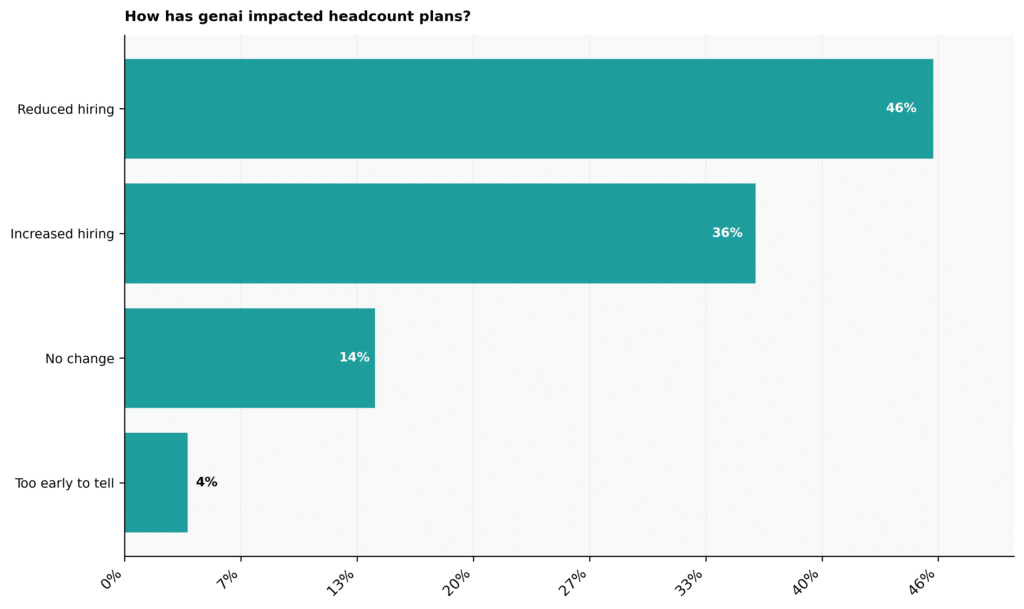
GenAI is pushing headcount plans in two directions across C-suite leaders’ organizations. Goldman Sachs researchfound the same split in the wider labor market. AI substitution removed an estimated 25,000 jobs per month over the past year, while augmentation added around 9,000, leaving a net reduction of roughly 16,000 jobs each month.
Reduced hiring leads at 46% of our audience. Some organizations may need fewer new employees, where GenAI can handle routine research, drafting, administration, analysis, or customer queries. Hiring plans may also slow when existing teams can take on more work with AI support.
At the same time, 36% have increased hiring. GenAI can create demand for people who can implement the technology, manage data, set governance standards, check outputs, and help teams use it effectively. Growth may also require more specialist or strategic roles as routine work becomes easier to automate.
Another 14% have made no change to headcount plans. Their GenAI use may still be too limited to alter staffing needs, or they may be using it to support current employees rather than change team size.
Only 4% consider it too early to tell, showing that most leaders have already connected GenAI with practical workforce decisions.
Daniel Burrus, Futurist and Strategic Advisor Comments: GenAI is not simply reducing jobs. It is changing the composition of work. Some tasks will require fewer people, while new capabilities will increase demand for employees who can apply AI, manage it, question it, and use it to create greater value. Leaders should avoid viewing headcount only through the lens of reduction. The more strategic question is which roles will diminish, which will expand, and which new roles will emerge. Organizations that anticipate those shifts can re-skill people earlier, redesign work more intelligently, and build the talent they will need before the market makes that talent harder to find.
How is GenAI affecting competitive positioning for C-suite leaders?
GenAI is giving 37% of C-suite leaders a slight advantage over their competitors, 20% are gaining a strong competitive advantage, and 28% are not noticing any impact, while 8% are unsure, and 7% are falling behind their competitors
The payoff is starting to show:
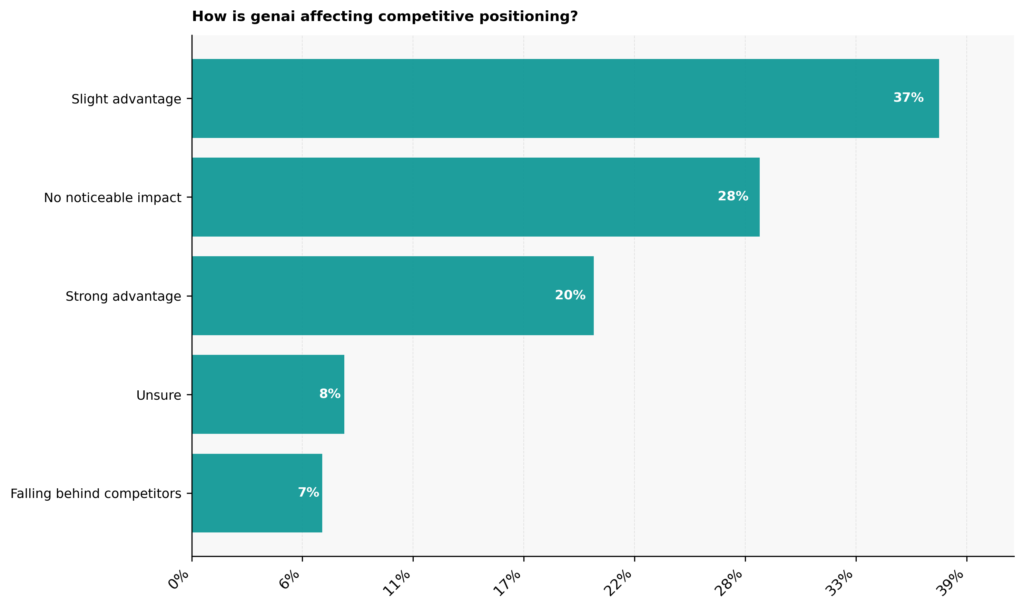
GenAI is giving many C-suite leaders a competitive lift, though the advantage is usually more incremental than decisive. 37% of our audience is seeing a slight advantage. Faster analysis, smoother processes, or quicker responses may be helping, but not yet enough to separate them clearly from competitors.
A strong advantage is emerging for 20%. These organizations may have moved beyond isolated use cases and built GenAI into products, customer experience, or decision-making in ways that are harder for rivals to match.
Yet 28% see no noticeable impact, which may mean their use is still limited or that competitors are adopting similar tools at much the same pace. GenAI can improve performance without changing the competitive position when everyone has access to comparable capabilities.
Uncertainty remains for 8%, especially where gains are spread across several areas, or leaders lack a clear way to compare progress with competitors. Meanwhile, 7% are falling behind. Rivals may be moving faster on implementation, talent, product development, or customer use.
Daniel Burrus, Futurist and Strategic Advisor Comments: GenAI can create an advantage, but access to the technology alone will not sustain it because competitors can often obtain the same tools. The real advantage comes from how quickly an organization learns to apply AI to its unique data, processes, customer relationships, and strategic opportunities. Leaders should focus on creating capabilities that are difficult to copy, not simply adopting what everyone else is using. Competitive advantage emerges when AI is combined with foresight, proprietary knowledge, and faster execution. The companies that anticipate where AI will change their industry and act early will be much harder to catch.
What worries C-suite leaders most about GenAI risk?
Data privacy or security is a top GenAI concern for 47% C-suite leaders and a real worry for 17%, regulatory compliance is tops for 24%, 7% cite it as a real worry, and 3% as some concern, and fewer than 1% are worried about misinformation or hallucinations
GenAI risk starts where control begins to slip:
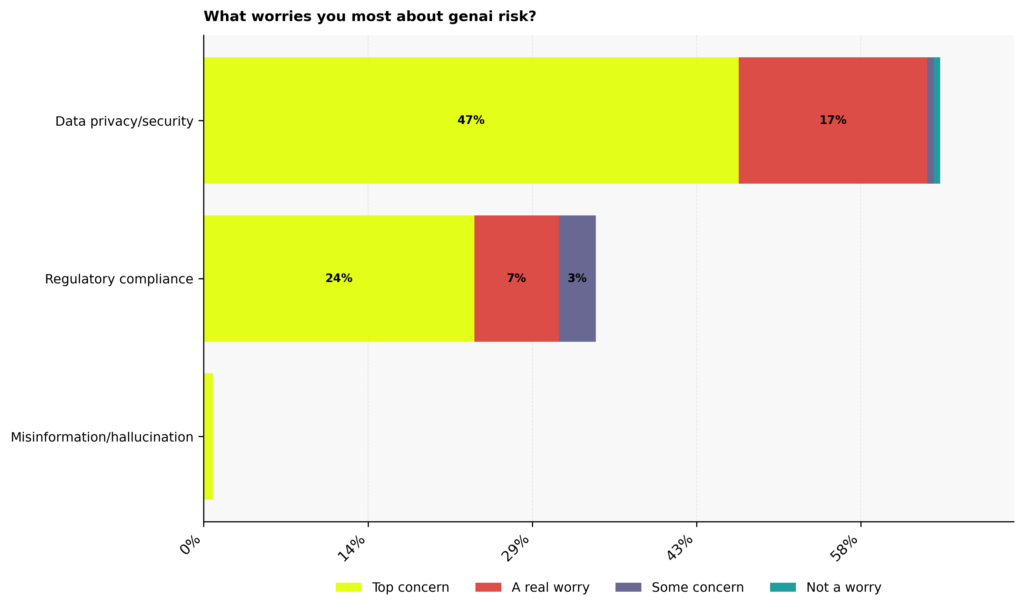
GenAI risk is most serious for C-suite leaders when sensitive information and regulatory exposure are involved. Data privacy and security are the top concern for 47%, a real worry for 17%, some concern for less than 1%, and not a worry for less than 1%.
A 2025 Data Privacy Benchmark Study shows why this concern runs so high. It found that 64% of privacy and security professionals worry about sensitive information being shared publicly or with competitors, while nearly half have already entered personal employee data or non-public company information into GenAI tools. The risk is already present in everyday use, especially when employees work with public tools outside normal company controls.
Compliance and hallucinations also a concern
Regulatory compliance is the top concern for 24%, a real worry for 7%, and some concern for 3%. Leaders need to know how GenAI use fits existing privacy, industry, employment, and consumer protection rules while new AI regulation continues to develop. Unclear accountability can make even useful projects harder to approve or scale.
Misinformation and hallucination are the top concerns for less than 1%. The low figure doesn’t mean inaccurate output carries little risk. It may be seen as easier to manage through human review and fact-checking than privacy breaches or compliance failures, where the damage can be harder to contain once sensitive information has been exposed.
Daniel Burrus, Futurist and Strategic Advisor Comments: Privacy, security, and compliance deserve serious attention, but leaders should not allow risk management to become a reason for strategic paralysis. The goal is to identify which risks can be anticipated, establish clear safeguards, and build trust into AI use from the beginning. Organizations also need to recognize that misinformation and hallucinations can create significant business consequences even when they are not viewed as the top concern. Strong AI strategy combines innovation with verification, accountability, and disciplined governance. The companies that manage risk proactively will be able to move faster because they have created the confidence to use AI at scale.
Which industry’s GenAI use most inspires C-suite leaders?
80% of C-suite leaders are most inspired by the use of GenAI in retail or e-commerce, 10% of its use in technology, 7% are inspired by how it’s used in healthcare, and 4% are inspired by GenAI in manufacturing
GenAI earns attention where browsing turns into buying:
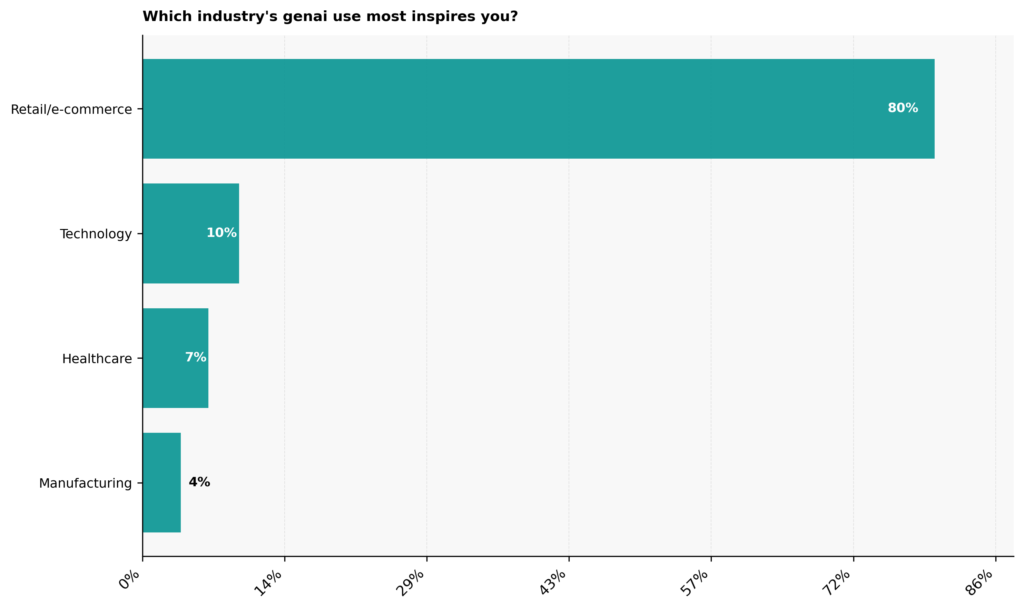
The industries that most inspire C-suite leaders are those turning GenAI into visible, practical gains. Retail and e-commerce lead by a wide margin at 80% of our audience, helped by applications that improve the customer journey and produce measurable commercial results.
Columbia Business School research found that a GenAI pre-sale chatbot increased online retail sales by 16.3% and conversion by 21.7%. AI-enhanced search and richer product descriptions also lifted sales. Retail makes GenAI’s value easy to see because the technology can help customers find products, compare options, get faster answers, and move toward a purchase.
Other sources of inspiration
Technology inspires 10% of our audience, largely because the sector shows how GenAI can be embedded directly into products, software development, customer support, and internal workflows. These examples can demonstrate what large-scale adoption looks like, even when some applications feel less transferable outside technology companies.
Healthcare inspires 7%, where the appeal comes from GenAI’s potential to support clinical documentation, patient communication, research, and administrative work. Progress can be harder to replicate quickly because privacy requirements, accuracy concerns, and professional oversight place tighter limits on deployment.
The remaining 4% look to manufacturing, where many of the gains sit behind the scenes. Maintenance guidance, technical documentation, product design, supply chain planning, and workforce training can all benefit from GenAI, though these uses may attract less attention because customers rarely see them directly.
Daniel Burrus, Futurist and Strategic Advisor Comments: Retail and ecommerce are attracting attention because they make GenAI value visible and measurable. Customers can experience the improvement directly through better search, faster answers, greater personalization, and easier purchasing decisions. But leaders should look beyond the industry and focus on the underlying pattern. The strongest AI opportunities often appear where technology can remove friction, anticipate needs, and improve the speed or quality of a decision. Every industry should be asking where those same principles can be applied to create a better experience and a stronger business outcome.
How do C-suite leaders see GenAI’s role in 5 years?
38% of C-suite leaders see GenAI as playing a niche role or being used for specialized purposes only in the next 5 years, 23% think it will be core to every function, 19% think it will be replaced by next-gen tech, and 18% think it will play a major role, but not one that’s central, and 1% are uncertain about its long-term value
Leaders agree GenAI will last, but not what it will become:
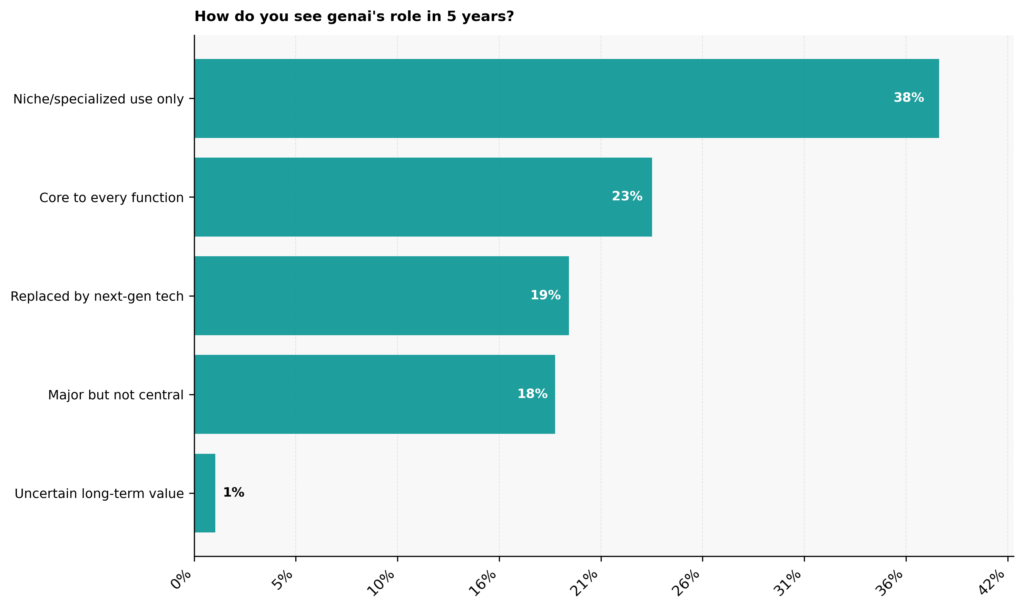
C-suite leaders see several possible futures for GenAI over the next five years. 38% expect niche or specialized use only. These leaders may see GenAI settling into areas like coding, research, content, or customer support without spreading across the entire business.
Another 23% expect GenAI to become core to every function. Their outlook assumes the technology will move beyond isolated tools and become part of daily work across finance, operations, marketing, HR, and strategy.
A further 19% believe GenAI will be replaced by next-generation technology. Current tools may simply become a stepping stone toward systems that are more capable, reliable, and deeply integrated.
18% see their role as major, but not central. GenAI may become a standard support layer across many teams, helping people work faster while strategic direction, specialist systems, and human judgment still carry more weight.
Only 1% are uncertain about GenAI’s long-term value. They may still be waiting to see whether the early gains hold up, how regulation changes the picture, or whether today’s tools are overtaken before they become firmly embedded in the business.
Daniel Burrus, Futurist and Strategic Advisor Comments: GenAI will not remain a separate category of technology for long. Over the next five years, many of its capabilities will become embedded into the systems, workflows, and decisions people use every day. Some of today’s tools will certainly be replaced by more advanced technologies, but that does not reduce the importance of what is happening now. It makes preparation more important. Leaders should focus less on predicting which platform will win and more on identifying the capabilities that are becoming increasingly predictable, then preparing their organizations to use them. The companies that do that will be ready not only for GenAI, but for the next generation of intelligent systems that follows.
The future of GenAI in business
The analysis of these C-suite leaders’ opinions gives us a clear view of where generative AI stands in business today. Leaders are looking past the hype and asking what GenAI can actually deliver.
The gap between interest and impact is now becoming much harder to ignore. Companies have to decide where the technology deserves investment, where it can improve the way the business works, and where it simply adds noise. The next phase will be defined by which organizations can turn that interest into clear decisions, practical use, and results that show up where it counts.
Daniel Burrus, Futurist and Strategic Advisor Comments: The future of GenAI in business will not be defined by who adopts the most tools. It will be defined by who develops the clearest strategy for using intelligence to create measurable value. The organizations that lead will distinguish between short term experimentation and long term transformation, identify the changes that are becoming increasingly predictable, and act on them before the opportunity becomes obvious to everyone else. GenAI is only one stage in a larger progression toward more capable intelligent systems. Leaders who build the right skills, governance, data, and decision making disciplines now will be far better prepared for what comes next.
Top Strategic Foresight Advisors Statistics: US 2026 >> Futurist Speakers Statistics: USA 2026