C-suite leaders are making long-range decisions while the ground is still moving. A strategic foresight advisor helps them work through that uncertainty with more discipline, perspective, and confidence. The top advisors do not simply describe what the future might look like. They help executives think more clearly about which signals deserve attention, which assumptions need to be tested, and where the organization may need to move before the pressure becomes obvious.
To find out what 38,502 opinions of C-suite leaders in the US were about top strategic foresight advisors, we utilized AI-driven audience profiling to synthesize insights from online discussions over 12 months, ending on June 10th, 2026, to a high statistical confidence level. Looked at collectively, these perspectives give a broad view of how senior leaders separate polished advisory positioning from guidance they are willing to trust. They also help clarify what makes foresight advice feel credible, relevant, and useful when executives are making decisions with long-term consequences.
Index
- 76% of C-suite leaders primarily seek a broad, cross-industry perspective in a strategic foresight advisor rather than tailored guidance; however, 20% say that a tailored approach that specifically suits their industry or organizational context is absolutely essential, as generic frameworks are not a valued option, and 5% agree it’s very important and they expect significant customization
- While 4% of C-suite leaders agree that a proprietary, branded methodology with documented outcomes is a credibility signal that increases confidence in a strategic foresight advisor before engaging them, 48% find active advisory relationships with Fortune 500 organizations somewhat helpful, yet 48% think these relationships are not convincing
- 31% of C-suite leaders’ organizations evaluate a strategic foresight advisor before making a final selection by conducting an introductory or discovery session with the advisor, 31%prefer to speak directly with executives who have worked with them, 31% watch keynote presentations or recorded speaking engagements, and 8% assess the alignment between the advisor’s frameworks and their strategic priorities
- 62% of C-suite leaders allocate budget for strategic foresight advisory services on a project-by-project basis as needs arise, 31% draw funds from the innovation and R&D budget, and 8% fund these services through the CEO or board discretionary budget
- For 59% of C-suite leaders, inconsistent availability or depth of engagement over time is the most common shortcoming they’ve experienced with a strategic foresight advisor, while 4% say that a limited understanding of their specific industry or competitive landscape is somewhat of an issue, and 37% express minor concerns about insights that are too theoretical and lack practical, actionable guidance
- 16% of C-suite leaders agree that their executive title is best described as Chief Executive Officer; this title could describe 24%, but it’s not quite right for 11%, and doesn’t fit 1%, white Chief Strategy Officer is the perfect fit for 9%, and could describe 18%, it’s not quite right for 11%, and doesn’t fit for 11%
- Translating broad perspectives into practical decisions
- About the data
Is it important to C-suite leaders that a strategic foresight advisor tailors their approach to their industry?
76% of C-suite leaders primarily seek a broad, cross-industry perspective in a strategic foresight advisor rather than tailored guidance; however, 20% say that a tailored approach that specifically suits their industry or organizational context is absolutely essential, as generic frameworks are not a valued option, and 5% agree it’s very important and they expect significant customization
Most C-suite leaders value advisors who can widen the frame:
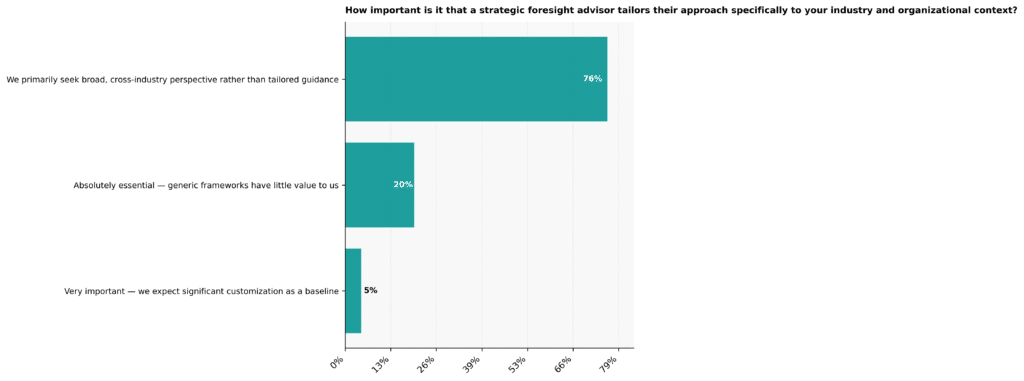
For most C-suite leaders, industry and organizational tailoring is less important than access to perspectives from outside their immediate operating environment. 76% of our audience primarily seek a broad, cross-industry perspective rather than tailored guidance from a strategic foresight advisor. This gives external foresight support a specific role.
Senior leaders may already have internal teams, market specialists, operational leaders, and competitive intelligence functions focused on their own sector. An outside advisor can add a different kind of value by connecting developments from adjacent markets, emerging technologies, regulatory change, geopolitics, consumer behavior, and business models beyond the organization’s usual frame of reference.
The unique role of an external strategic foresight advisor
The World Economic Forum describes strategic foresight as a structured way to look beyond the immediate business environment and explore future challenges, opportunities, and uncertainties. It also connects foresight with better decision-making and stronger strategic options. This justifies why a cross-industry perspective carries so much weight for C-suite leaders. If foresight is meant to broaden how leaders think about the future, an advisor who starts too narrowly with current industry assumptions may limit the value they can bring.
PwC’s Global CEO Survey adds a sharper business reason for this preference. It found that nearly 40% of CEOs did not believe their organizations would be economically viable in ten years if they continued on their current path without transformation. For leaders facing that kind of transformation pressure, the advisor’s value may come from challenging the current business model, identifying outside forces that could disrupt it, and showing where future value could come from.
The 20% of C-suite leaders who see tailoring as absolutely essential because generic frameworks have little value for them may still value a broad perspective, but they also need it tied to the organization’s real constraints. In highly regulated, technically complex, capital-intensive, or geopolitically exposed businesses, a framework can feel too detached if it does not reflect how decisions are actually made.
The remaining 5% says tailoring is very important, and expect significant customization as a baseline. This points to a highly specific standard. For these leaders, a bespoke approach is part of the minimum advisory requirement. They likely expect a strategic foresight advisor to connect wider signals to their industry dynamics, organizational context, and decision-making environment from the outset.
The business case for strategic foresight
Influential research on corporate foresight strengthens the commercial case for getting this balance right. It found that future-prepared firms outperformed the average by 33% higher profitability and 200% higher market capitalization growth.
This reinforces the value of strategic foresight when it helps organizations look beyond immediate operating conditions, challenge current assumptions, and prepare for future change in a more systematic way. The strongest role for advisors may be to bring the wider lens most leaders want, then translate those signals into guidance that fits the organization’s real context.
Commentary from Daniel Burrus:: The most effective strategic foresight advisors do not simply customize yesterday’s industry assumptions; they help leaders see beyond the boundaries of their industry to identify the forces that will redefine it. C-suite leaders already have access to internal expertise, competitive intelligence, and operational knowledge. What they often need is a broader anticipatory lens that connects Hard Trends across technology, regulation, demographics, AI, cybersecurity, customer behavior, and new business models before those forces fully impact their market.
The future rarely disrupts one industry in isolation. It moves through convergence. That is why a cross-industry perspective is so valuable: it reveals patterns, opportunities, and threats that are often invisible to leaders focused only on their current sector. At the same time, foresight must become actionable. Broad perspective creates strategic advantage only when it is translated into the organization’s real context, constraints, and opportunities.
The best advisors bring both breadth and precision. They challenge leaders to look outside their familiar frame, separate Hard Trends from assumptions, and use future certainty to make better decisions today. In an environment where many CEOs recognize that their current business models may not remain viable without transformation, strategic foresight becomes more than planning. It becomes a leadership discipline for anticipating disruption, accelerating innovation, and shaping the future before competitors are forced to react.
Which credibility signal increases C-suite leaders’ confidence in an advisor?
While 4% of C-suite leaders agree that a proprietary, branded methodology with documented outcomes is a credibility signal that increases confidence in a strategic foresight advisor before engaging them, 48% find active advisory relationships with Fortune 500 organizations somewhat helpful, yet 48% think these relationships are not convincing
Big-name experience opens the door, but does not close the deal:
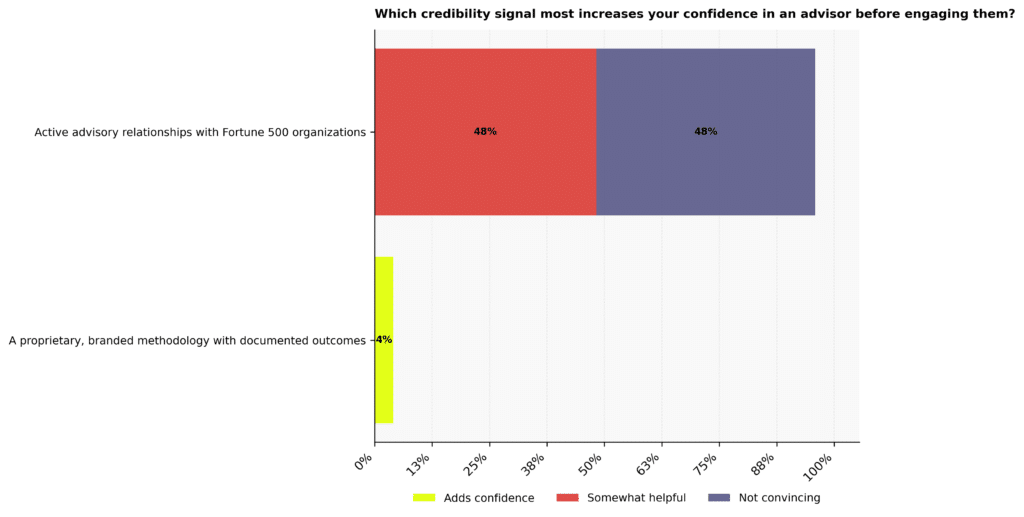
Credibility signals before engagement do not land evenly with C-suite leaders. Active advisory relationships with Fortune 500 organizations split opinion exactly among our audience, with 48% describing them as somewhat helpful and another 48% saying they are not convincing.
This points to a cautious view of borrowed credibility. A Fortune 500 relationship can help because it signals that an advisor has operated around complex organizations, senior stakeholders, and high-pressure strategic decisions. It may also imply experience with large-scale uncertainty, governance expectations, and long-range planning. However, the equal share who find the same signal unconvincing shows that recognizable client names do not automatically create confidence.
Why large-organization experience can divide opinion among C-Suite leaders
Research from 2019 found that 25% of Fortune 500 companies practiced foresight in some capacity. While a Fortune 500 advisory relationship may indicate exposure to serious corporate foresight activity, it does not show how deep that involvement went. Helping guide long-term strategy, running a workshop, contributing to innovation planning, or working on a narrower operational project represent very different levels of involvement.
This is likely why the credibility signal divides opinion so sharply. C-suite leaders may want proof of what the advisor actually influenced, rather than a broad claim that they have worked with a large organization.
A recent World Economic Forum article on why companies must change their approach to corporate foresight helps explain why large-company experience may divide opinion. Drawing on a global study of 400 senior executives from Forbes Global 2000 companies, it found that 81% of companies use foresight for operational purposes such as goal setting, while fewer apply it to exploratory events or adaptive, long-term strategic planning, at 40% and 43% respectively.
A major-company advisory relationship may therefore show exposure to large-company foresight activity, but C-suite leaders may still want to know whether the advisor helped shape long-term strategy, challenge assumptions, or simply supported planning activity.
The 4% who identify a proprietary, branded methodology with documented outcomes as adding confidence keep methodology in perspective. Even when a branded process comes with outcomes attached, it still carries little weight for most of our audience. Documented outcomes may still need interpretation. Senior leaders may want to know whether those outcomes came from organizations with similar stakes, decision cycles, and leadership pressures.
The role of experience behind a strategic foresight methodology
A methodology can demonstrate structure, but it does not automatically prove the advisor can adapt when the executive context changes. This does not make methodology irrelevant. It may help an advisor explain how they work and show that their approach has been used before. However, the low share implies that leaders may be more persuaded by evidence of relevance, judgment, and direct strategic fit than by a packaged framework, even one supported by documented results.
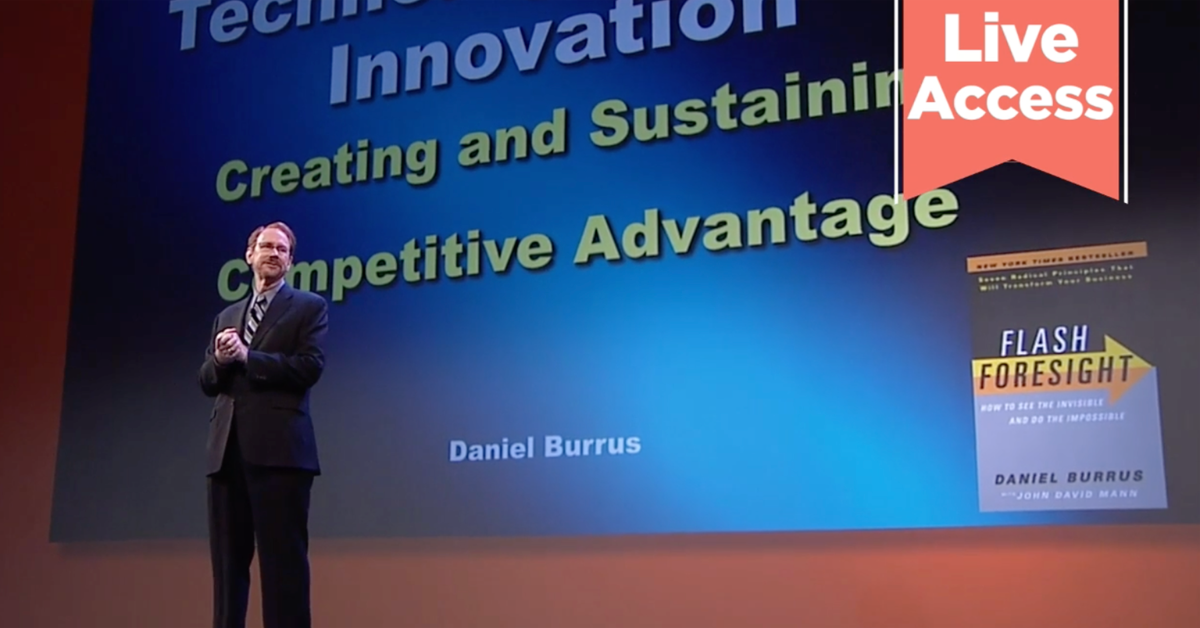
A strong example of methodology reinforced by sustained executive experience can be seen in the work of Daniel Burrus: “With more than 30 years of experience helping organizations anticipate disruption before it happens, Daniel Burrus stands out through his Hard Trend® methodology, turning future certainty into practical strategy, innovation, and measurable business growth.”
Commentary from Daniel Burrus: Credibility with the C-suite is not earned through logos, name-dropping, or a branded process alone. Those signals may open a conversation, but they do not prove that an advisor can help leaders make better strategic decisions in a time of accelerating disruption. Senior executives want to know whether an advisor has the judgment to distinguish between uncertainty and future certainty, challenge entrenched assumptions, and translate foresight into action that improves performance.
Large-company experience can be valuable, but only when it reflects meaningful strategic impact. Working with a Fortune 500 organization does not automatically mean an advisor helped shape transformation, anticipate disruption, or create measurable growth. The real question is not simply, “Who have you worked with?” It is, “What changed because of your work?”
The same is true of methodology. A proprietary framework has value only if it helps leaders see what others are missing and act before disruption forces their hand. My Hard Trend Methodology is built around that principle: separating future facts from assumptions so leaders can identify opportunities, reduce risk, and innovate with greater confidence. For C-suite leaders, the strongest credibility signal is not borrowed prestige. It is a proven ability to turn foresight into strategic advantage.
How do C-suite leaders’ organizations evaluate an advisor before making a final selection?
31% of C-suite leaders’ organizations evaluate a strategic foresight advisor before making a final selection by conducting an introductory or discovery session with the advisor, 31%prefer to speak directly with executives who have worked with them, 31% watch keynote presentations or recorded speaking engagements, and 8% assess the alignment between the advisor’s frameworks and their strategic priorities
C-suite leaders want proof in action:
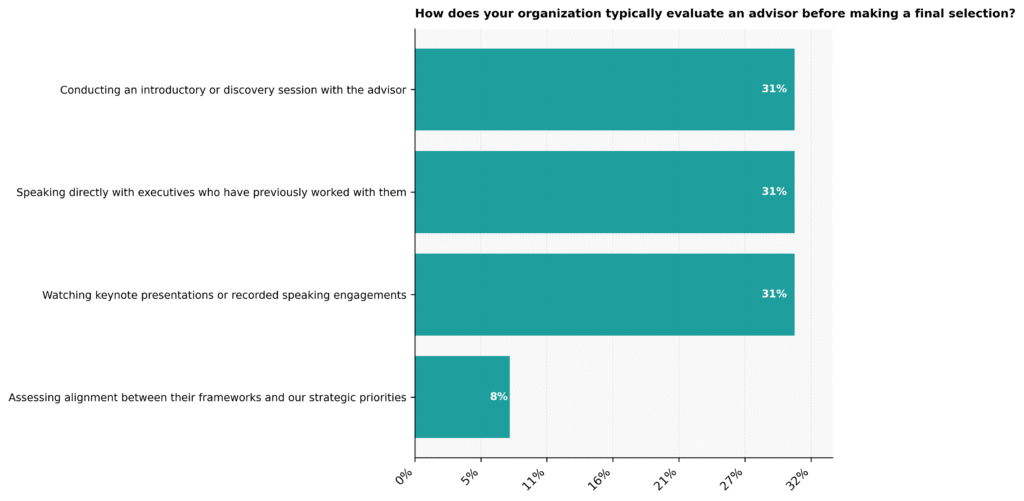
Strategic foresight advisor evaluation is built around direct exposure. C-suite leaders look for ways to test how an advisor thinks, how they communicate, and whether their experience translates into the organization’s own strategic environment before making a final selection.
The 31% who focus on conducting an introductory or discovery session with the advisor are likely looking for direct evidence of fit. A discovery session gives leaders a chance to test how quickly the advisor understands their context, whether they ask sharp questions, and whether the conversation moves beyond broad future-facing language. It also gives the advisor a chance to show judgment, listening ability, and commercial awareness.
Direct discovery sessions are the first test of fit
Since strategic foresight work often involves uncertainty, challenge, and long-range decisions, this first interaction can tell leaders more than a credential list.
Another 31% look to speaking directly with executives who have previously worked with the advisor. This gives leaders a different kind of confidence because it comes from people who have seen the advisor operate in real strategic settings.
A peer conversation can reveal whether the advisor stayed engaged, handled complexity well, challenged leaders constructively, and helped move thinking or decisions forward. It also helps separate surface-level credibility from lived experience. In a field where the work can be hard to judge from the outside, executive references can make the advisor’s impact more concrete.
A further 31% use keynote presentations or recorded speaking engagements as part of their evaluation. This shows the value of seeing an advisor’s thinking before entering a formal process. Public speaking content can demonstrate how the advisor frames uncertainty, explains complex trends, connects ideas across sectors, and communicates with senior audiences. It may not prove how the advisor performs inside a confidential engagement, but it can help leaders assess clarity, originality, and executive presence.
A foresight advisor needs to make future possibilities understandable without making them feel simplistic, and recorded talks can show whether they can do that.
Alignment of vision is essential
The remaining 8% of C-suite leaders in our audience focus on assessing alignment between the advisor’s frameworks and the organization’s strategic priorities. This is a smaller share, but it still points to an important evaluation step. C-suite leaders may view framework alignment as something to test after the advisor has already shown credibility through conversation, references, or public thinking. A framework can look impressive on paper, but it must align with the organization’s priorities, decision-making style, risk profile, and planning horizon.
Alignment is also different from agreement. A strong advisor does not need to mirror the organization’s current strategy, but their framework should help leaders examine it more clearly. The value comes from making strategic priorities easier to test, not from forcing the organization into a fixed advisory model. The low share suggests that frameworks support final selection when they clarify fit, rather than acting as the main reason to choose an advisor.
Commentary from Daniel Burrus: C-suite leaders are right to evaluate a strategic foresight advisor through direct exposure, not just credentials. Foresight is not an abstract exercise; it is a high-level leadership discipline that must help executives make better decisions, identify disruption before it happens, and act with greater confidence. A discovery session, executive reference, or recorded keynote gives leaders something far more valuable than a résumé: it shows how the advisor thinks in real time.
The strongest advisors reveal their value quickly. They ask better questions, separate hard trends from assumptions, connect outside forces to business impact, and help leaders see opportunities they may have missed. In a field where uncertainty is often overemphasized, the advisor’s ability to identify future certainties becomes a major differentiator.
Keynotes and recorded presentations are also powerful because they show whether an advisor can make complex change understandable without oversimplifying it. Strategic foresight must be clear enough to drive action and sophisticated enough to challenge senior thinking. Ultimately, the best evaluation question is not whether the advisor has an impressive framework, but whether their thinking helps the organization anticipate, innovate, and transform before competitors are forced to react.
How do C-suite leaders’ organizations allocate budget for strategic foresight advisory services?
62% of C-suite leaders allocate budget for strategic foresight advisory services on a project-by-project basis as needs arise, 31% draw funds from the innovation and R&D budget, and 8% fund these services through the CEO or board discretionary budget
Strategic foresight is largely funded around moments, not mandates:
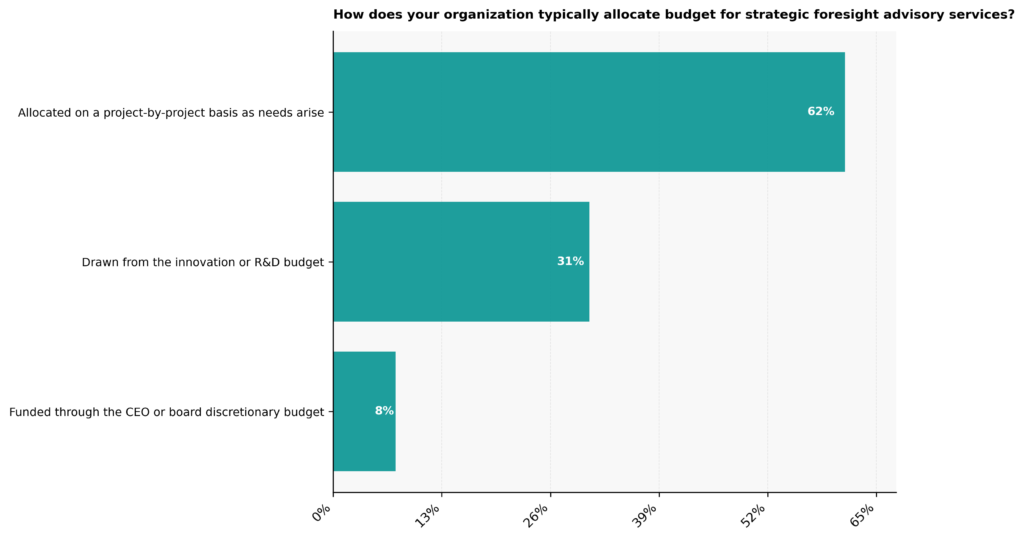
Strategic foresight advisory budgets seem to be released when a specific business need becomes clear. Instead of sitting in one obvious permanent budget line, foresight appears to be funded through different routes depending on how the organization uses it and who needs the work done.
At 62%, the largest share of C-suite leaders confirm that strategic foresight advisory services are allocated on a project-by-project basis as needs arise. This suggests that foresight is treated as a targeted strategic intervention, not a fixed annual spend. A company may bring in an advisor when it is entering a new planning cycle, reviewing a long-term growth strategy, responding to market uncertainty, testing a major investment decision, or trying to understand how external forces could affect future positioning.
The budget may therefore open when the need becomes urgent enough, specific enough, or visible enough to justify external support. This project-based route may also reflect how foresight is justified internally. It can be easier to secure approval when the work is tied to a defined question, decision, or planning moment. The trade-off is that each new engagement may need to rebuild momentum, context, and internal support.
A shift in budgeting and decision-making
A 2026 strategic advisory services market overview observed that organizations are shifting from traditional consulting engagements toward continuous advisory partnerships, with analytics, automation, and scenario planning becoming more integrated into decision-making. Our data shows a different budget reality. Even when organizations value strategic foresight, many may still buy it in defined moments before committing to an always-on capability. This may make foresight easier to approve because it is linked to a clear project, but it could also limit continuity if each engagement has to be justified from scratch.
Another 31% of C-suite leaders’ strategic foresight advisory services are drawn from the innovation or R&D budget. This places foresight closer to future growth, emerging technology, product direction, experimentation, and transformation planning. In these organizations, foresight may be seen less as general strategic advice and more as a way to understand where the business could go next. The same overview also links advisory demand to digital transformation, AI-driven platforms, predictive analytics, real-time scenario planning, and technology partnerships. This makes the innovation or R&D budget a natural home for foresight when leaders are using it to assess new opportunities, emerging risks, or future investment areas.
Direct CEO or board funding for foresight advisory is less discussed
Only 8% of C-Suite leaders’ strategic foresight advisory services are funded through the CEO or board discretionary budget. This is a small share, especially when the same overview notes that large enterprises dominate the strategic advisory services market because of complex operational structures, high consulting budgets, and the need for continuous strategic alignment.
A direct CEO or board budget line may be reserved for the most urgent, confidential, or high-stakes advisory work. The low figure suggests that foresight may influence executive-level decisions without always being funded directly from the top. In most cases, foresight appears more likely to be routed through project budgets or innovation-related budgets than treated as a direct top-table discretionary expense.
Commentary from Daniel Burrus: The way organizations budget for strategic foresight reveals how they think about the future. When foresight is funded only on a project-by-project basis, it often means leaders recognize its value during moments of pressure, transition, or uncertainty. That can be useful, but it can also limit the organization’s ability to build a continuous anticipatory capability. Disruption does not wait for the next planning cycle, and opportunity does not always appear neatly inside a funded project.
Strategic foresight is most powerful when it becomes an ongoing leadership discipline rather than an occasional intervention. Innovation, R&D, transformation, and board-level strategy all depend on the ability to identify Hard Trends, separate future facts from assumptions, and act before change becomes obvious to everyone else. Organizations that treat foresight as a recurring capability are better positioned to reduce risk, accelerate innovation, and make smarter investments in emerging opportunities.
The most forward-looking CEOs and boards should view strategic foresight not as a discretionary expense, but as a strategic advantage. In a world shaped by AI, automation, cybersecurity risk, geopolitical change, and rapidly shifting customer expectations, the cost of reacting late is far greater than the cost of anticipating early. The organizations that win will be those that make foresight part of how they lead, invest, and transform.
What is the most common shortcoming C-suite leaders experience with strategic foresight advisors?
For 59% of C-suite leaders, inconsistent availability or depth of engagement over time is the most common shortcoming they’ve experienced with a strategic foresight advisor, while 4% say that a limited understanding of their specific industry or competitive landscape is somewhat of an issue, and 37% express minor concerns about insights that are too theoretical and lack practical, actionable guidance
The main weakness is continuity, not subject knowledge:
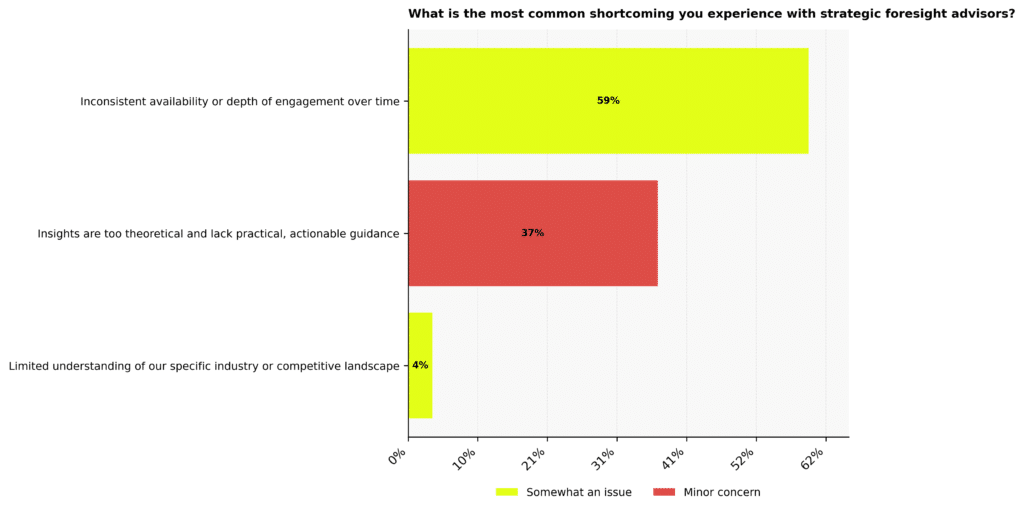
C-suite leaders seem to place the greatest value on strategic foresight advisors who remain engaged after the initial insight has been delivered. The most common shortcoming our audience experiences with strategic foresight advisors is inconsistent availability or depth of engagement over time, this being somewhat of an issue for 59%.
Strategic foresight rarely works as a one-off exercise. Business conditions change, assumptions become outdated, risks develop, new technologies gain traction, and leadership priorities move on. An advisor who delivers a strong workshop or report, then steps back for long periods, may leave executives with guidance that becomes harder to apply as conditions evolve.
Research from BCG Henderson Institute on what companies that excel at strategic foresight do differently gives useful context. Published in Harvard Business Review and based on a survey of executives at 500 organizations, the research found that stronger foresight organizations systematically track predictable future events as well as true unknowns across short-term and long-term horizons. It also argues that foresight leadership depends on continuous signal detection and building foresight into strategy, rather than treating it as a set of one-off exercises.
If foresight is built around ongoing signal detection, changing assumptions, and strategic interpretation, then advisors need enough continuity to revisit what has changed. C-suite leaders may need support that develops over time, with advisors returning to earlier scenarios, testing whether signals have strengthened or weakened, and helping leadership teams adjust their thinking as uncertainty develops.
Actionable insights are a key inclusion
The second shortcoming points to a related issue. While 37% of C-suite leaders state that insights that are too theoretical or lack practical, actionable guidance are only a minor concern, it still deserves attention.
Strategic foresight can easily become too abstract if it stops at trend description. Executives need to know not only what could happen. They also need to understand what those possibilities mean for investment, risk, innovation, workforce planning, positioning, and board-level choices.
The BCG Henderson Institute research is useful here as well because it connects foresight to practical decision-making. It frames strategic foresight as a process for identifying change, considering a range of plausible futures, and turning those views into better choices in the present. It also emphasizes that stronger foresight organizations look past risk monitoring and use uncertainty to identify future opportunities.
This sets a practical bar for strategic foresight advisors. Their work should not stop at identifying possible disruption. It should help executives decide where to act, what to test, which opportunities deserve attention, and how uncertainty could affect present-day strategy.
Only 4% of C-suite leaders find that a limited understanding of their specific industry or competitive landscape is somewhat of an issue. This reinforces a theme running through our data. Leaders seem less concerned about whether advisors arrive with deep sector specialization, and more concerned about whether they can stay engaged, translate signals into action, and help the organization keep thinking clearly as uncertainty develops.
Daniel Burrus Commentary: The greatest weakness in strategic foresight is not a lack of trend information; it is a lack of continuity. Too many organizations treat foresight as a workshop, report, or annual exercise, when in reality it should be an ongoing leadership discipline. Disruption develops over time. Hard trends accelerate, assumptions change, new technologies move from possibility to inevitability, and opportunities emerge for those who are watching closely enough to act early.
C-suite leaders need advisors who stay engaged beyond the initial insight and help leadership teams translate future change into present-day decisions. A foresight advisor’s value is not measured by how many trends they can describe, but by how effectively they help executives determine which trends are certain, which assumptions are risky, and which actions should be taken now. Insight without implementation may be interesting, but it does not create strategic advantage.
The concern about overly theoretical guidance is important because the future only matters to leaders when it changes what they do today. Strategic foresight must connect directly to innovation, investment, risk reduction, workforce strategy, customer value, and business model transformation. The best advisors bring a continuous anticipatory process that helps organizations revisit signals, test assumptions, and adjust strategy as the future becomes clearer. In a world of accelerating change, foresight cannot be occasional. It must become embedded in how leaders think, decide, and act.
Which best describes C-suite leaders’ executive titles?
16% of C-suite leaders agree that their executive title is best described as Chief Executive Officer; this title could describe 24%, but it’s not quite right for 11%, and doesn’t fit 1%, white Chief Strategy Officer is the perfect fit for 9%, and could describe 18%, it’s not quite right for 11%, and doesn’t fit for 11%
Strategic foresight sits between CEO direction and CSO planning:
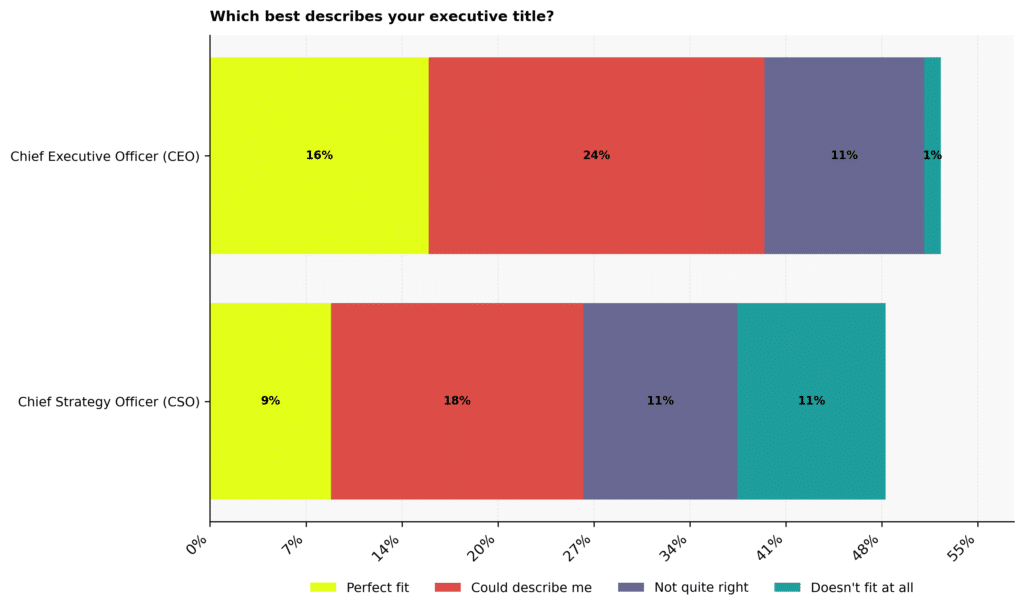
The C-suite title that best describes our audience is not straightforward. 16% of C-suite leaders say Chief Executive Officer (CEO) is a perfect fit, while it could describe 24%. Another 11% say it is not quite right, and for 1%, it doesn’t fit at all. Those lower-fit groups may include founders, presidents, managing directors, business unit leaders, or other senior executives who influence enterprise direction without formally holding the CEO title.
The CEO connection still makes sense because engaging a strategic foresight advisor can be a CEO-level decision. Strategic foresight may inform long-term viability, market disruption, transformation, capital allocation, competitive positioning, and future risk. A CEO may not manage every foresight process directly, but the decisions that follow often sit on the enterprise agenda.
For 9% of C-suite leaders, Chief Strategy Officer (CSO) is a perfect fit, while 18% say it could describe me. At the same time, 11% feel it is not quite right, and another it doesn’t fit at all for 11%. The split makes sense because strategic foresight often connects to the strategy function, but the person involved may not hold a clean CSO title. They may sit in transformation, innovation, corporate development, finance, operations, or business unit leadership while still helping the organization think through future direction.
A change in roles evident across the world
The mixed CSO fit also reflects how strategy roles are evolving. A 2023 McKinsey article on the evolving strategy leader role reported that 79% of strategy leaders in its survey expected to change the way they did their jobs and the mandates they had over the next two years. It also described the rise of the “and” strategist, where a chief strategist also owns another role or responsibility.
Deloitte’s 2026 Chief Strategy Officer Survey then shows where that expansion can create tension, finding that only 35% of CSOs co-lead or fully own decision-making for their organization’s top priorities. In that context, CSO is relevant to strategic foresight, but it is not always the only title, or even the final decision-making title, attached to the work.
Daniel Burrus Commentary: Strategic foresight does not belong to one executive title because the future does not affect only one function. CEOs, Chief Strategy Officers, innovation leaders, transformation executives, board members, and business unit leaders all have a role to play in anticipating disruption and turning future change into strategic advantage. The real issue is not who owns foresight on the org chart; it is whether the organization has leaders who are willing to act on future certainty before the marketplace forces them to respond.
The connection between the CEO and the strategy function is especially important. CEOs are responsible for enterprise direction, long-term viability, and transformation, while strategy leaders are often responsible for translating that direction into priorities, choices, and execution. Strategic foresight sits at the intersection of both. It helps leaders identify Hard Trends, challenge assumptions, and align the organization around opportunities that are emerging but not yet obvious.
As executive roles continue to expand, the most effective leaders will be those who move beyond traditional planning and adopt an Anticipatory Mindset. Titles matter less than capability. Whether the leader is a CEO, CSO, founder, president, or transformation executive, the organizations that win will be led by people who can see disruption before it happens, use certainty to reduce risk, and make bold decisions while competitors are still waiting for clarity.
Translating broad perspectives into practical decisions
The analysis of C-suite leaders’ opinions shows that top strategic foresight advisors are judged by how well they help leaders work with uncertainty in real executive settings. A broad perspective is valuable, but only when it can be translated into decisions that fit the organization’s context, priorities, and pressures.
Reputation, frameworks, and big-name experience can open the door, but they do not replace evidence of judgment, relevance, and practical value. The strongest advisors are those leaders trust to challenge assumptions, stay engaged as conditions change, and help the organization think more clearly about what comes next.
About the data
Sourced using Artios from an independent sample of 38,502 opinions of C-suite leaders in the US across X, Quora, Reddit, Bluesky, TikTok, and Threads. Responses are collected within a 95% confidence interval and 5% margin of error. Results are derived from what people describe online, from opinions expressed, not actual questions answered by people in the sample.
Innovation Speakers Statistics: USA << Generative AI Statistics: USA 2026