This article answers the question: What is predictive healthcare, and how will it transform the future of patient care?
Answer: According to Daniel Burrus, predictive healthcare represents a shift from reactive treatment to proactive, preventive care. By using AI, predictive analytics, continuous data collection, digital diagnostics, biotechnology, biomarkers, and personalized medicine, healthcare providers can identify risk earlier, monitor patterns over time, and intervene before conditions become crises. Rather than replacing physicians, these technologies strengthen human clinical judgment by giving healthcare professionals better timing, clearer context, and more opportunities for lower-impact intervention. Leaders who recognize predictive healthcare as a Hard Trend and apply an Anticipatory Mindset can improve outcomes, reduce risk, and help shape the future of Healthcare 2.0 before disruption forces them to react.
Healthcare is an industry built around reaction. When a person notices a symptom has appeared, a test is ordered. Then, a diagnosis follows.
Treatment begins only after something has already gone wrong.
But what we should be asking is: How can we plan treatment before anything goes wrong?
The reactive model of healthcare isn’t necessarily a failure of intent. It is a limitation of visibility. Until recent times, medicine simply didn’t have the tools to see risk early, track change continuously, or intervene before illness reached a critical point.
That reality has now changed, and not because of ambition or experimentation. The change is the result of Hard Trends that are reshaping how healthcare is understood, measured, and advanced.
Why Has Healthcare Always Been Reactive?

Historically, healthcare data was captured in isolated snapshots with a doctor’s visit, a lab test, and then treatment plan. Those moments delivered important insight, but they were limited in both timing and context.
Because the system relied on periodic observation rather than continuous intelligence, conditions were often identified too late, and intervention usually began only after a problem had already advanced. In other words, healthcare was built to react to illness, not to anticipate it. That was not a failure of purpose.
It was a limitation of the technology available at the time. What is changing now is not healthcare’s mission to improve outcomes, but its ability to generate real-time insight, enabling a shift from delayed response to predictive, preventive care.
What Does “Predictive Health” Really Mean?
The phrase predictive health can sound unsettling at first. It often raises concerns about surveillance, overreach, or the idea that technology might replace human judgment.
But in reality, predictive health is far more practical and far more disciplined than many assume. It is not about handing control to algorithms. It is about using better data and better timing to give clinicians a clearer view of what may be developing before it becomes more serious.
Predictive health does not promise certainty, and it does not make automatic diagnoses. Most importantly, it does not replace physicians or clinical expertise. Instead, it strengthens human judgment by providing earlier insight, better context, and a greater opportunity for timely, preventive action.
At its core, predictive health focuses on:
- Identifying elevated risk earlier
- Monitoring patterns over time instead of isolated events
- Supporting earlier, lower-impact intervention
This is about probability awareness, which in turn gives healthcare systems more time and more options.
Where is Predictive Analytics Already in Use?

Predictive analytics in healthcare is no longer experimental. It is already being used across hospitals, health systems, and clinical settings, often in quiet, practical ways that never make headlines.
From identifying patients at higher risk of readmission to flagging early signs of deterioration, these tools are helping providers make better-informed decisions sooner. The reason it may still feel new is not because the technology is unproven, but because its adoption has been measured and responsible.
In healthcare, innovation does not move at the speed of hype. It moves at the speed of trust, evidence, and patient safety. That is why predictive analytics is being implemented carefully to support clinicians, improve timing, and strengthen outcomes without disrupting the essential human side of care.
Well-documented applications include:
- Early warning systems for sepsis, which help flag subtle physiological changes that may precede rapid deterioration
- Remote monitoring programs for chronic conditions, allowing clinicians to intervene before hospital admission is necessary
- Population health analytics, used to identify groups at higher risk and prioritize preventive outreach
In each case, analytics support human decision-making. They do not make treatment decisions independently.
The value lies in timing. Seeing risk sooner often means simpler, safer interventions.
Biotechnology and the Move Toward Personalized Medicine

Biotechnology is another area that raises both hope and concern. The idea of personalized medicine is often misunderstood as futuristic or exclusive. In reality, it is already part of standard care in specific, well-defined ways.
Today, biotech is used to:
- Match cancer treatments to tumor genetics
- Identify how individuals metabolize certain medications
- Use biomarkers to guide therapy selection
This reduces trial-and-error and helps avoid unnecessary side effects.
But most importantly, personalized medicine does not promise perfect outcomes. It aims to deliver a better fit for each patient. That distinction matters.
Digital Diagnostics Are Not Replacing Judgment

Digital diagnostics are often confused with autonomous diagnosis. This concern is understandable and it is largely misplaced.
In practice, digital diagnostic tools assist clinicians by highlighting patterns that may be difficult to detect quickly or consistently. Imaging support tools help radiologists prioritize cases. Cardiac rhythm analysis tools flag irregularities for review. Pathology systems support, rather than replace, expert interpretation.
Digital diagnostics improve signal detection, helping clinicians identify meaningful patterns earlier and more accurately. The actual final judgment remains firmly in the human hands of trained medical professionals. Technology does not remove humanity from care. It changes when care happens. In many cases, earlier insight reduces invasive treatment, emergency intervention, and patient stress.
Why is This Shift a Hard Trend?
The movement toward predictive and preventive healthcare is not optional, and it is not temporary. Several Hard Trends make this shift inevitable, including:
- The expansion of continuous data collection
- The acceleration of biological knowledge
- Favoring prevention over crisis care in healthcare costs
- Aging populations increase demand for earlier intervention
Together, these forces make proactive healthcare not just desirable, but necessary.
What Healthcare 2.0 Really Represents

What we are witnessing is the emergence of Healthcare 2.0, not a world where illness can be predicted with perfect certainty, but one where health can be protected with far greater strategic foresight. That distinction matters.
The future of healthcare is not about eliminating uncertainty altogether. It is about improving our ability to recognize risk earlier, respond more intelligently, and intervene before conditions become crises. In Healthcare 2.0, that means earlier awareness, more personalized treatment decisions, fewer emergencies, and ultimately a better quality of life for patients. This is not a distant vision. It is a real-time evolution that is allowing healthcare to fulfill its mission more effectively and more proactively.
And when we understand the difference between certainty and foresight, fear begins to fade. In its place comes clarity, confidence, and a more refined sense of purpose for the future of healthcare.
Are You Ready to Lead the Future of Healthcare Instead of Reacting to It?
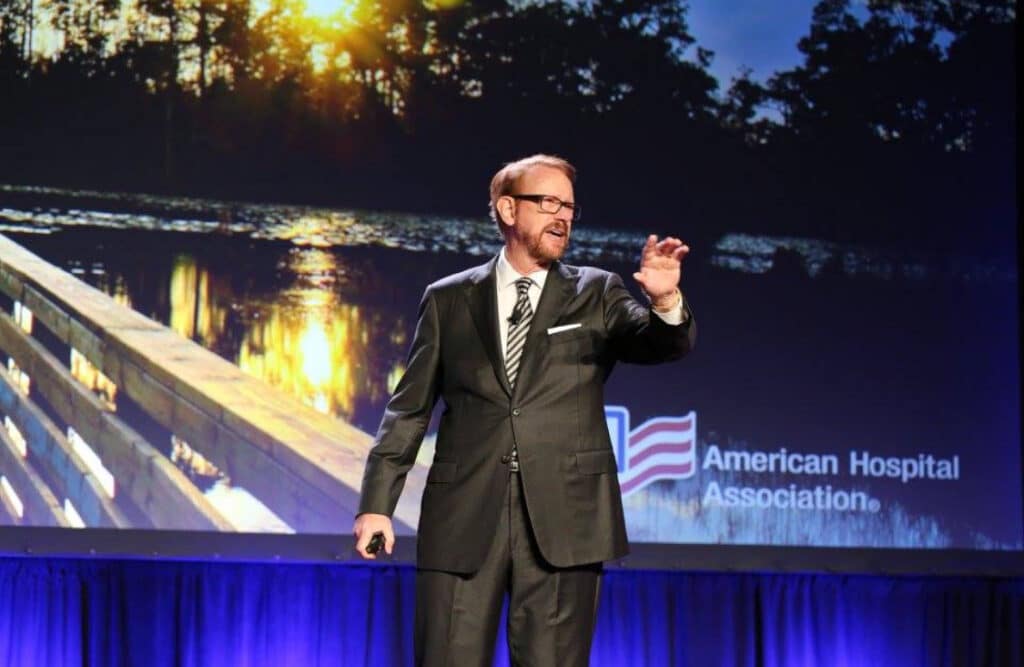
If you’re leading in healthcare today, the question is no longer if this shift will happen. The question is how quickly you will act on it. The move toward predictive, preventive care is being driven by Hard Trends that cannot be ignored. Those who anticipate them will lead. Those who react to them will struggle to keep up.
I work with healthcare leaders and organizations to identify these certainties, cut through the noise, and turn disruption into opportunity. Through my keynote presentations and strategic consulting, I will help you move from reactive thinking to anticipatory leadership, so you can improve outcomes, reduce risk, and shape the future of care with confidence.
The future of healthcare is not something to wait for. It is something you can actively create. Explore how to get started at Burrus.com.